Definition and Meaning
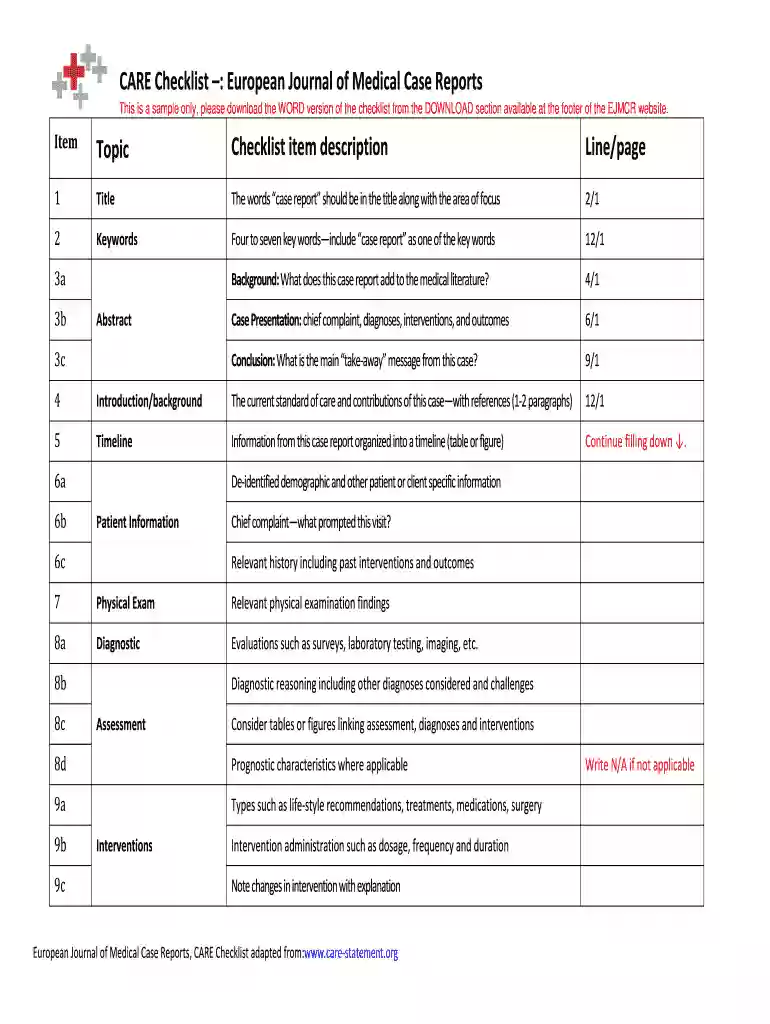
The "Sample CARE-checklist - European Journal of Medical Case" is a structured tool used by medical professionals to document case reports in a comprehensive manner. It outlines the essential components required for a well-documented case report, complying with the standards set by the European Journal of Medical Case Reports. The checklist ensures clarity, consistency, and thoroughness, enhancing the quality of reports submitted for publication.
Key Elements of the Sample CARE-Checklist
Understanding the core components of the CARE checklist is crucial for effective use:
- Title and Keywords: Clearly define the title and include relevant keywords to classify the case report’s focus.
- Background: Provide context to the case, explaining the medical significance or rarity.
- Case Presentation: Detail demographic information and clinical features, including diagnostic assessments.
- Conclusion: Summarize findings and their implications for practice, theory, or future research.
- Patient Information: Ensure confidentiality while providing necessary patient details, maintaining ethical standards.
Steps to Complete the Sample CARE-Checklist
Completing the checklist requires careful attention to detail:
- Title and Abstract: Formulate a descriptive title with a concise abstract highlighting key findings.
- Introduction: Offer a clear background, outlining the case significance.
- Patient Information: Detail the demographic data and medical history without breaching confidentiality.
- Clinical Findings: Elaborate on the symptoms, diagnostic tests, and results.
- Timeline: Construct a chronological timeline of patient events and interventions.
- Diagnostic Assessment: Discuss diagnostic processes and challenges.
- Treatment Plan and Outcomes: Explain the treatment regimen and patient outcomes.
- Discussion and Conclusion: Analyze the case impact on existing literature and future directions.
How to Use the Sample CARE-Checklist
Effectively utilizing the CARE checklist involves integrating it seamlessly into the case report writing process:
- Initiation: Start with the checklist to outline the report structure.
- Coherence: Use checklist headings as subheadings in the report for clarity.
- Revision: Aid in steering revisions by ensuring all checklist sections are thoroughly covered.
- Submission: Confirm that all elements align with journal requirements before submission.
Who Typically Uses the Sample CARE-Checklist
The checklist is predominantly used by:

- Medical Researchers: To ensure robust documentation in case reports.
- Healthcare Professionals: Physicians and healthcare providers documenting complex cases.
- Academic Institutions: Students learning to write detailed case reports.
- Publishers and Reviewers: Assisting in evaluating the completeness and quality of submitted reports.
Legal Use and Ethical Considerations
Legal and ethical compliance is paramount when using the CARE checklist:
- Confidentiality: Maintain patient anonymity throughout the report.
- Consent: Engage in informed consent procedures when using patient data.
- Compliance: Adhere to journal, institutional, and legal standards for case reporting.
Form Submission Methods
Submitting a case report using the CARE checklist can be done through various channels:
- Online Portals: Most journals, including the European Journal of Medical Case Reports, offer online submission platforms.
- Email: Direct submission to journal editors via email.
- In-Person: Less common, but applicable in scenarios requiring physical submission or if requested by the editor.
Examples of Using the Sample CARE-Checklist
Using examples to illustrate the checklist’s application can provide clarity:
- Rare Disease Reports: Detail how a rare condition was identified, managed, and outcomes achieved.
- Innovative Treatment Cases: Document new treatment protocols and their results on patient health.
- Diagnostic Challenges: Outline the process of overcoming diagnostic hurdles in complex cases.
Software Compatibility
While not strictly necessary, software tools can facilitate checklist integration:
- Document Editing Tools: Software like Microsoft Word or Google Docs for drafting reports.
- Reference Managers: Use tools such as EndNote or Zotero for managing citations.
- Medical Record Software: Electronic Health Records (EHR) systems for accessing patient data.
Quick Facts
- The CARE checklist improves case report quality by offering clear guidelines.
- It supports academic and clinical environments, enhancing research dissemination.
- Ethical concerns, such as patient consent and confidentiality, are crucial components.
- Submissions can be made digitally through established journal portals.
- The checklist streamlines the process, making it easier for authors to create standardized, high-quality reports.
This structured guide on the "Sample CARE-checklist - European Journal of Medical Case" provides medical professionals with a comprehensive understanding of its purpose, use, and application to produce high-quality, ethically sound case reports.