




01. Edit your form online
Type text, add images, blackout confidential details, add comments, highlights and more.

Type text, add images, blackout confidential details, add comments, highlights and more.

Draw your signature, type it, upload its image, or use your mobile device as a signature pad.

Send it via email, link, or fax. You can also download it, export it or print it out.
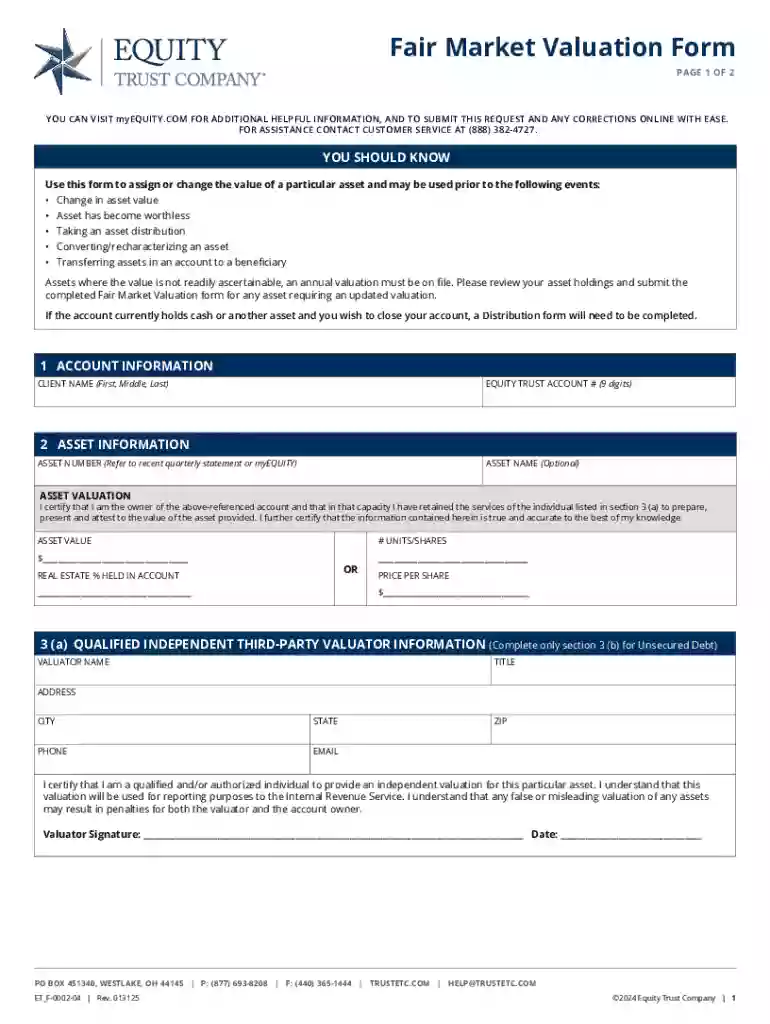
The Fair Market Valuation Form is a document used to determine or update the value of assets within an account. This form is essential for various purposes, including asset distribution, valuation updates, and sometimes taxation. It involves crucial data such as account and asset details, as well as certification of asset ownership. It often requires the involvement of a qualified independent third-party valuator, especially when the valuation is subject to regulatory standards or legal scrutiny. These valuations are used in scenarios where an accurate representation of asset value is critical, such as in estate settlements or business acquisitions.
The form comprises several important sections that ensure comprehensive asset valuation:
Account Information: This includes details about the account holder, such as name, address, and contact information. It is critical for establishing the context of the valuation.
Asset Details: Lists all assets that need valuation, including their description, quantity, and previous valuation if applicable.
Valuation Certification: Involves a declaration where asset owners certify that the information provided is accurate and complete to the best of their knowledge.
Third-party Valuator Section: Often required for credibility, this section includes the details and certification of the independent evaluator assessing the value.
Documentation Section: Provides space to include evidence supporting the valuation, like financial statements or market analysis reports.
Completing the Fair Market Valuation Form involves a systematic approach:
Gather Necessary Information: Start by collecting detailed information about all assets, including relevant documentation like purchase receipts or previous valuations.
Fill Out Account Information: Enter the account holder's details accurately to avoid later discrepancies.
Complete Asset Details: List each asset with precision including descriptions and current estimated values.
Certification and Signatures: Provide the necessary certifications ensuring the accuracy of data, followed by appropriate signatures.
Third-party Evaluation (if required): Engage a qualified third-party valuator to independently verify the asset values.
Submit Supporting Documents: Attach required documentation to substantiate the provided valuations.
Understanding certain terms is critical when dealing with the Fair Market Valuation Form:
Fair Market Value (FMV): The price that an asset would sell for on the open market between a willing buyer and seller.
Third-party Valuator: An independent professional who assesses asset value to ensure unbiased appraisal.
Certified Valuation: A formal evaluation of an asset's worth, verified by a third party to support legal or fiscal documentation.
Asset Ownership Certification: A statement confirming the owner’s right to include the asset in the valuation.
The Fair Market Valuation Form plays a significant role in legal and financial contexts:
Estate Planning: Used to value assets for equitable distribution among beneficiaries.
Business Transactions: Helps in due diligence processes by accurately capturing business asset values during mergers or acquisitions.
Tax Compliance: Ensures asset valuations are consistent with IRS guidelines, reducing risks of audits or fines.
The IRS has stringent guidelines regarding asset valuations:
Accurate Valuation Requirements: It’s essential that the valuations align with the true market conditions to avoid penalties.
Documentation for Valuation: Proper records must be maintained to corroborate reported asset values in tax filings.
Audit Readiness: Keeping detailed evaluations can protect individuals and businesses during random IRS audits.
This form is utilized by various entities:
Individuals: For personal asset management or during estate planning processes.
Executors: Responsible for managing an estate’s assets and liabilities.
Corporate Entities: Engaging in acquisitions, mergers, or valuing corporate assets.
Financial Advisors: Assisting clients in structuring their asset portfolios.


Submitting the Fair Market Valuation Form can be done through multiple methods:
Online Submission: Many platforms, like DocHub, allow online completion and submission, streamlining documentation processes.
Mail: Physical copies can be sent to relevant financial institutions or legal entities when original signatures or notarized documents are required.
In-Person Submission: Provides a direct approach by submitting to the concerned parties or authorities, often useful for immediate verification.
The form submission requires several supporting documents:
Proof of Ownership: Deeds or titles proving legal ownership of assets.
Previous Valuations: Reports or appraisals providing historical value data.
Financial Statements: Supporting documents showing an asset's financial record or market performance.
Independent Valuation Reports: Completed by third-party valuators providing unbiased asset assessments.
We've got more versions of the Fair Market Valuation Form form. Select the right Fair Market Valuation Form version from the list and start editing it straight away!
At DocHub, your data security is our priority. We follow HIPAA, SOC2, GDPR, and other standards, so you can work on your documents with confidence.

The FMV should be similar to prices others have paid for something comparable. The FMV should be a reasonable value for todays market. Determine the scope andRead more
Fair Market Value (FMV) lease process administered by the Bureau of Land Management (BLM) provided a $28.9 billion subsidy to coal producers and utilities


