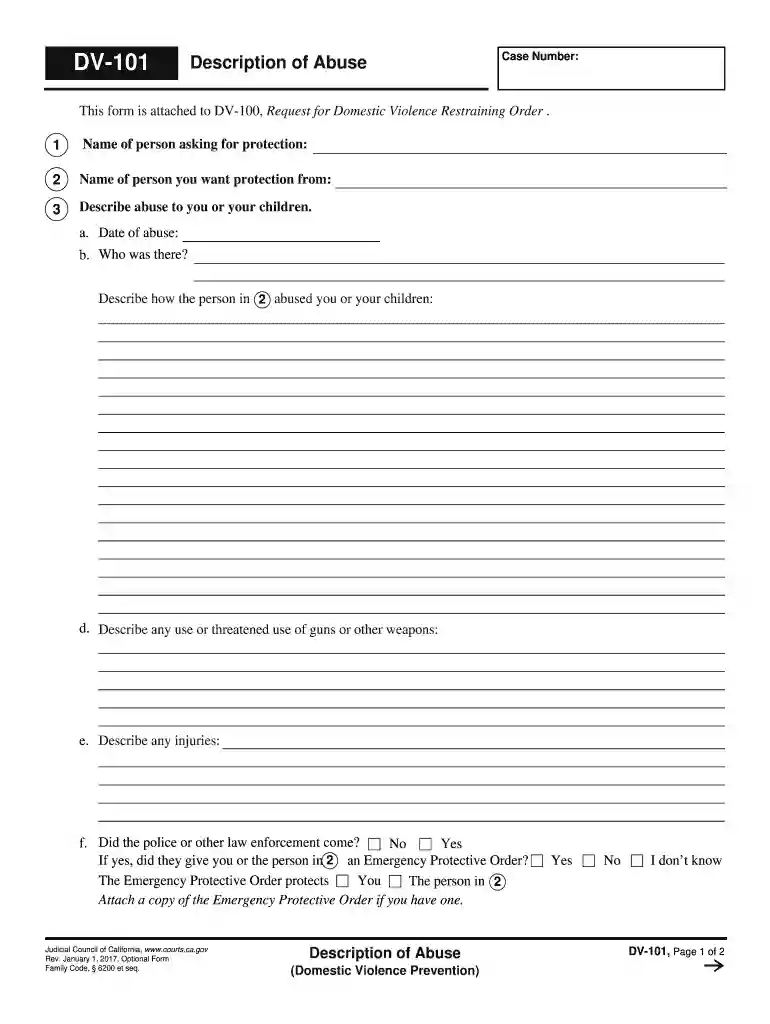
Dv 101 description of abuse form 2026

Get Form
dv101 Preview on Page 1

Here's how it works

01. Edit your dv101 online
Type text, add images, blackout confidential details, add comments, highlights and more.

02. Sign it in a few clicks
Draw your signature, type it, upload its image, or use your mobile device as a signature pad.

03. Share your form with others
Send it via email, link, or fax. You can also download it, export it or print it out.

How to use or fill out dv 101 description of abuse form with DocHub

Form edit decoration
9.5
Ease of Setup
DocHub User Ratings on G2
9.0
Ease of Use
DocHub User Ratings on G2
  1. Click ‘Get Form’ to open the DV-101 description of abuse form in our platform.
  2. Begin by entering your case number at the top of the form. This helps in tracking your request.
  3. Fill in your name as the person asking for protection, followed by the name of the individual you seek protection from.
  4. In the section describing abuse, provide detailed accounts including dates, witnesses, and specific actions taken against you or your children.
  5. Indicate any use or threatened use of weapons and describe any injuries sustained during these incidents.
  6. Answer whether law enforcement was involved and if an Emergency Protective Order was issued. Attach a copy if available.
  7. If there are additional instances of abuse, repeat steps 4 to 6 for each occurrence. Use extra sheets if necessary, labeling them appropriately.
  8. Once completed, utilize our editor's features to save or print your form. Remember to clear sensitive information after printing for your privacy.

Start filling out your DV-101 form today on our platform for free!

See more dv 101 description of abuse form versions

We've got more versions of the dv 101 description of abuse form form. Select the right dv 101 description of abuse form version from the list and start editing it straight away!
Versions Form popularity Fillable & printable
2017 4.8 Satisfied (60 Votes)
2012 4.4 Satisfied (249 Votes)
be ready to get more

Complete this form in 5 minutes or less

Get form

Got questions?

We have answers to the most popular questions from our customers. If you can't find an answer to your question, please contact us.
Contact us
What to say when writing about domestic abuse talk about survivors and perpetrators. keep to the facts, as we could be subject to libel accusations if we misrepresent the situation in any way. place responsibility firmly on the perpetrator. use empowering language.
A statutory definition of domestic abuse will help to do this, emphasising that domestic abuse is not just physical or sexual violence, but can also be emotional, coercive or controlling, and economic abuse.
The US Department of Justice defines domestic violence as a pattern of abusive behavior in any relationship that is used by one partner to gain or maintain power and control over another intimate partner. Domestic violence can be verbal, physical, sexual, or psychological.
We define domestic abuse as an incident or pattern of incidents of controlling, coercive, threatening, degrading and violent behaviour, including sexual violence, in the majority of cases by a partner or ex-partner, but also by a family member or carer.
Focus on what the crime means to you physically, emotionally, financially and spiritually. Write and speak from the heart about your pain. Dont repeat evidence presented in the trial. Ideally, the statement should take no longer than 10 minutes to read.

Security and compliance

At DocHub, your data security is our priority. We follow HIPAA, SOC2, GDPR, and other standards, so you can work on your documents with confidence.

Learn more
ccpa2
pci-dss
gdpr-compliance
hipaa
soc-compliance
be ready to get more

Complete this form in 5 minutes or less

Get form

People also ask

Recording dates, times, and descriptions of incidents. If furniture is overturned or items were thrown, describe the scene and take photos of the damage. Documenting any injuries, no matter how small (with photos if possible).
We define domestic abuse as an incident or pattern of incidents of controlling, coercive, threatening, degrading and violent behaviour, including sexual violence, in the majority of cases by a partner or ex-partner, but also by a family member or carer. It is very common.

Related links