




01. Edit your form online
Type text, add images, blackout confidential details, add comments, highlights and more.

Type text, add images, blackout confidential details, add comments, highlights and more.

Draw your signature, type it, upload its image, or use your mobile device as a signature pad.

Send it via email, link, or fax. You can also download it, export it or print it out.
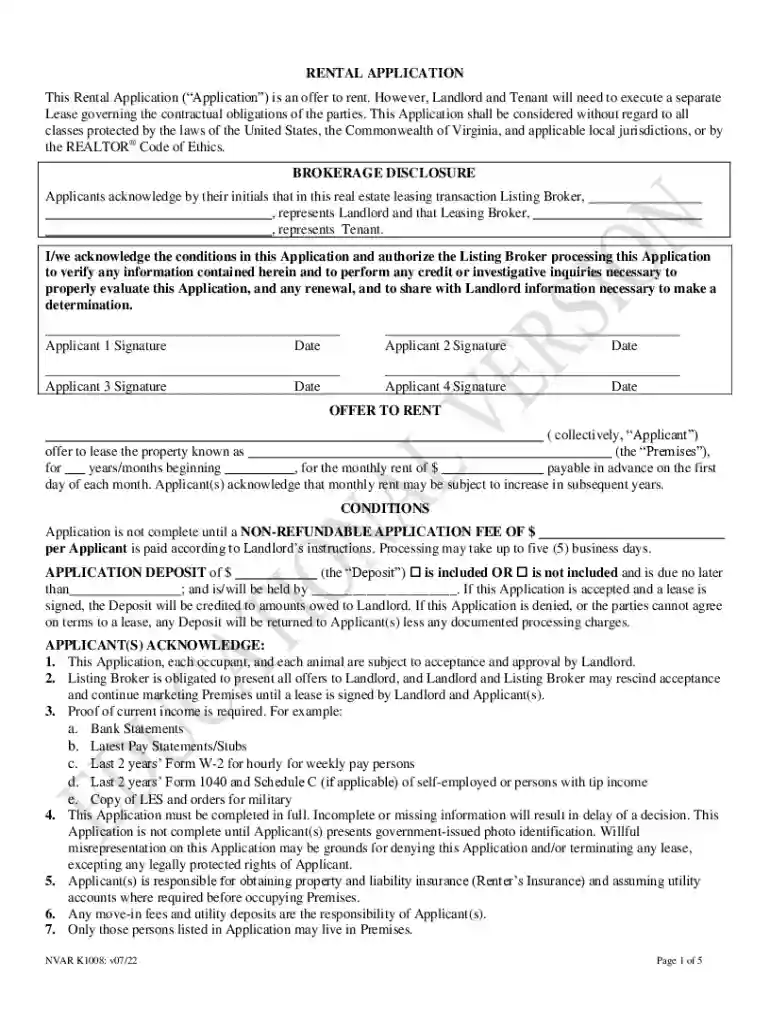
The Rental Application NVAR is a standardized form used primarily in Virginia to gather essential information from prospective tenants seeking to rent residential properties. This application acts as an initial offer, leading to the execution of a formal lease agreement if accepted. It serves to collect critical details from applicants, including personal, financial, and rental history, to assess their suitability as tenants.
The application requires completion to evaluate potential renters comprehensively. It encompasses personal identification details, employment information, income verification, and consent for background checks. By establishing a uniform application process, landlords and property managers can efficiently manage tenant selection while ensuring that applicants understand the expectations and obligations involved in renting property.
Personal Identification Information:
Residential History:
Employment and Income Details:
Consent and Authorization:
Additional Information:
Obtaining the Rental Application NVAR is a straightforward process. Prospective tenants can typically download the form from the Northern Virginia Association of Realtors (NVAR) website, or receive a copy directly from the landlord or property management office. Some real estate or management companies may offer digital submission options via email or their website. Ensuring you have the most current version of the application is crucial to avoid administrative delays.
The use of the Rental Application NVAR must comply with all applicable federal, state, and local laws. It is designed to prevent discrimination based on race, color, religion, sex, handicap, familial status, or national origin. The completion of the application must follow Fair Housing laws and regulations, ensuring equal opportunity for applicants.
Landlords and agents need to maintain confidentiality of the information provided and use it solely for the purpose of tenant evaluation. The storage and disposal of applications must adhere to privacy laws, keeping applicants' data secure from unauthorized access or misuse.
In Virginia, landlords are required to adhere to specific statutes outlined in the Virginia Residential Landlord and Tenant Act. This includes the maximum allowable fee a landlord can charge for processing the application, typically capped at $50. Additionally, Virginia law mandates that landlords must provide written notice of the acceptance or denial of the application within 20 days.
Prospective tenants today may choose between digital and paper versions when completing the Rental Application NVAR. The digital version can be filled and submitted online, offering conveniences such as electronic signatures and immediate transmission to the landlord. It reduces processing time and minimizes errors associated with manual entry.
In contrast, paper applications might be suitable for individuals who prefer traditional methods or lack access to digital tools. However, paper submissions may require additional time for mailing and physical processing, which could delay the application decision.
We've got more versions of the Rental Application NVAR form. Select the right Rental Application NVAR version from the list and start editing it straight away!
At DocHub, your data security is our priority. We follow HIPAA, SOC2, GDPR, and other standards, so you can work on your documents with confidence.
by JS Baen Cited by 116 * Faxed mortgage applications and other real estate documents are common. Internet loan applications will be posted by potential borrowers who will then.Read more
Any landlord may require a refundable application deposit in addition to a nonrefundable application fee.


