




01. Edit your form online
Type text, add images, blackout confidential details, add comments, highlights and more.

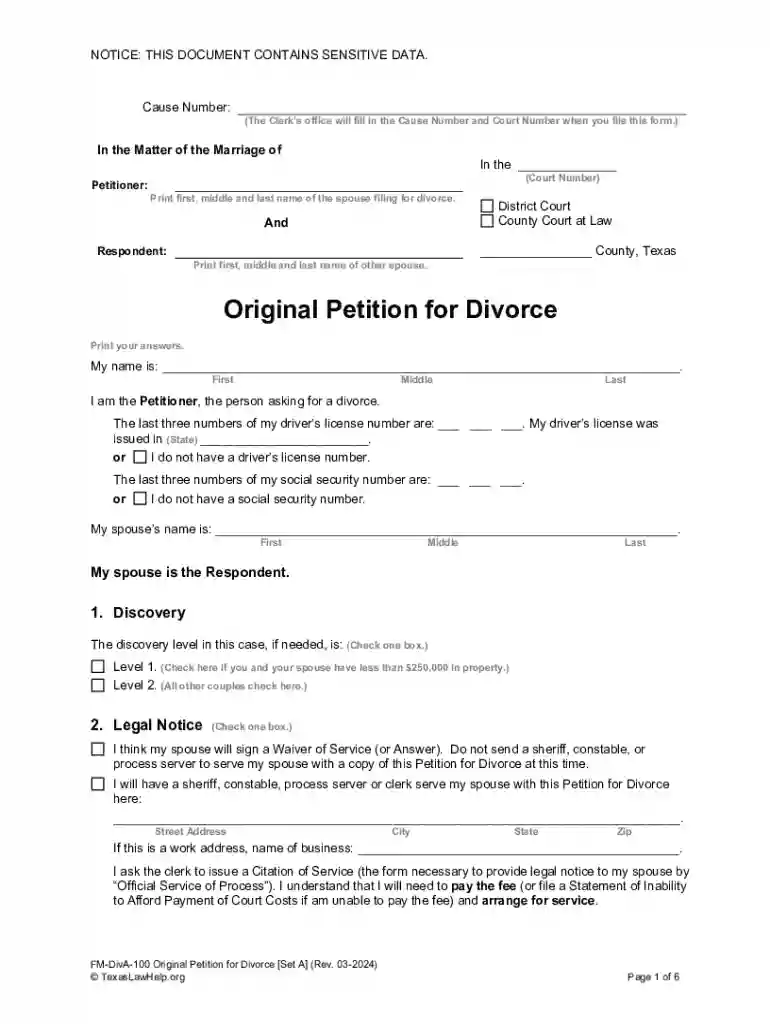
Type text, add images, blackout confidential details, add comments, highlights and more.

Draw your signature, type it, upload its image, or use your mobile device as a signature pad.

Send it via email, link, or fax. You can also download it, export it or print it out.
The phrase "I'm wanting to file for divorce, we have no children, I..." typically refers to the beginning steps an individual might take when seeking to dissolve their marriage without minor dependents involved. In legal terms, it describes a divorce proceeding that does not involve child custody, support, or visitation. Such divorces are often categorized as "simplified" or "uncontested" due to the absence of complex issues concerning children. This type of proceeding primarily focuses on the equitable division of property and debts accumulated during the marriage. Understanding the full scope of this process is crucial for anyone considering this step.
To effectively use the divorce form for couples without children, individuals should first ensure they meet the criteria for filing, which typically involves residency requirements and grounds for divorce as dictated by state law. The form should be completed with pertinent details, such as personal information, marriage facts, separation date, and agreements on property division. Experts recommend reviewing each section carefully to avoid incomplete information which can delay proceedings. Comparatively, in states like California or Texas, the process might have slight variations which need careful consideration.
Gather Personal Information: Include full names, contact details, and marriage dates, ensuring accuracy for identification.
Outline Grounds for Divorce: State whether the divorce is due to irreconcilable differences commonly accepted in no-fault states.
Divide Property: List assets and debts with clear intentions for how they should be divided, often requiring mutual agreement.
Sign and Date the Document: Both parties should sign to confirm the information is true to the best of their knowledge, possibly with notarization where required.
File with the Court: Submit the completed form to the local family court. Many jurisdictions allow electronic submission, speeding up the process.
Taking each step methodically ensures compliance with legal requirements and minimizes the chance of rejection.
This form is most commonly used by married couples seeking an amiable dissolution of marriage where there are no children involved nor disputes regarding shared property. It’s particularly tailored to those who agree on all aspects of their separation, including asset division. Additionally, individuals seeking a quicker and less costly way to divorce often utilize this form, as it bypasses the need for extensive mediation or court hearings, which are more prevalent in cases involving children.
Each section is integral to ensuring the divorce agreement covers all legal bases and expedites the dissolution process. Proper completion helps avoid unnecessary legal complications later.
Different states may have unique requirements for filing a divorce without children. For instance, some states like Nevada offer quicker processing due to shorter residency requirements, while states like New York might demand a longer separation period required before filing. Familiarity with specific state laws ensures compliance and an informed approach. In Texas, the process might require additional documentation compared to states like Florida, which has different property division methodologies.
Forms can be submitted through various channels:
Selecting the most convenient method may depend on personal circumstances, accessibility, and urgency.
Completing this divorce form typically necessitates additional documentation for comprehensive filing:
Keeping documents organized aligns with legal standards and facilitates smooth processing.
This form serves as an official document to initiate divorce proceedings under state jurisdiction. Legally, its completion and submission signal the intent to dissolve a marriage, legally recorded by the court. It grants the court authority to review and approve the terms set forth, particularly focusing on equitable distribution given no child-related concerns exist.iftung a considered approach and comprehensive knowledge of how this document operates within the legal framework is vital.
We've got more versions of the Im wanting to file for divorce We have no children I form. Select the right Im wanting to file for divorce We have no children I version from the list and start editing it straight away!
At DocHub, your data security is our priority. We follow HIPAA, SOC2, GDPR, and other standards, so you can work on your documents with confidence.
These Divorce Without Children forms are available, in an interactive PDF format, so they may be completed online and printed.
The decision to get married, the decision to have children, the decision to terminate a marriage are among the most intimate, personal, and consequentialRead more


