







Definition and Meaning
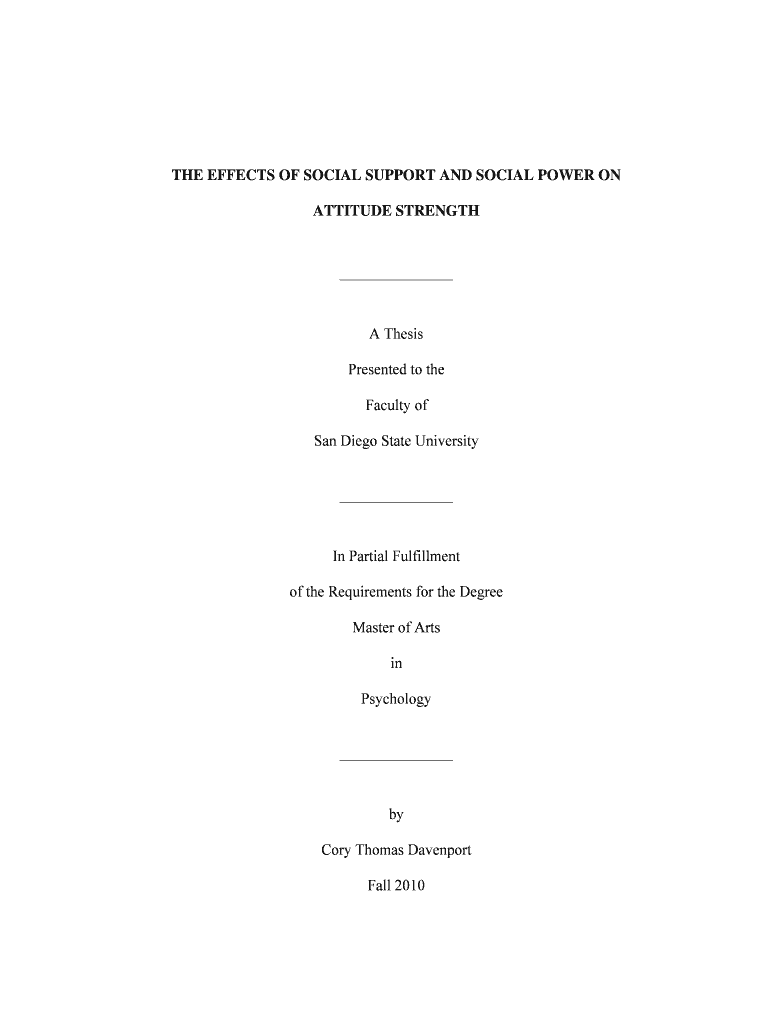
The form "THE EFFECTS OF SOCIAL SUPPORT AND SOCIAL POWER ON - sdsu-dspace calstate" is a comprehensive study examining the impact of social dynamics on attitude strength. This form is typically used for academic or research purposes to delve into how social support and power influence various aspects of attitudes such as clarity, confidence, and importance. It is utilized mainly within educational and psychological research settings to contribute to the understanding of social psychology.
How to Use the Form
To effectively use the form, participants or researchers need to carefully review each section related to social support and power influences. The form is designed to collect data on several indicators of attitude strength. When filling out the form, users should provide accurate and honest responses to ensure the reliability and validity of the research findings. This process often involves controlled environments where scenarios are simulated to gauge participant responses under different conditions of social support and power dynamics.
Steps to Complete the Form
When completing this form, follow these steps to ensure thorough and accurate input:
-
Understand the Research Objectives: Familiarize yourself with the purpose of the study and the specific role of the form in the research.
-
Provide Participant Details: Accurately fill in your personal and demographic information as required by the form.
-
Respond to Attitude Measurement Indicators: Answer questions or scales that measure attitude strength, such as your level of certainty or ambivalence.
-
Reflect on Social Dynamics: Consider and respond to various scenarios presented, highlighting your perceptions of social support and power.
-
Review and Submit: Carefully review your entries for accuracy before submitting the form to the research team.
Important Terms Related to the Form
Several key terms are associated with this form, ensuring clarity and understanding among participants and researchers:
- Attitude Strength: Refers to the durability and impact of an attitude, often characterized by clarity and confidence.
- Social Support: Involves the perceived comfort, caring, and assistance from others.
- Social Power: Describes the ability to influence others’ attitudes or behaviors within a social setting.
Who Typically Uses the Form
The primary users of this form include academic researchers, psychology students, and educational institutions conducting studies on social psychology. It is also used by professionals in fields that require understanding of human social behaviors, such as marketing and organizational management.


State-Specific Rules for the Form
While the form is used widely across the United States, it's essential to consider state-specific regulations that may affect data collection and the administration of research studies. Researchers must adhere to both federal and state laws concerning privacy and the ethical treatment of research participants.
Examples of Using the Form
In practice, a researcher at San Diego State University might use this form to study how different levels of peer support affect student attitudes towards group projects. Another example could be a corporation using the form to assess how managerial support impacts employee confidence and willingness to innovate.
Digital vs. Paper Version
The form has both digital and paper versions, accommodating varied preference for data collection. The digital version provides easy access and data transfer, essential for large-scale studies and remote research, while the paper version might be preferred in face-to-face settings or scenarios with limited technological access.
Form Submission Methods (Online / Mail / In-Person)
The form can be submitted through multiple channels:
-
Online: Most researchers prefer this method due to its efficiency in data collection and analysis.
-
Mail: Some institutions might require physical copies for records, making mailing a necessary option.
-
In-Person: Direct submission can be facilitated in controlled environments where researchers are on-site to monitor and guide participants.




