




01. Edit your irs form 2553 llc online
Type text, add images, blackout confidential details, add comments, highlights and more.

Type text, add images, blackout confidential details, add comments, highlights and more.

Draw your signature, type it, upload its image, or use your mobile device as a signature pad.

Send it via email, link, or fax. You can also download it, export it or print it out.
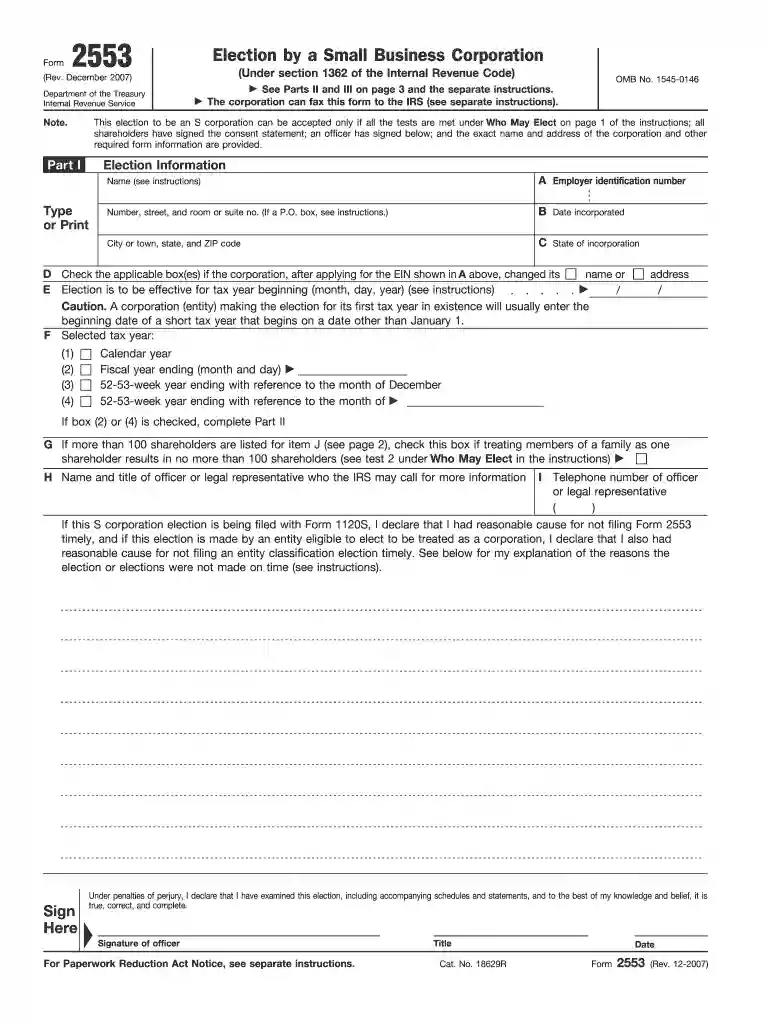
Form 2553, also known as the Election by a Small Business Corporation form, is used by small business corporations in the United States to elect S corporation status under section 1362 of the Internal Revenue Code. This election allows businesses to pass corporate income, losses, deductions, and credits through to their shareholders for federal tax purposes. As a result, S corporations avoid double taxation on the corporate income, which is first taxed at the corporate level and again at the shareholder level when distributed as dividends. The use of Form 2553 therefore can impart significant tax benefits to eligible small business corporations by aligning their tax treatment with similar benefits available to partnerships.
Filing Form 2553 is a multi-step process that requires precision and attention to detail. The form is divided into several sections, each of which collects specific information necessary for the IRS to process the election. Business owners must complete detailed sections including general business information, shareholder consent, and corporate detail verification. Each shareholder's consent is vital because all shareholders must agree to the S corporation election. After gathering comprehensive information, businesses should ensure accuracy before submitting the form to avoid any unnecessary IRS queries or rejections.
Collect Necessary Information: Before beginning the form, ensure you have the corporation's name, EIN (Employer Identification Number), and mailing address.
Complete Section I: This section requires details like the name and EIN of the corporation, the tax year for the election, and corporation's address.
Shareholder Consent: Gather consent from all shareholders, ensuring each individual or entity signs the form to verify their participation in the election.
Specify the Tax Year: Decide and fill in your desired tax year for the application of S corporation status. For many, this will align with the calendar year.
Fill Additional Sections if Applicable: Sections II and III of the form may require specific information pertinent to late elections or US possessions if applicable to the business's circumstances.
Review and File: Double-check all sections for accuracy and completeness, then file the form with the IRS.
Form 2553 is most commonly used by domestic corporations that are planning to become S corporations. This includes small to mid-sized businesses aiming to optimize their tax liabilities while supporting several shareholders without facing double taxation. Businesses structured as partnerships or sole proprietorships and converting into corporations might also file Form 2553 if they meet the eligibility criteria and seek the tax advantages offered by S corporation status.


Adherence to IRS guidelines is crucial for a smooth election process. The IRS mandates that Form 2553 be filed no later than two months and 15 days after the beginning of the tax year the election is to take effect. It is also important to follow any additional IRS instructions specific to your situation, such as providing explanations for late elections or choosing a year-end other than December 31. Failure to meet these guidelines could result in delays or denial of the election.
Not all corporations qualify to file Form 2553. To be eligible, the business must:

For timely processing, it is important to note that Form 2553 should be filed by the 15th day of the third month of the tax year for which the election is to be effective. If a corporation is newly established, it can file Form 2553 anytime during the tax year if the election is desired for the current year, as long as it meets the IRS’s conditions on filing timing.
While Form 2553 is commonly completed on paper or online through the IRS website, many tax software programs like TurboTax or QuickBooks support its preparation. These tools often provide step-by-step guidance, automatic calculations, and checks to ensure the form is filled accurately before submission. Users can benefit from these software solutions to streamline the completion process, especially if they are unfamiliar with IRS forms.
We've got more versions of the irs form 2553 llc form. Select the right irs form 2553 llc version from the list and start editing it straight away!
Yes, it is possible with DocHub. This secure and compliant online solution features a phone-based signing option. When you log in to your DocHub account and import your form 2553 2007 to our editor, fill out all necessary areas and use the Sign feature on the top barf. Click on Create your signature and choose Phone from the available choices. Here, you scan a QR code using your smartphone and draw your signature on your phone display, as you normally do when signing hard copies. If you access DocHub right from your mobile device, you can eSign your document by drawing your eSignature, uploading its picture, or simply with a typed name.
With DocHub, you have several convenient ways to edit your form 2553 2007 online. You can drag and drop the form and edit it straight at the DocHub site or use our browser extension to fill out your form immediately. Additionally, you can edit your PDF on your phone, as DocHub is compatible with all the available mobile platforms.
At DocHub, your data security is our priority. We follow HIPAA, SOC2, GDPR, and other standards, so you can work on your documents with confidence.


Attach to Form 2553 a statement describing the relevant facts and circumstances and, if applicable, the gross receipts from sales and services necessary toRead more
Jun 27, 2013 To facilitate efficient investments and financing of infrastruc- ture projects and new job creation through the establish-. VerDate Mar 15 2010Read more
As this edition goes to press, the S corporation remains the most popular business entity for tax purposes. It dominates both.Read more


