Type text, add images, blackout confidential details, add comments, highlights and more.
02. Sign it in a few clicks
Draw your signature, type it, upload its image, or use your mobile device as a signature pad.
03. Share your form with others
Send ucc 1 form via email, link, or fax. You can also download it, export it or print it out.
How to use or fill out UCC 1 form with our platform
Ease of Setup
DocHub User Ratings on G2
Ease of Use
DocHub User Ratings on G2
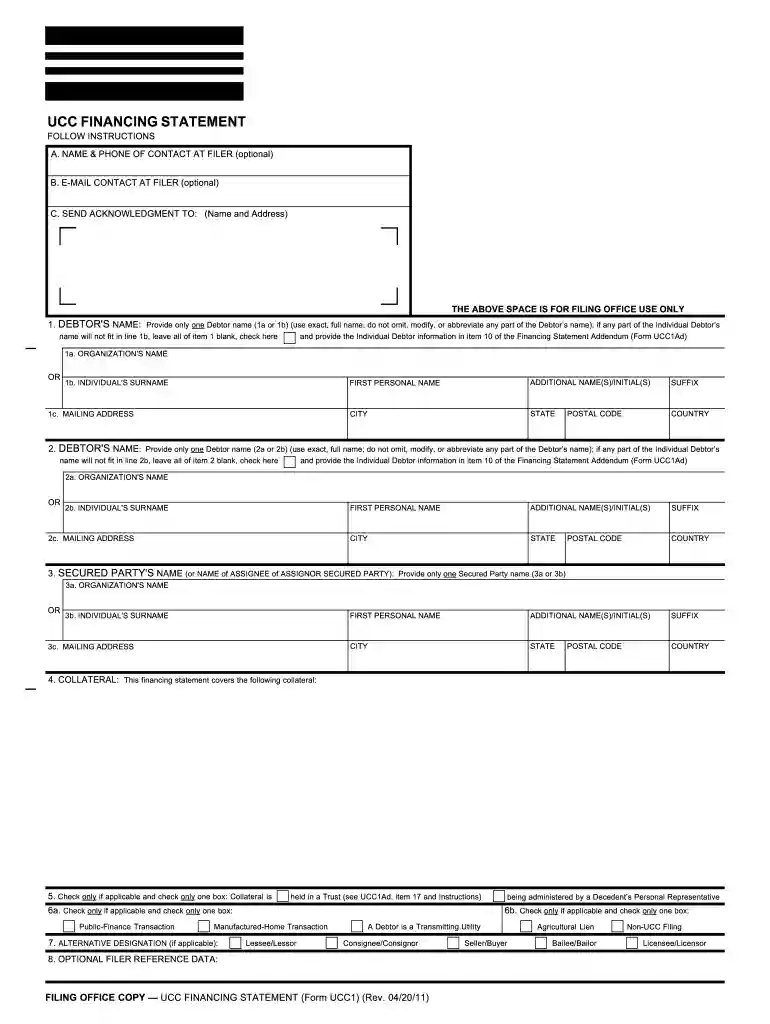
Click ‘Get Form’ to open the UCC 1 form in the editor.
Begin by filling in the Debtor's name. You can choose either an organization’s name or an individual’s surname. Ensure you use the exact, full name without abbreviations.
Next, provide the mailing address for the Debtor. This includes city, state, country, and postal code.
If there is an additional Debtor, repeat the process for item 2, ensuring to follow the same naming conventions as before.
In section 3, enter the Secured Party's name and mailing address. This is crucial as it identifies who holds the security interest.
Describe the collateral in section 4. Be specific about what is covered under this financing statement.
Review all entries carefully for accuracy before submitting your form through our platform.
Start using our platform today to fill out your UCC 1 form online for free!
A creditor files a UCC-1 to provide notice to interested parties that he or she has a security interest in a debtors personal property. This personal property is being used as collateral in some type of secured transaction, usually a loan or a lease.
Can an UCC freeze your bank account?
A UCC-1 lien alone cannot freeze your personal bank account. UCC liens apply to business assets used as collateral. However, if you signed a personal guarantee and the lender obtains a court judgment against you, they may be able to pursue personal assets including bank accounts through separate legal action.Feb 4, 2026
What happens if you dont file a UCC-1?
If you dont file the UCC-1 financing statement on time, you can lose priority should the debtor default or file bankruptcy. UCC-1 filings are often subject to a first to file rule, so timing is critical.Jul 30, 2024
What is the purpose of a UCC-1 form?
A UCC-1 Financing Statement is a legal form filed by a creditor to give public notice of their security interest in a debtors personal property (collateral) used for a loan or lease, protecting the creditor by establishing priority over other potential lenders if the debtor defaults. Its essentially a public record, similar to a deed for real estate, that informs others a specific asset is already pledged as security for a debt. Key Uses: Securing Loans: Lenders file UCC-1s when providing financing for specific assets (like vehicles, equipment, inventory) or a general lien on a businesss assets. Establishing Priority: The first-to-file rule often applies, meaning the first creditor to file a UCC-1 usually has a superior claim to the collateral if the debtor cant repay, notes LII | Legal Information Institute and Wolters Kluwer . Public Notice: It alerts other potential lenders or buyers that the property isnt free and clear, preventing them from being misled into lending against already encumbered assets. Protecting Sellers: A seller financing a purchase (like furniture or equipment) can file a UCC-1 to retain an interest until final payment, protecting them if the buyer defaults or tries to sell it. When its used (Examples): A bank financing a business purchase of new machinery. A vendor extending credit for a large inventory order. A furniture company financing a customers purchase. How it works: Filing: The creditor (secured party) files the UCC-1 form with the appropriate state office (usually the Secretary of State). Public Record: It becomes a public record indexed by the debtors name. Protection: It protects the creditors interest in the collateral for a set period, requiring renewals (UCC-3 continuation statements) to remain active. For legal advice, consult a professional. UCC Financing Statement | Wex | US Law | LII / Legal Information InstituteUCC Financing Statement (usually called a UCC-1 Form) is a form that creditors file with states in which they have a security inteLII | Legal Information InstituteWhat Is a UCC Filing? Learn the basics | Wolters KluwerIn fact, it is sometimes called a UCC financing statement. A creditor files a UCC-1 to provide notice to interested parties that hWolters Kluwer
How does a UCC-1 differ from a mortgage?
It is easiest to think about a UCC-1 financing statement as similar to a mortgage on real property, the difference is that the UCC-1 relates to movable or personal property instead of immovable or real property.Aug 4, 2025
ucc financing statement
Ucc 1 form pdfUCC 1 form californiaUCC 1 Form California pdfUcc 1 form downloadUCC-1 Form New YorkUCC 1 Form DelawareUCC 1 form MichiganUCC-1 form Louisiana
Security and compliance
At DocHub, your data security is our priority. We follow HIPAA, SOC2, GDPR, and other standards, so you can work on your documents with confidence.
Failure to file timely If you dont file the UCC-1 financing statement on time, you can lose priority should the debtor default or file bankruptcy. UCC-1 filings are often subject to a first to file rule, so timing is critical.Jul 30, 2024
Who needs to file a UCC?
Entities that have an interest in a Section 202 and/or Section 811 property must file a UCC as part of the closing process and every five years thereafter. You may also have your Title Company file the UCC.
Is a UCC-1 a lien?
To protect their right to get paid by your customers, they file a UCC-1 lien on your accounts receivable. This lien eliminates confusion about who owns the rights to your invoices. It also protects against duplicate financing or fraud.Jul 14, 2025
ucc 1 financing statement
UCC-1 Form | Wex - Cornell Law School
UCC-1 Form (commonly called a UCC financial statement) is a form that creditors should file with states in which they have a security interest in personalRead more
This is a finance agreement as defined in. Article 2A of the Uniform Commercial Code (UCC) and is not a loan or installment sale. Lessee grants Lessor aRead more
Cookie consent notice
This site uses cookies to enhance site navigation and personalize your experience.
By using this site you agree to our use of cookies as described in our Privacy Notice.
You can modify your selections by visiting our Cookie and Advertising Notice.