




01. Edit your form online
Type text, add images, blackout confidential details, add comments, highlights and more.

Type text, add images, blackout confidential details, add comments, highlights and more.

Draw your signature, type it, upload its image, or use your mobile device as a signature pad.

Send it via email, link, or fax. You can also download it, export it or print it out.
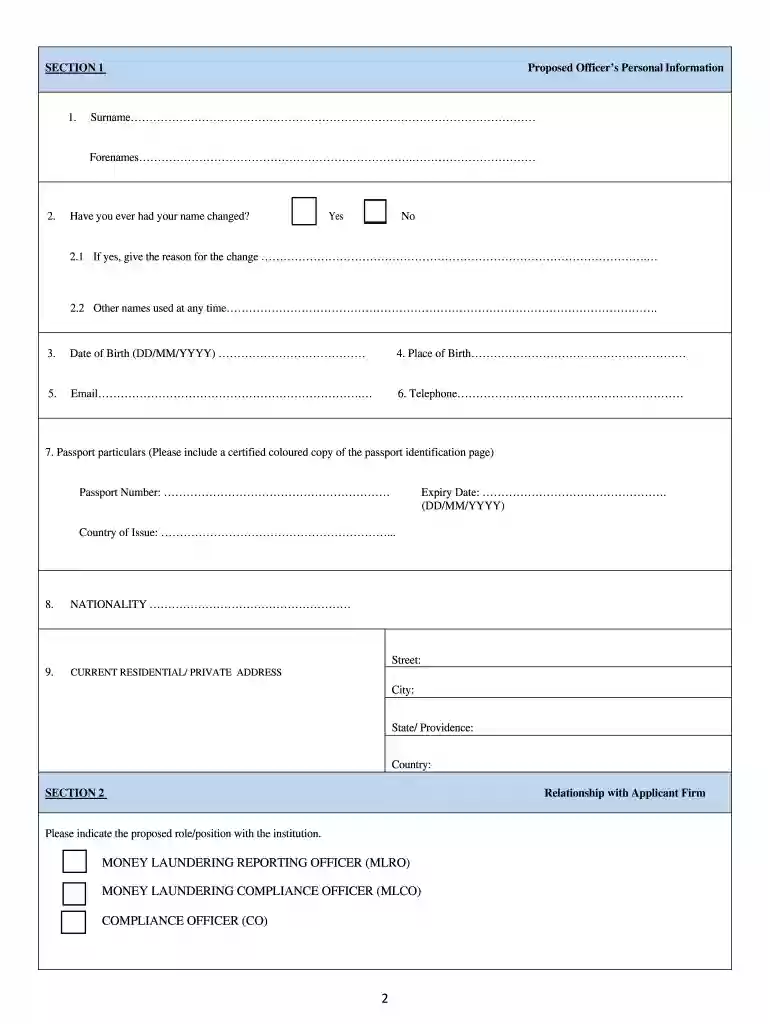
The Turks and Caicos Islands Financial Services Commission forms are essential for individuals seeking roles in compliance and anti-money laundering (AML) within the islands. These forms are particularly crucial for Money Laundering Reporting Officers (MLRO), Money Laundering Compliance Officers (MLCO), and Compliance Officers (CO). Each position involves a deep understanding of AML regulations and requires detailed personal and professional information.
The form requires disclosure of personal data, which includes full name, contact details, and identification documentation. Additionally, professional qualifications, including any relevant certifications or degrees, need to be listed to demonstrate suitability for the role. This helps ensure the applicant has the required knowledge and expertise to handle the responsibilities of an MLRO or MLCO.
Applicants must provide a comprehensive employment history, emphasizing positions related to compliance, finance, or legal fields. Providing character references from previous employers or industry professionals is also required, demonstrating the applicant’s integrity and reliability. These references must be from credible sources within the industry to support the applicant's credibility.
Applicants need to submit various supporting documents as part of their application process. These typically include educational certificates, professional qualifications, and proof of professional memberships. Verification processes may involve background checks to ensure there are no conflicts of interest or previous infractions that would disqualify the applicant from the position.
Completing the form involves several steps to ensure accuracy and completeness.
Gather All Required Information: Before starting the form, collate all necessary personal, professional, and educational documents.
Fill Out Personal Details: Provide accurate personal information, ensuring consistency with official documents like passports or national IDs.
Detail Employment History: Outline relevant past positions, highlighting roles that involved compliance oversight or financial responsibility.
Provide Character References: Secure references from industry professionals or past employers to affirm your suitability and trustworthiness.
Compile Supporting Documents: Attach copies of all necessary documents, which could include certifications, diplomas, and letters of recommendation.
Review and Submit: Double-check for any errors or omissions. Submission can typically be done online through the commission’s official portal or via mail where online access isn't available.
The form supports adherence to regional AML regulations, making it a legal requirement for individuals in certain financial roles. Compliance ensures that the applicant is authorized to prevent unlawful financial activities such as money laundering. Legal proficiency in AML regulations and a flawless submission are crucial to avoiding penalties and ensuring regulatory compliance.
Completing and submitting the Turks and Caicos Islands Financial Services Commission form benefits both the applicant and the financial framework within the islands. It ensures only qualified individuals assume roles that safeguard the financial sector against illicit activities. Furthermore, it enhances personal professional standing, underscoring a commitment to legal and ethical standards.
Real-world application of the form includes the onboarding of new compliance officers within financial firms or banks operating in the Turks and Caicos Islands. By adhering to the application process, organizations can maintain a strong compliance function, crucial for international partnerships that demand rigorous AML practices.
The form is primarily used by professionals aspiring to join compliance departments within banks, financial institutions, and other regulated entities. It is essential for roles directly responsible for managing the risk of money laundering and ensuring compliance with financial regulations.


Applicants should be aware of any official deadlines stated by the Financial Services Commission. These deadlines are crucial for timely submission and processing. The form can often be submitted through multiple channels: online portals, direct mail, or in-person submissions at designated offices. It is imperative to confirm the most efficient and recommended submission method to avoid any unnecessary delays.
At DocHub, your data security is our priority. We follow HIPAA, SOC2, GDPR, and other standards, so you can work on your documents with confidence.


The Commission is an independent statutory body tasked with supervising the financial services sector, and is responsible for the oversight of company formationRead more
The Turks and Caicos Islands Financial Services Commission is an organization that is tasked with the supervision of the financial services sector,


