
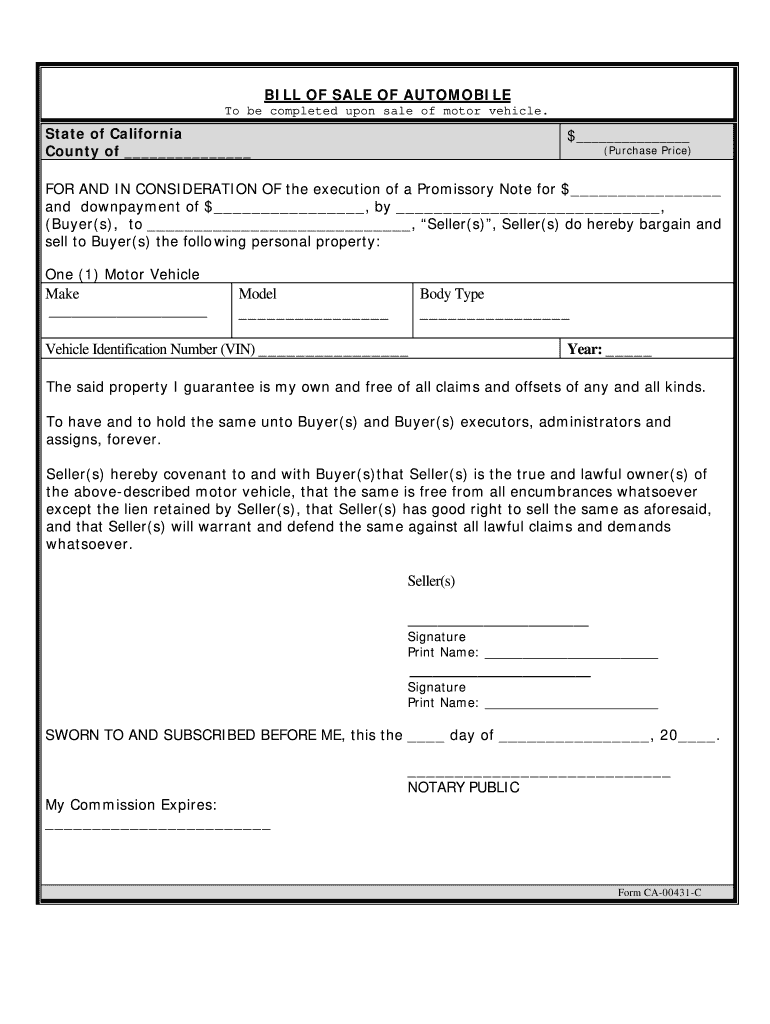







Understanding the California Bill of Sale for Automobile or Vehicle
The California Bill of Sale for Automobile or Vehicle is a crucial document that formalizes the transfer of ownership between a seller and a buyer. This document includes important details such as the purchase price, vehicle specifications (make, model, VIN), and the odometer statement, which verifies the vehicle's mileage at the time of sale. Additionally, it typically contains a promissory note if any payment terms are being negotiated. It serves as a legal record that protects both parties in the transaction.
Definition and Importance
The California Bill of Sale is a legally recognized instrument that specifies the transfer of a vehicle from one party to another. By providing all necessary details about the vehicle and the transaction, it reduces the likelihood of disputes related to ownership, payment, and condition of the vehicle. This document is not only essential for the seller and buyer but may also be a requirement for the California Department of Motor Vehicles (DMV) for title transfer and registration purposes.
How to Use the California Bill of Sale
Utilizing the California Bill of Sale is straightforward. Upon reaching an agreement on the sale, both the buyer and seller must fill out the document accurately. Key sections to be completed include:
- Vehicle Information: Include the make, model, year, VIN, and color.
- Buyer and Seller Details: Full names, addresses, and contact information.
- Sale Price: Clearly state the amount for which the vehicle is being sold.
- Odometer Disclosure: Report the current mileage on the vehicle to confirm the odometer’s accuracy.
- Promissory Note: If payment terms are structured over time, outline the agreement here.
Once completed, both parties should sign and date the document, ensuring that the transaction is formally recorded.
Steps to Complete the Bill of Sale
Completing the California Bill of Sale for an automobile involves several clear steps to ensure accuracy and legal compliance:
- Download or Obtain the Template: The form can be easily downloaded from various online sources, or you can create one based on the necessary elements.
- Fill in Vehicle Details: Input all relevant information about the car including make, model, year, VIN, and mileage.
- Enter Buyer and Seller Information: Provide full names and addresses for both parties involved in the sale.
- Specify the Sale Price: Indicate the exact amount agreed upon for the sale of the vehicle.
- Odometer Disclosure Statement: This statement must be included, confirming the vehicle’s mileage at the time of sale.
- Add Payment Terms (if applicable): If there are payment terms that involve a promissory note, detail these clearly.
- Signatures: Both parties must sign and date the document to validate the agreement.
- Notary Acknowledgment: Although not always necessary, obtaining notarization can add another layer of legitimacy, especially for certain transactions.
Legal Use of the California Bill of Sale
The California Bill of Sale serves multiple legal functions. Firstly, it provides proof of the sale and transfer of ownership, which may be required by the DMV during registration. Secondly, it serves as a record in case of any future disputes regarding the transaction. Importantly, while this document is essential for formalizing sales, buyers should verify that the seller is the documented owner of the vehicle and that there are no liens associated with it.
Key Elements of the California Bill of Sale
Understanding the specific components of the California Bill of Sale helps in accurately completing the document:
- Buyer and Seller Information: Names and addresses of both parties.
- Vehicle Information: Make, model, year, VIN, color, and condition.
- Sale Price: Exact amount of the transaction.
- Odometer Reading: Verification of mileage.
- Promissory Note: Outlines payment all arrangements if applicable.
- Signatures and Date: Validation of agreement.
By accurately capturing these elements, both the buyer and seller are protected, and the transaction is legally sound.
State-Specific Rules and Variants
California has specific rules regarding the Bill of Sale for vehicles, including:
- Notarization: While it is optional, having the bill notarized can provide additional validation.
- DMV Requirement: The DMV may require this document for title transfers.
- Variability: The format of Bill of Sale can vary slightly based on whether the sale involves a vehicle, trailer, or other forms of transport.
Each vehicle transaction should be approached with an understanding of these details to ensure compliance and protection for both parties involved.




