






Definition & Meaning
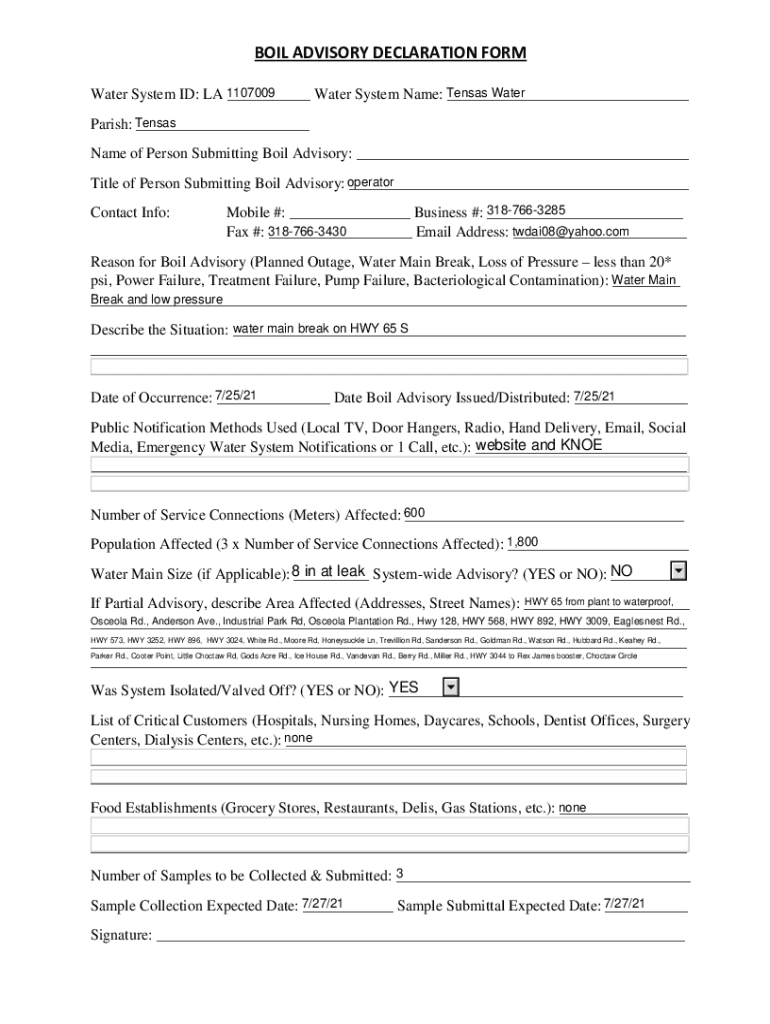
The Boil Advisory Declaration Form is a critical document issued typically when a water supply system experiences issues such as contamination, water main breaks, or low pressure, necessitating a boil water advisory. This form serves multiple purposes: it informs the public about the safety of their water supply, guides them on necessary precautions, and lays out steps to ensure water safety. For example, if the Tensas water system undergoes a disruption affecting 600 service connections, a Boil Advisory Declaration Form would be distributed to notify the estimated 1,800 residents of the need to boil water before use.
Key Elements of the Boil Advisory Declaration Form
The form comprises several critical components to ensure comprehensive communication:
- Reason for the Advisory: Clearly describes the incident prompting the boil advisory, such as a water main break or the detection of harmful bacteria.
- Public Notification Methods: Outlines how information is disseminated to the public, which may include local news outlets, official websites, or social media.
- Affected Areas: Lists specific locations under the advisory and any identifying boundaries to help residents understand if they are impacted.
- Sample Collection Requirements: Details the protocols for collecting and testing water samples to monitor contamination levels and determine when the advisory can be lifted.
Steps to Complete the Boil Advisory Declaration Form
- Identify the Incident: Collect detailed information about the event that necessitated the advisory, including date, time, and location.
- Document Affected Areas: Accurately list all neighborhoods, streets, or geographical areas impacted.
- Notification Strategy: Specify methods for public advisories, ensuring timely and widespread dissemination.
- Water Testing Procedures: Outline the process for water sample collection, testing criteria, and expected timelines for results.
- Review & Sign: Ensure all information is correct, then sign the form to make it official and actionable.
Who Typically Uses the Boil Advisory Declaration Form
This form is primarily used by municipal water authorities, environmental health departments, and public utility companies. In situations where a boil advisory is necessary, these entities play a crucial role in assessing the situation, implementing safety measures, and communicating with the public. For example, if a small city experiences a sudden drop in water pressure, the local water management authority would initiate the use of this form to instruct residents on safety practices and anticipated resolution timelines.


Important Terms Related to the Boil Advisory Declaration Form
Understanding crucial terminology is essential for accurately completing and interpreting the form:
- Contaminant: Any physical, chemical, biological, or radiological substance in water that may pose a health risk.
- Boil Water Advisory: A public health directive advising residents to boil tap water before consumption due to potential contamination.
- Compliance: Adherence to the regulations outlined in the advisory to ensure personal and public safety.
- Sample Testing: Laboratory analysis of water samples to detect contaminants, often conducted at state-certified facilities.
Legal Use of the Boil Advisory Declaration Form
The legal integrity of the Boil Advisory Declaration Form is grounded in its adherence to public health and safety regulations. It acts as a binding document that obligates water authorities to take specific steps for contamination management, public notification, and advisory implementation. Noncompliance or inaccuracies in the form's execution can lead to legal repercussions, including fines or sanctions from regulatory bodies. The form also provides documentation in legal contexts, demonstrating a responsible approach to public safety.
Software Compatibility
While not directly associated with tax software, document management platforms like DocHub can facilitate seamless form completion and sharing. Compatibility with formats such as PDF, DOC, and others ensures that the form can be accessed, filled, and distributed digitally. For instance, a utility company could use DocHub to create a fillable version of the form that residents can easily download and complete online.
Form Submission Methods
Submission of the Boil Advisory Declaration Form is contingent on jurisdictional practices:
- Online: Many water authorities provide online portals for rapid submission and distribution.
- Mail: Traditional mailing addresses may be available for hardcopy submissions, particularly in rural areas lacking robust internet infrastructure.
- In-Person: Direct submission at a local water authority office may be required during emergencies needing swift action.
State-Specific Rules for the Boil Advisory Declaration Form
Regulations and requirements can vary by state, affecting the form's content and distribution process. Some states may mandate the inclusion of specific testing procedures or a minimum frequency for water sample collection. Water authorities need to adapt the form to align with both federal guidelines and state-specific mandates, ensuring compliance across all levels.