
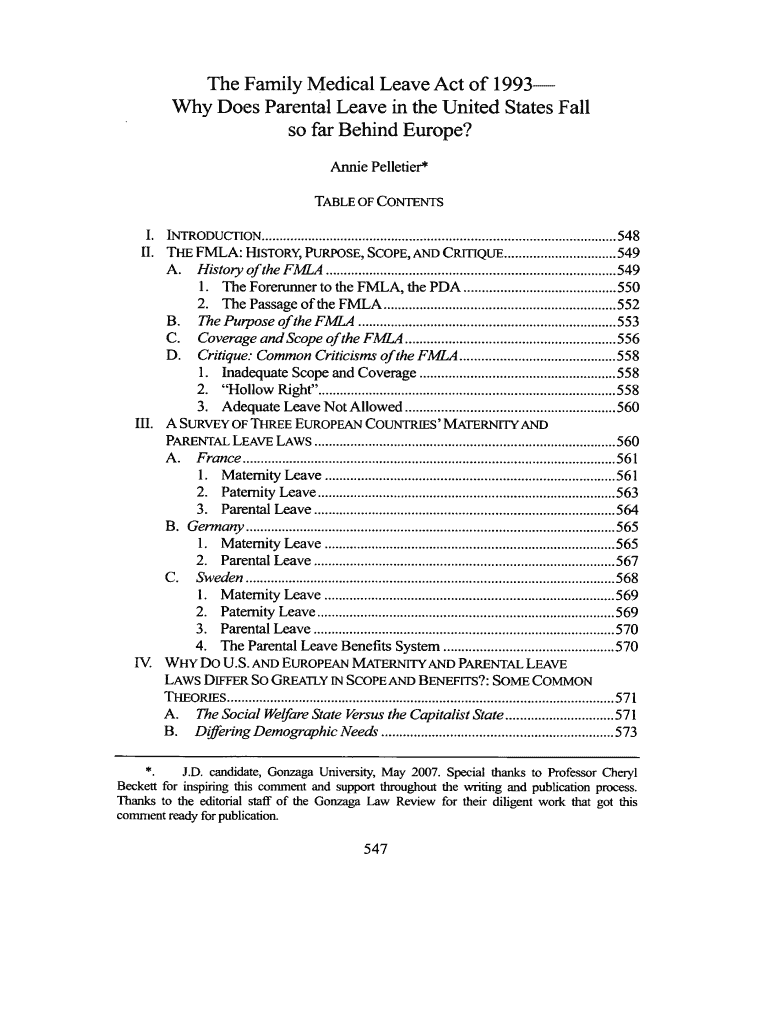







Definition and Historical Context of the Family and Medical Leave Act
The Family and Medical Leave Act (FMLA) of 1993 is a U.S. federal labor law established to provide certain employees with up to twelve weeks of unpaid, job-protected leave per year. The purpose of the FMLA is to balance the demands of the workplace with the needs of families, allowing employees to deal with personal or family health issues, birth or adoption of a child, or exigencies related to a family member's military service. In its historical context, the FMLA was designed to protect both men and women from losing their jobs when they need time off for family-related matters. This act was a pivotal step aimed at improving work-life balance at a time when family dynamics and workplace realities were rapidly evolving.
Key Provisions of the Family and Medical Leave Act
The provisions of the FMLA apply to employers who have 50 or more employees within a 75-mile radius. Covered employers are required to provide eligible employees the following benefits:
- Up to twelve weeks of unpaid leave during any twelve-month period for specific family and medical reasons.
- Continuation of group health insurance coverage under the same terms and conditions as if the employee had not taken leave.
- Reinstatement to the same or an equivalent job at the end of the leave period.
Eligibility criteria for employees include having worked for the employer for at least twelve months, with at least 1,250 hours of service during those twelve months.
Comparison with European Parental Leave Policies
Parental leave policies in the United States, as established by the FMLA, differ significantly from those in European countries such as France, Germany, and Sweden. These countries offer more comprehensive parental leave benefits, including paid leave and extended time off. For instance:
- France provides paid maternity leave for up to sixteen weeks at 100 percent of the salary.
- Germany allows up to fourteen months of parental leave shared between both parents with a benefit that partially replaces lost income.
- Sweden offers 480 days of paid parental leave, with 390 days at approximately 80 percent of a parent's income.
These differences largely stem from varied social welfare systems, cultural expectations, and labor market structures.
Criticisms and Limitations of the Family and Medical Leave Act
The FMLA is often criticized for its limited scope and lack of paid leave options, which can disproportionately affect low-income workers who cannot afford to take unpaid leave. Key critiques include:
- The exclusion of businesses with fewer than 50 employees, which leaves a significant number of American workers without FMLA protections.
- The unpaid nature of the leave, which can place financial strain on families during critical periods.
- Limited coverage of specific family situations that may not fall under the defined criteria for FMLA leave.
These limitations highlight the need for policy amendments or additional programs to address gaps in the current parental leave system.
Legal Implications and Employee Rights
Understanding the legal implications of the FMLA is crucial for both employers and employees. Employees who qualify for FMLA leave are entitled to:
- Job protection and the maintenance of health benefits during the leave.
- Protection from retaliation or discrimination for exercising their FMLA rights.
- Recourse through the U.S. Department of Labor or legal action if their rights under the FMLA are violated.
Employers must ensure compliance with the FMLA and provide the necessary documentation and communication to support eligible employees who request leave.
The Role of Social and Economic Factors
The differences in parental leave policies between the U.S. and Europe can be attributed to various social and economic factors:
- Social Welfare Systems: European countries often have more robust social welfare programs that support families and provide ample parental leave benefits.
- Labor Market Needs: The discrepancies can also reflect different labor market demands and job security structures.
- Demographic Trends: Variations in demographic trends and social expectations around family roles influence policy development.
These factors contribute to the ongoing debate about the adequacy and evolution of parental leave policies in the United States.
Alternatives and Proposed Reforms
Several alternatives and reforms to the FMLA have been proposed to enhance or supplement its provisions:
- Paid Family Leave Programs: Some states, including California and New York, have implemented paid family leave measures that provide partial income replacement for covered workers.
- Federal Legislation Initiatives: Ongoing legislative efforts aim to introduce federal paid family leave, potentially expanding the reach and impact of family leave protections.
- Employer-Led Initiatives: Private companies sometimes offer more generous parental leave policies than those required by the FMLA to attract and retain talent.
These alternatives highlight a movement toward more comprehensive support systems for working families in the U.S.
Navigating the FMLA Application Process
Employees seeking to use FMLA leave should follow a systematic process:
- Notification: Inform the employer of the need for FMLA leave as soon as possible.
- Documentation: Provide any required documentation, such as medical certification or family military service orders.
- Leave Management: Coordinate with the employer on how to manage the absence and maintain communication.
- Reintegration: Plan for reintegration into the workplace following FMLA leave, ensuring understanding of any changes or developments during the absence.
This structured approach assists employees in maximizing the benefits of their FMLA leave.




