







Definition & Meaning
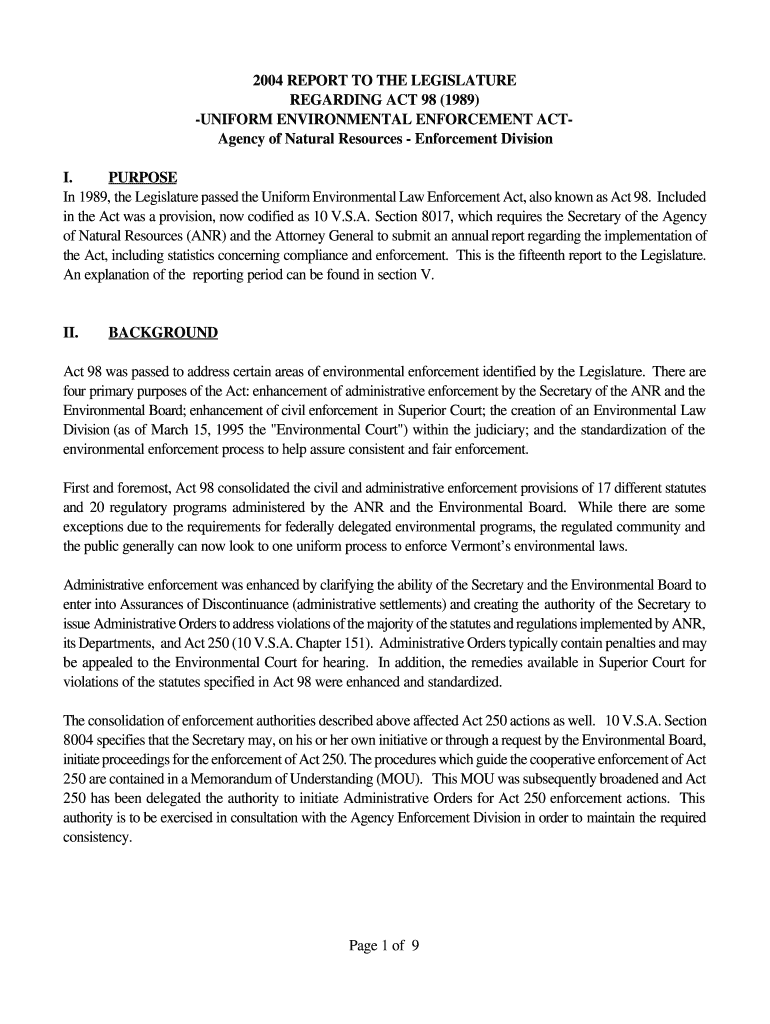
The 2004 Report to the Legislature regarding Act 98, also known as the Uniform Environmental Enforcement Act, is a detailed document produced by the Agency of Natural Resources (ANR). Its primary aim is to provide an evaluative overview of the enforcement and compliance measures undertaken to uphold environmental laws in Vermont. The Act was enacted to standardize enforcement procedures across various environmental statutes, bolster compliance efforts, and ensure a cohesive approach to addressing violations. The report is integral in understanding how environmental regulations are implemented, monitored, and enforced within the state.
Key Elements of the Report
The report covers several critical areas to ensure comprehensive environmental law enforcement:
- Enforcement Actions: Statistics on enforcement measures, including the number of inspections and penalties imposed, are documented.
- Citizen Complaints: Data on complaints lodged by citizens regarding environmental issues, providing insight into public engagement and areas needing attention.
- Investigative Capabilities: The report highlights the ANR's investigative efforts, emphasizing improvements and challenges faced in identifying and responding to violations.
- Funding Details: Allocation and utilization of funds for the Enforcement Division, offering transparency on resource management.
Who Typically Uses the Report
The primary users of the 2004 report include:
- Policymakers and Legislators: To assess the effectiveness of current environmental policies and propose necessary changes.
- Environmental Agencies: For strategic planning and resource allocation to improve enforcement efforts.
- Researchers and Academics: As a data source for studies related to environmental law enforcement.
- Environmental Activists and NGOs: To evaluate the government's accountability and effectiveness in enforcing environmental laws.


Steps to Complete the Report
- Data Collection: Gather necessary data from various enforcement actions, citizen complaints, and other relevant sources.
- Analysis: Analyze the data to identify trends, areas of concern, and the effectiveness of current enforcement measures.
- Drafting: Compile the analysis into a draft report, ensuring clear presentation and comprehensive coverage of all relevant elements.
- Review and Feedback: Submit the draft for review by stakeholders and incorporate feedback for accuracy and completeness.
- Finalization: Finalize the report, ensuring it adheres to legislative requirements and is ready for submission to the legislature.
How to Obtain the Report
To access the 2004 report, individuals can:
- Visit the ANR Website: The report is often available as a downloadable document on the Agency of Natural Resources' official site.
- Request from the Vermont Legislature: Physical or digital copies may be requested through official channels at the Vermont legislature.
- Consult University and Public Libraries: Many libraries maintain archives of governmental reports for public access.
Importance of the Report
The 2004 Report to the Legislature plays a pivotal role in:
- Enhancing Transparency: By providing detailed insights into how environmental laws are enforced, the report promotes transparency.
- Informing Policy Decisions: It serves as a critical tool for policymakers to make informed decisions regarding environmental legislation.
- Public Engagement: Offering citizens and organizations information to engage more effectively in environmental advocacy.
Legal Context and Compliance
The report serves as a vital legal document, ensuring that:
- Compliance with Environmental Laws: By evaluating enforcement actions, the report ensures that compliance with environmental statutes is maintained.
- Policy Improvement: Insights from the report can lead to legislative amendments to enhance environmental protection.
- Inter-Agency Coordination: Promotes collaboration among different governmental agencies to streamline enforcement processes.
Examples of Using the Report
Practical applications of the report include:
- Policy Development: Using data from the report to guide the creation or revision of environmental policies.
- Public Campaigns: NGOs leveraging information from the report to launch awareness campaigns about environmental issues in Vermont.
- Academic Research: Utilizing the report in research papers and academic discussions related to environmental law and policy enforcement.
State-Specific Rules for Implementation
In Vermont, specific rules govern the implementation of the Uniform Environmental Enforcement Act:
- Standardized Procedures: The report outlines procedures to ensure uniformity in enforcement actions across the state.
- Community Involvement: Encourages public participation in environmental monitoring through structured channels.
- Periodic Review: Ensures that the effectiveness of enforcement measures is periodically assessed and reported.
Business Types That Benefit Most
Industries particularly interested in the report's findings include:
- Manufacturing: Companies can assess compliance requirements and potential penalties.
- Agriculture: Farmers can understand environmental regulations impacting their operations.
- Energy Sector: Provides insights into regulatory requirements for energy production and distribution companies.
Legal Use of the Report
The report is a legal document utilized to:
- Audit Compliance: Serve as an auditing tool for environmental compliance checks by regulatory bodies.
- Support Legal Proceedings: Used in court cases as evidence of compliance efforts or violations.
- Guide Legal Reforms: Acts as a foundation for legal frameworks and reforms in environmental law.
Important Terms and Definitions
Understanding these terms is essential when navigating the report:
- Compliance: Adherence to environmental laws and regulations set by authorities.
- Enforcement: Measures taken to ensure adherence to laws, including penalties and corrective actions.
- Violation: Breaches of environmental statutes or regulations, addressed through enforcement actions.
Software Compatibility
While the report itself may not require specific software, it can be accessed and viewed using standard document reading tools:
- Document Readers: Such as Adobe Acrobat Reader for PDF files.
- Cloud Platforms: Access through Google Docs or other document management systems.
- Research Software: For more advanced analysis, software like Excel can be used to handle statistical data presented in the report.




