




01. Edit your form online
Type text, add images, blackout confidential details, add comments, highlights and more.

Type text, add images, blackout confidential details, add comments, highlights and more.

Draw your signature, type it, upload its image, or use your mobile device as a signature pad.

Send it via email, link, or fax. You can also download it, export it or print it out.
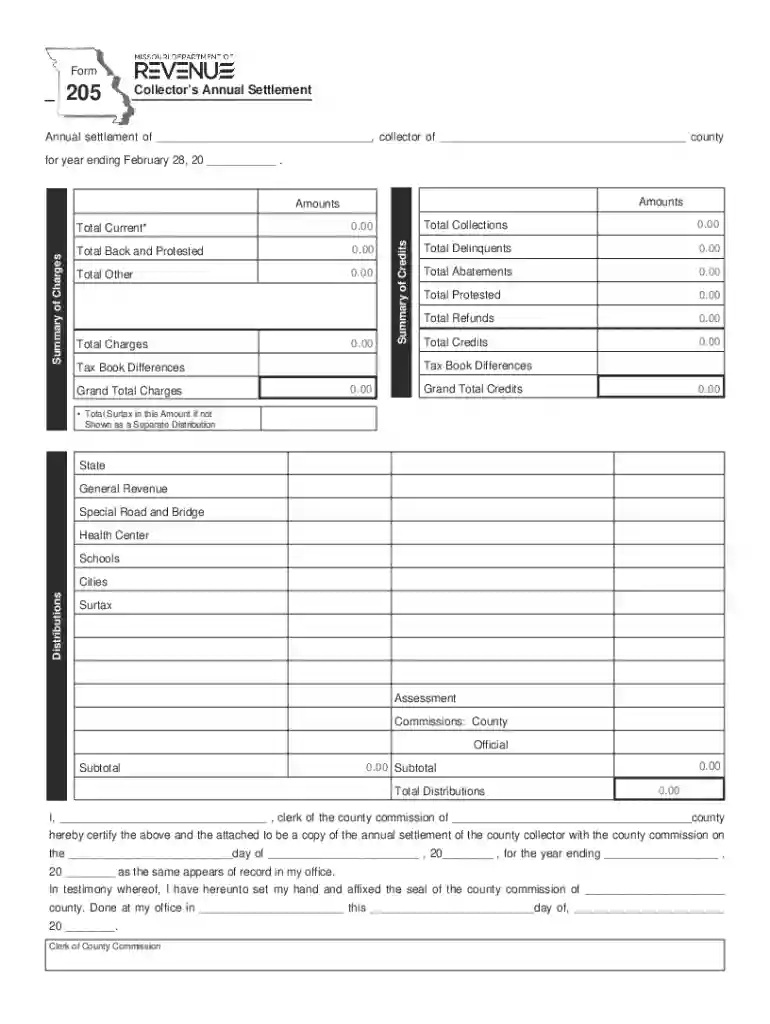
Form 205, known as the Collector's Annual Settlement, is a financial document crucial for tax collection and distribution within a county. This form summarizes the fiscal activities related to tax collections, detailing financial figures such as charges, credits, and distributions for the fiscal year ending on February 28. Its importance lies in ensuring transparency and accuracy in the county's financial dealings, as the form is certified by the county commission clerk and reviewed by the Taxation Division.
Form 205 is primarily used by financial officers within the county to report and settle annual tax collections. This involves a detailed entry of various financial figures including current charges, back charges, and credits. Tax collectors utilize this form to balance their accounts, ensuring all figures align with actual collections and distributions. This process requires precision to uphold legal and financial accountability.
To obtain Form 205, county officials may access it through their local Taxation Division's office or official government websites, where it is typically available for download. It is essential for county clerks or financial officers to ensure they access the most current version to remain compliant with tax reporting requirements.
Completing Form 205 involves several precise steps to ensure that all tax-related financial data is accurately reported:
Form 205 is typically used by county tax collectors and financial officers tasked with managing and reporting on public funds derived from tax collections. It may also involve auditors or financial advisors who assist in ensuring compliance with local and state tax regulations.
The form contains various critical elements that contribute to its role in financial reporting:
Form 205 must be filed by the end of the fiscal year, specifically by February 28, to ensure compliance with reporting deadlines set by the Taxation Division. It is critical for tax collectors to adhere to these deadlines to avoid potential penalties and ensure seamless financial operations.
While Form 205 retains a standardized purpose across counties, specific regulations might vary state by state, requiring officials to conform to local stipulations pertinent to tax collection and reporting. Understanding state-specific rules ensures that the form complies with broader regulatory frameworks.
Submission of Form 205 can be executed through various channels, each offering different conveniences:
These systems provide flexibility, accommodating different preferences and operational capabilities of county officials responsible for tax reporting and settlement.
We've got more versions of the Form 205 - Collector s Annual Settlement form. Select the right Form 205 - Collector s Annual Settlement version from the list and start editing it straight away!
At DocHub, your data security is our priority. We follow HIPAA, SOC2, GDPR, and other standards, so you can work on your documents with confidence.


NOTICE: The project that is the subject of this report was approved by the Governing Board of the National Research Council, whose members are drawn from the
Form 205 - Collectors Annual Settlement Page ending February 28, Phone: (573) 751-5900 Fax: (573) 522-1720
Mar 27, 2026 This Court Forms page is only somewhat searchable. However if you have located a form number from this guide, you can find both a PDF and a WordRead more


