Tc 706 2026

Get Form
tc706 Preview on Page 1

Here's how it works

01. Edit your tc706 online
Type text, add images, blackout confidential details, add comments, highlights and more.
02. Sign it in a few clicks
Draw your signature, type it, upload its image, or use your mobile device as a signature pad.
03. Share your form with others
Send tc 706 via email, link, or fax. You can also download it, export it or print it out.

How to use or fill out tc 706 with our platform

Form edit decoration
9.5
Ease of Setup
DocHub User Ratings on G2
9.0
Ease of Use
DocHub User Ratings on G2
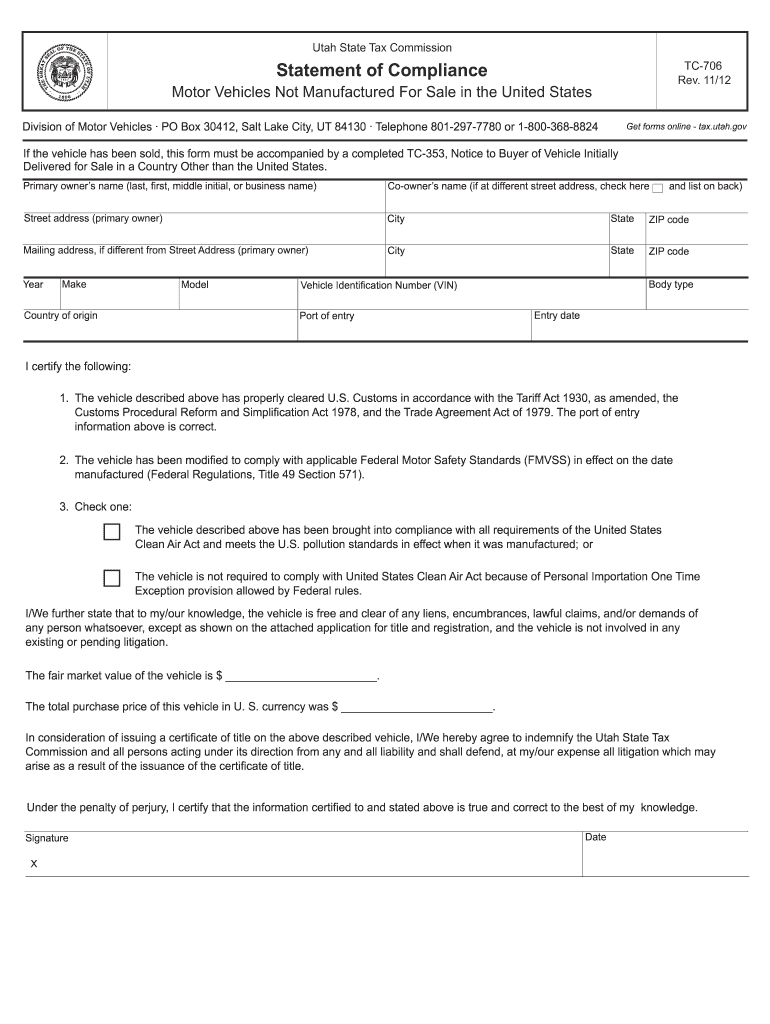
  1. Click ‘Get Form’ to open the TC-706 in the editor.
  2. Begin by entering the primary owner's name, including last, first, and middle initial. If applicable, add the co-owner's name and check the box if they have a different street address.
  3. Fill in the primary owner's street address, city, state, and ZIP code. If there is a different mailing address, provide that information as well.
  4. Next, input vehicle details: year, make, country of origin, model, body type, and Vehicle Identification Number (VIN).
  5. Indicate the port of entry and entry date for the vehicle.
  6. Certify compliance by checking the appropriate boxes regarding U.S. Customs clearance and Federal Motor Safety Standards.
  7. State the fair market value and total purchase price of the vehicle in U.S. currency.
  8. Finally, sign and date the form to certify that all information provided is true and correct.

Start using our platform today to easily complete your TC-706 form online for free!

See more tc 706 versions

We've got more versions of the tc 706 form. Select the right tc 706 version from the list and start editing it straight away!
Versions Form popularity Fillable & printable
2012 4.9 Satisfied (42 Votes)
be ready to get more

Complete this form in 5 minutes or less

Get form

Got questions?

We have answers to the most popular questions from our customers. If you can't find an answer to your question, please contact us.
Contact us

With DocHub, you can easily sign your tc 706 or any other document on iOS, even without installing additional applications. You can access your DocHub account from any web-connected browser and complete and sign your form in any preferred method with just a couple of clicks.

As a comprehensive document editing service, DocHub is accessible on mobile devices. Open DocHub in your choice of mobile internet browser and employ our smart mobile-friendly toolset to complete your tc 706.

Form 706 ensures that estate taxes are adequately assessed for larger estates, while Form 1041 helps report the estates income during the settlement process. By understanding these differences, executors and administrators can better manage estate obligations.
This code indicates that Form 706, which is used to determine the amount of the estate tax, has been accepted as filed and an examination has been concluded.
Typical IRS Processing Timeline It should be recognized that the IRS generally takes six to nine months to process Form 706. However, specific variables may influence this timeline as follows: Completeness and accuracy of submitted documents.
be ready to get more

Complete this form in 5 minutes or less

Get form

People also ask

The executor of a decedents estate uses Form 706 to figure the estate tax imposed by Chapter 11 of the Internal Revenue Code. Form 706 is also used to compute the generation-skipping transfer (GST) tax imposed by Chapter 13 on direct skips.
An estate tax return (Form 706) must be filed if the gross estate of the decedent (who is a U.S. citizen or resident), increased by the decedents adjusted taxable gifts and specific gift tax exemption, is valued at more than the filing threshold for the year of the decedents death, as shown in the table below.
Federal Form 706, also known as the United States Estate (and Generation-Skipping Transfer) Tax Return, is used to report the value of a deceased persons estate and determine the amount of estate tax due, if any. A snapshot of the value of the decedents assets and liabilities is taken on the day of death.
At our firm, we frequently encounter these errors that can put families at risk: Not filing Form 706 because the estate falls below the exemption threshold. Incomplete or inaccurate asset valuations that trigger IRS audits. Missing critical deadlines for filing or requesting extensions.

Related links