




01. Edit your planilla contribucion sobre ingresos online
Type text, add images, blackout confidential details, add comments, highlights and more.

Type text, add images, blackout confidential details, add comments, highlights and more.

Draw your signature, type it, upload its image, or use your mobile device as a signature pad.

Send puerto rico 482 via email, link, or fax. You can also download it, export it or print it out.
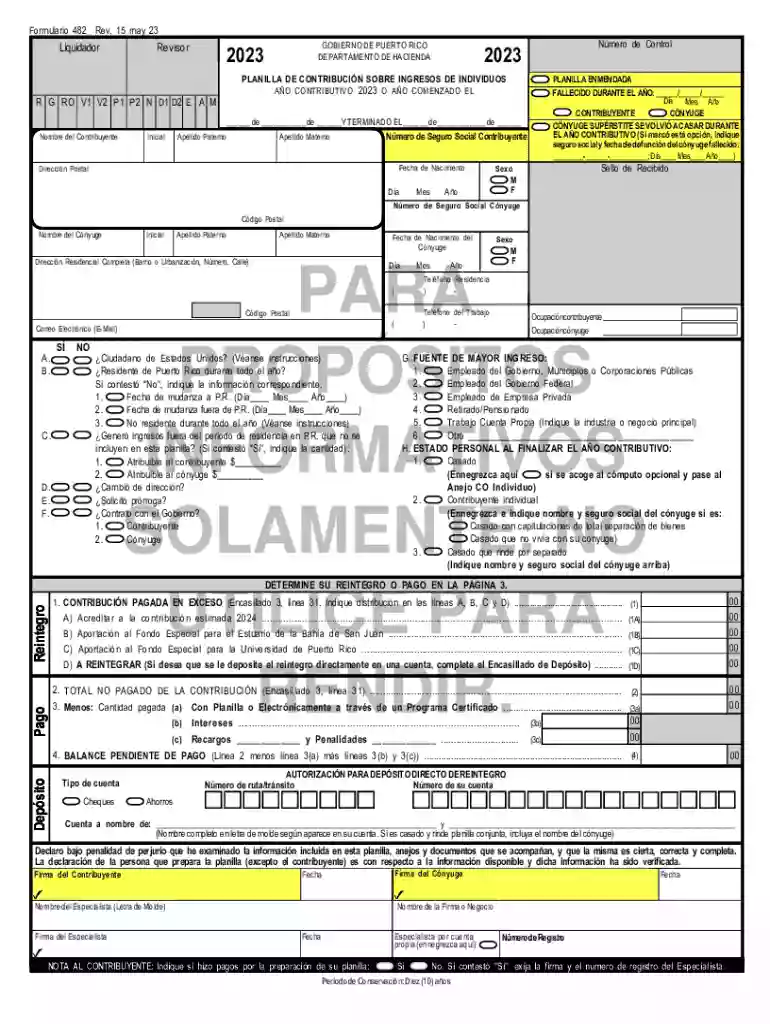
The "PLANILLA INDIVIDUOS FORMA UNICA 16 nov 16" is a tax document typically used for reporting individual income contributions in Puerto Rico. It includes sections for the taxpayer's information, their spouse’s details, and various income sources. The form serves to detail earnings from wages, interests, dividends, and capital gains, alongside deductions and applicable tax credits. The primary purpose of this form is to accurately determine net income and ensure proper compliance with income tax obligations under Puerto Rican tax law.
Gather Necessary Information: Before starting, collect all the required details such as personal information for both the filer and their spouse, income statements, and documentation for any deductions or credits.
Complete Income Sections: Fill out all segments related to different income streams. Include precise figures from employment, passive income like dividends, and other earnings.
Calculate Deductions: Identify possible deductions and credits that apply. Use supporting documents to justify each claim, such as receipts or official statements.
Review and Submit: Double-check all entries for accuracy. Once verified, you can submit the form electronically or via mail, following specific submission guidelines.
The PLANILLA INDIVIDUOS FORMA UNICA is typically available through Puerto Rico’s Departamento de Hacienda or its official website. You might also access it via certified tax professionals who distribute official forms to their clients. Digital versions of these tax forms may also be available for download, providing an upfront look at what information is needed before official submission.
Personal Information: Begin by filling out the taxpayer’s details, including name, address, social security number, and similar data for any declared dependents.
Income Reporting: Move onto the income section, where you need to enter figures from all income sources accurately.
Deductions and Credits: Carefully document all applicable deductions and credits, using receipts and statements for verification.
Final Calculations: Use provided instructions to calculate the total tax obligation or refund due.
Verification and Submission: After a thorough review, submit the completed form via the designated method.
This form is commonly utilized by residents of Puerto Rico who have earned income during the fiscal year, regardless of their employment status. It applies to both employees and self-employed individuals, as well as those receiving passive income streams like interest or dividends. Taxpayers engaged in foreign income activities must also report and reconcile any tax obligations using this form.
While the form is standardized for Puerto Rican residents, it’s crucial to consider state-specific provisions. These may include special deductions or credits unique to Puerto Rico. Filing deadlines are generally aligned with federal tax deadlines, but it’s important to verify any specific state deadlines that might affect filing dates.
Self-Employed Individuals: The form accommodates various income types and provides sections specifically tailored for reporting self-employment income and associated expenses.
Retirees with Diverse Income: Individuals who have multiple income streams such as pensions and investments can utilize the designated sections to manage their diverse earnings efficiently.
For legal compliance, accurate completion and timely submission are required. Failure to follow these guidelines can result in penalties, ranging from fines to increased scrutiny in future tax assessments. Hence, it’s essential to verify all information before submission to avoid potential legal issues.
We've got more versions of the planilla contribucion sobre ingresos form. Select the right planilla contribucion sobre ingresos version from the list and start editing it straight away!
At DocHub, your data security is our priority. We follow HIPAA, SOC2, GDPR, and other standards, so you can work on your documents with confidence.


Planilla de Contribucin Sobre Ingresos del ao 2015. 16-01 establece que ser requisito que la radicacin de la Planilla de Individuos del ao 2015. Impuestos
Nov 16, 2016 Planilla o Electrnicamente. Planilla de Contribucin sobre Ingresos de Individuos (Formulario 482)


