







Definition & Meaning
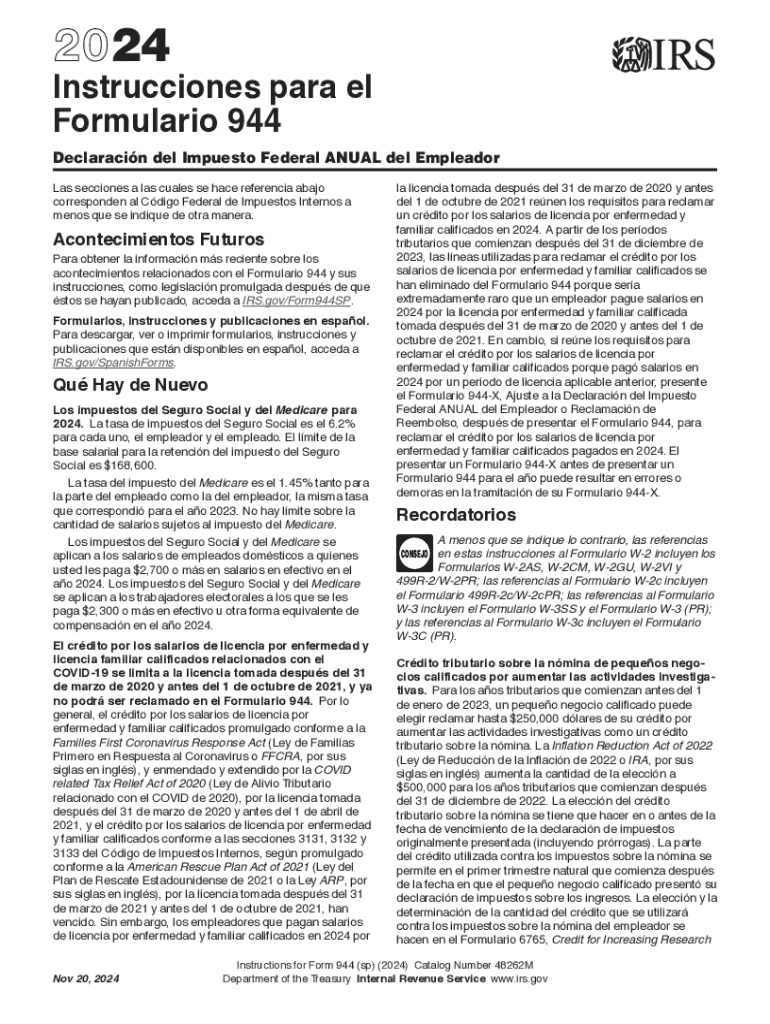
The "2024 Instrucciones para el Formulario 944" provides comprehensive guidelines for completing Form 944, known as the Annual Federal Employer's Tax Return. This form is specifically designed for small employers in the United States who report their total annual federal tax liabilities related to Social Security, Medicare, and withheld federal income taxes. By understanding these instructions, employers can accurately calculate their tax obligations and maintain compliance with federal tax laws.
-
Form 944 is intended to simplify the filing process for small employers by requiring them to file only once a year instead of quarterly like other IRS forms, such as Form 941.
-
Detailed instructions cover various aspects like eligibility, recording tax payments, applying for tax credits, and methods for correcting errors on previously submitted forms.
Eligibility Criteria
Understanding who qualifies to use Form 944 is crucial for ensuring compliance and avoiding penalties. Employers must meet specific criteria to be eligible to file this form.
-
Form 944 is designed for businesses with an estimated annual employment tax liability of $1,000 or less for the year. This typically includes small businesses and household employers.
-
Employers must be notified by the IRS that they qualify to use Form 944, and automatic permission is not assumed. If notified, transitioning to this form from quarterly filings is allowed.
-
If a business expects its tax liability to exceed the $1,000 threshold during the year, it should notify the IRS and switch to quarterly filings using Form 941.


Filing Deadlines / Important Dates
Adhering to the stipulated filing deadlines is vital to avoid late penalties. The deadlines outlined in the form instructions help keep small employers on track.
-
The deadline for filing Form 944 is generally January 31 of the year following the tax year being reported. For instance, for the 2024 tax year, the deadline will be January 31, 2025.
-
Employers can avoid late filing penalties if they make full payment of taxes due by the deadline, even if the form itself is filed with a short delay.
-
If January 31 falls on a weekend or federal holiday, the next business day becomes the deadline. Employers should refer to the exact calendar dates for the year in question to ensure submission timeliness.
Steps to Complete the 2024 Instrucciones para el Formulario 944
Following a systematic approach to filling out Form 944 can help prevent mistakes and ensure that all relevant information is accurately reported.
-
Enter Employer Information: Include the business name, address, and Employer Identification Number (EIN) at the top of the form.
-
Calculate Taxes: Accumulate the total wages paid subject to Social Security, Medicare, and federal income taxes. Use the instruction guide to ensure correct tax rate application.
-
Apply Credits: Deduct applicable tax credits from your total tax liability. Instructions provide specific examples of available credits and how to calculate them.
-
Record Tax Payments: Detail any federal tax deposits made throughout the year. Ensure these deposits match the figures stated to avoid discrepancies.
-
Review and Submit: Double-check all information and make sure it's consistent with business records before filing. Retain a copy for your records.
Important Terms Related to 2024 Instrucciones para el Formulario 944
Familiarity with key terminology can help employers better navigate the instructions and understand the form's requirements.
-
Social Security Tax: This is a federal tax levied on employers and employees to fund the Social Security program.
-
Medicare Tax: Similar to Social Security, this tax funds Medicare and is applied to all earnings with no upper limit.
-
Federal Income Tax Withholding: The process of deducting taxes from employees' total earnings throughout the year, which is reported annually.
-
Form 944-V: Payment voucher used if employers are submitting payment along with the paper Form 944.
IRS Guidelines
The IRS provides guidelines within the instructions document to help employers navigate federal tax obligations effectively.
-
It emphasizes electronic filing through IRS-approved software, which generally results in fewer errors and faster processing.
-
Employers can opt for the Electronic Federal Tax Payment System (EFTPS) to make tax deposits, which is encouraged within instructions.
-
Step-by-step guidance is included within the instructions to help small employers understand the implications of reporting errors, including how to address them.
Penalties for Non-Compliance
Non-compliance with the filing and payment requirements stipulated in the instructions can result in severe penalties for employers.
-
Late filers may face penalties starting at 5% of the unpaid taxes for each month the return is late, up to a maximum of 25% of the total tax liability.
-
Failure to deposit the required taxes timely can lead to penalties ranging from 2% to 15% of the underpaid amount, depending on the duration of the delay.
-
Accuracy-related penalties can be assessed for incorrect reporting, so employers are urged to verify all information before submission.
Form Submission Methods (Online / Mail / In-Person)
Employers have various options for submitting Form 944, each with specific benefits and requirements.
-
Electronic Filing: This is the most recommended method due to its efficiency and the immediate confirmation of receipt provided by the IRS.
-
Mailing: Paper forms can be mailed to the appropriate IRS address indicated in the instructions based on the employer's location. It's vital to retain proof of mailing.
-
In-Person Submission: Although less common, some IRS field offices may accept in-person submissions, preferably with an appointment for convenience.
Each method's specifics are contained in the instructions, guiding employers to choose the most suitable approach based on their preferences and circumstances.




