







Definition & Meaning
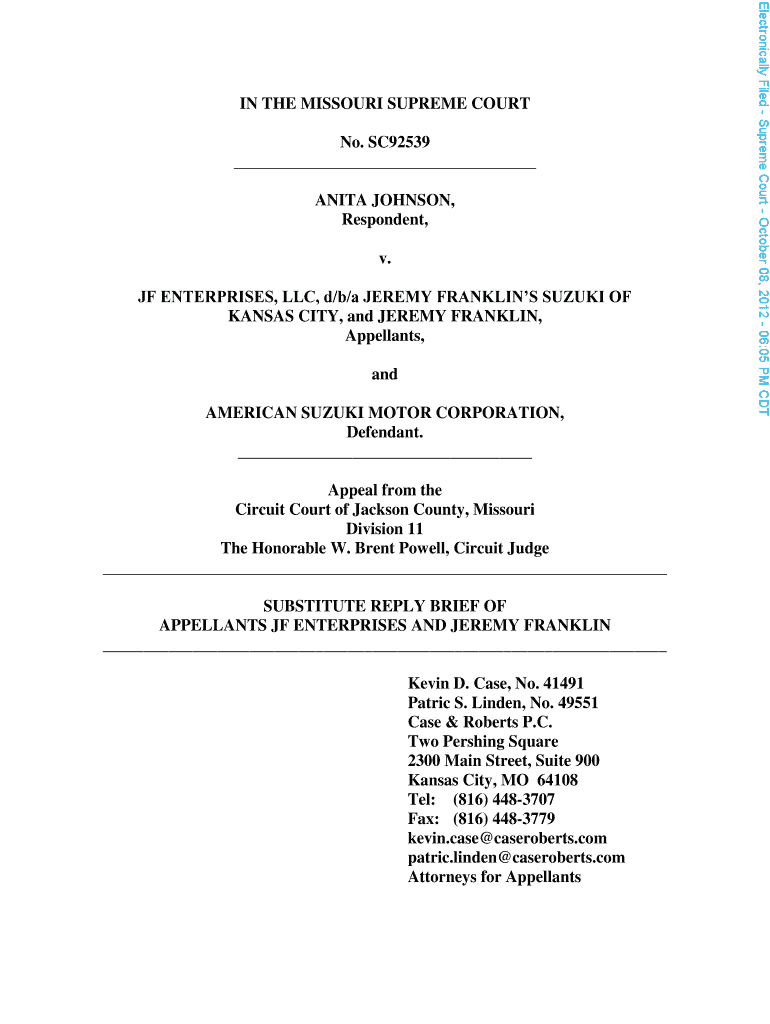
The case titled "IN THE MISSOURI SUPREME COURT No SC92539 ANITA" involves a legal dispute submitted to the Missouri Supreme Court. This case centers on an appeal by JF Enterprises, LLC and Jeremy Franklin, contesting a trial court's ruling that denied their Motion to Compel Arbitration involving Anita Johnson. The appellants argue the validity of the arbitration agreement and its alignment with Missouri's legal frameworks, especially regarding the Missouri Merchandising Practices Act.
Key Elements of the Case
The main components of this case include the arbitration agreement, which is the core focus of the dispute. The appellants maintain that this agreement was correctly executed after the retail installment contract. Additionally, they assert that the agreement does not hinder Anita Johnson's ability to seek recovery under pertinent laws. Key legal documents and arguments hinge on these elements and their interpretation by the courts.
Steps to Understand the Case
- Review the Arbitration Agreement: Examine the terms outlined in the arbitration agreement to understand its stipulations and context within the original transaction.
- Analyze the Trial Court's Decision: Understand the rationale behind the trial court's decision to refuse the enforcement of the arbitration agreement.
- Evaluate Appellants' Arguments: Study the reasoning presented by JF Enterprises, LLC and Jeremy Franklin, focusing on their challenge to the trial court's interpretation.
- Consider Legal Precedents: Investigate similar past cases in Missouri that could influence this decision through precedents regarding arbitration agreements.
Legal Use of the Case Information
This case serves a critical role in delineating the boundary between enforceable arbitration agreements and consumer rights under the Missouri Merchandising Practices Act. The legal interpretations and rulings here could set significant precedents affecting future disputes involving similar agreements.
Important Terms Related to the Case
- Arbitration Agreement: A contract in which parties agree to resolve disputes through arbitration rather than litigation.
- Missouri Merchandising Practices Act: A Missouri law aimed at protecting consumers from fraudulent and deceptive business practices.
- Motion to Compel Arbitration: A legal motion requesting the court to enforce a binding arbitration clause.
Who Typically Uses This Information
Lawyers representing parties in arbitration disputes, judges, legal scholars, and students are primary users. This case provides insights into arbitration agreement enforceability and consumer rights, valuable for professionals involved in contract law and consumer protection.
State-Specific Rules
In Missouri, arbitration agreements must align with state legislation, such as the Missouri Merchandising Practices Act. Local legal precedents also influence how terms in arbitration clauses are interpreted and enforced. The Missouri Supreme Court's decisions can shape state-specific interpretations of these agreements.
Examples of Using the Case Information
This case could be used as a reference in legal education to demonstrate the practical application of arbitration agreements and consumer law. It can also serve as a precedent in future cases where the enforceability of arbitration agreements is challenged under state statutes like the Missouri Merchandising Practices Act.




