




01. Edit your medicare certification recertification form online
Type text, add images, blackout confidential details, add comments, highlights and more.

Type text, add images, blackout confidential details, add comments, highlights and more.

Draw your signature, type it, upload its image, or use your mobile device as a signature pad.

Send medicare certification form via email, link, or fax. You can also download it, export it or print it out.
Medicare certification and recertification are essential processes that ensure healthcare providers meet specific standards to deliver services reimbursed by Medicare. Certification involves the initial approval of healthcare facilities, such as skilled nursing facilities (SNFs), to provide services eligible for Medicare reimbursement. The process confirms that these facilities comply with Medicare’s requirements for quality of care, safety standards, and operational protocols.
Recertification occurs periodically to reaffirm compliance with Medicare standards. All facilities must undergo this process to maintain their status and qualify for future reimbursement. This is crucial not only for the financial health of the facility but also for the assurance that patients receive appropriate care aligned with Medicare's regulations. Key terms associated with this process include the Medicare certification form, which is used to initiate and document the certification and recertification of facilities and their services.
Completing the Medicare certification and recertification forms requires thorough attention to detail and adherence to specific guidelines. The process generally unfolds in several key steps:
Gather Required Documentation
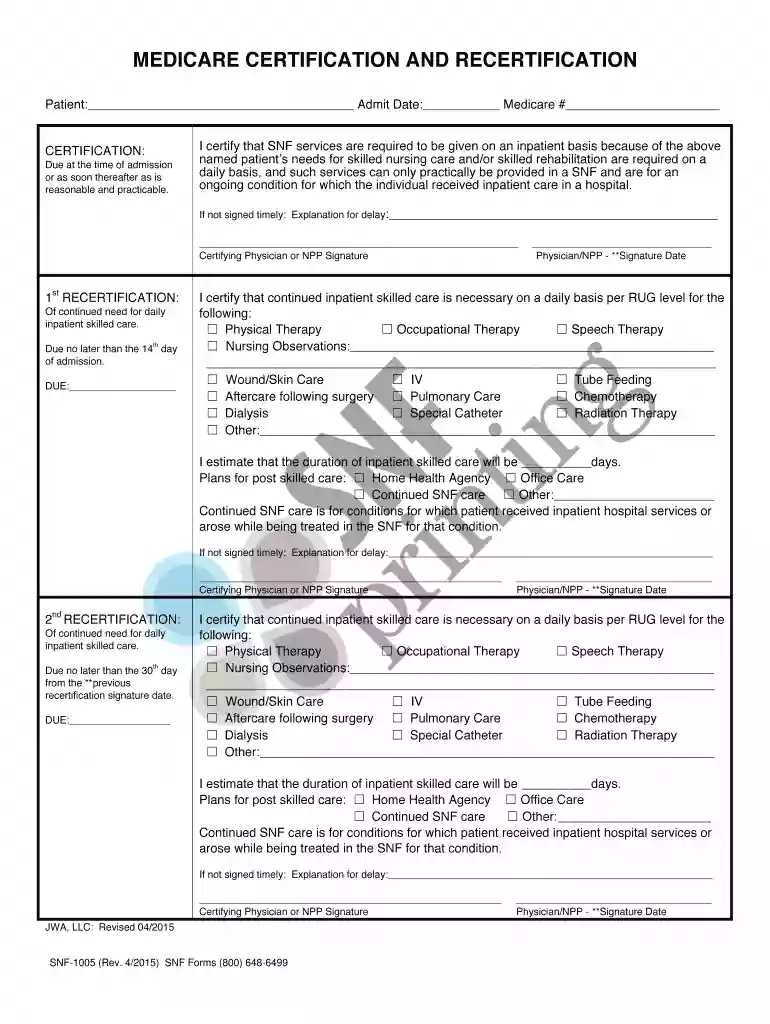
Fill Out the Medicare Certification Form (SNF 1005)
Review for Accuracy
Submit the Form
Follow Up on Submission Status
Completing this process diligently helps mitigate risks of delays in certification and ensures ongoing compliance with Medicare requirements.
Understanding the terminology associated with Medicare certification and recertification can enhance clarity and effective communication among healthcare providers. Here are key terms to be familiar with:
These terms form the foundation for understanding the Medicare certification process and the responsibilities of involved parties, from healthcare providers to patients.
The legal implications surrounding Medicare certification and recertification are crucial for healthcare providers. Compliance with the Medicare guidelines ensures that facilities can operate legally and receive reimbursement for services rendered. Key legal considerations include:
Adhering to these legal considerations is vital for sustaining the operational integrity of any healthcare facility participating in the Medicare program.
Real-world applications of Medicare certification and recertification highlight its importance in the healthcare ecosystem. Here are a few illustrative examples:
Skilled Nursing Facilities: A newly established SNF would undergo the certification process by submitting the SNF 1005 form. This form includes detailed information about the facility’s staff qualifications, care capabilities, and patient services provided. Upon successful review, the facility is recognized as Medicare compliant.
Hospice Care Providers: A hospice facility must routinely recertify to continue receiving Medicare funding. This process requires them to provide updated evidence of care delivery standards and patient satisfaction metrics to demonstrate consistent quality.
Home Health Agencies: Similar to SNFs, home health agencies undergo certification to provide in-home health services. Their recertification process is essential for verifying ongoing compliance with patient care requirements and operational standards.
These examples illustrate the role of certification and recertification in maintaining a high standard of care within Medicare-funded services.
We've got more versions of the medicare certification recertification form form. Select the right medicare certification recertification form version from the list and start editing it straight away!
| Versions | Form popularity | Fillable & printable |
|---|---|---|
| 2015 | 4.1 Satisfied (20 Votes) |
At DocHub, your data security is our priority. We follow HIPAA, SOC2, GDPR, and other standards, so you can work on your documents with confidence.


