01. Edit your form online
Type text, add images, blackout confidential details, add comments, highlights and more.

Type text, add images, blackout confidential details, add comments, highlights and more.

Draw your signature, type it, upload its image, or use your mobile device as a signature pad.

Send it via email, link, or fax. You can also download it, export it or print it out.
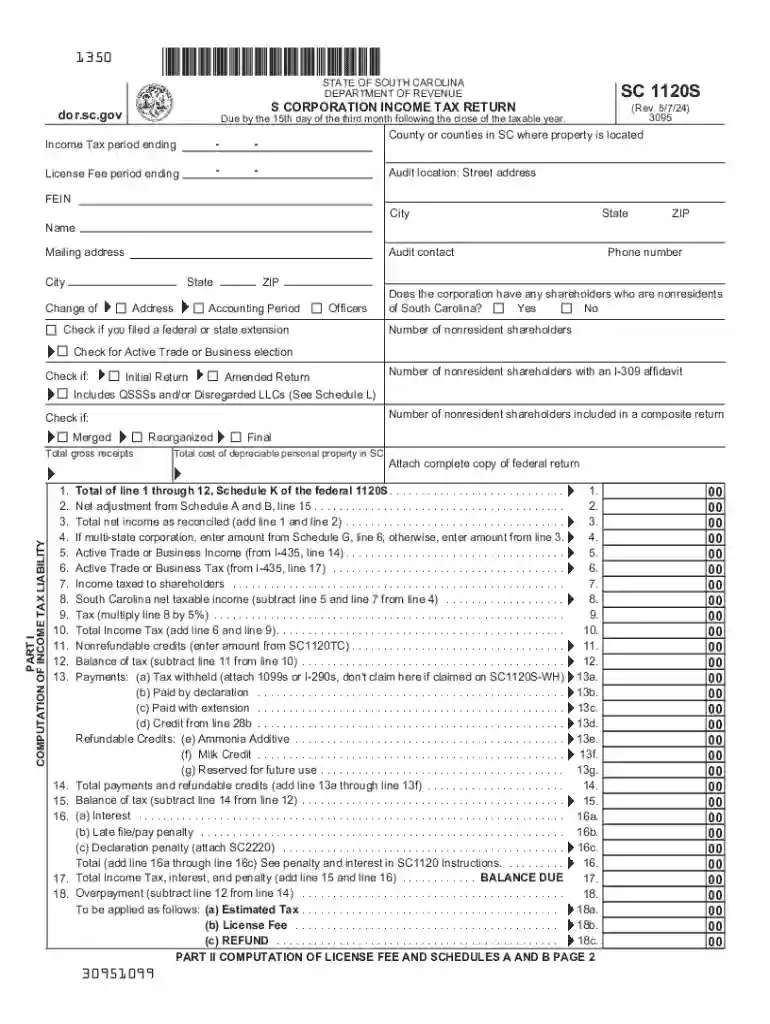
The SC1120S form is the South Carolina S Corporation Income Tax Return. It is specifically designed for S corporations operating within South Carolina to report their income, calculate taxable income, determine license fees, and provide necessary corporate information. This form assists in ensuring compliance with state tax regulations, enabling corporations to meet their fiscal responsibilities efficiently.
To use the SC1120S 3095 form effectively, begin by gathering all pertinent financial documentation related to the corporation's income and expenses. This form requires detailed entries for gross receipts, deductions, and other financial activities of the corporation. Ensure that all sections are completed accurately to avoid potential legal or financial complications. It is advisable to review the instructions provided with the form for any specific guidelines on filling each section.
The SC1120S must be filed by the 15th day of the third month following the close of the taxable year, aligning with federal deadlines to facilitate streamlined tax management for corporations in South Carolina. Corporations should be aware of these timelines to ensure timely submission and avoid late penalties.
This form is predominantly used by South Carolina-based S corporations. These entities elect to pass corporate income, losses, deductions, and credits through to their shareholders for federal tax purposes, allowing them to avoid double taxation. Companies engaging in various industries, such as manufacturing, services, or retail operating as S corporations, will find this form essential for compliance.


To be eligible to file the SC1120S, a corporation must have elected to be an S corporation at the federal level and meet South Carolina's requirements for transacting business within the state. The form is designed for companies that have no more than one hundred shareholders, all of whom must be eligible individuals or certain trusts and estates.

Consider a South Carolina-based tech startup classified as an S corporation. This entity would use the SC1120S form to report its annual taxable income, which might include revenue from software sales minus deductions for business expenses like research and development. Another example could be a regional restaurant chain structured as an S corporation, leveraging the form to calculate license fees based on its annual gross sales.
Failure to file the SC1120S on time may result in penalties ranging from late fees to interest charges on unpaid taxes. Additionally, inaccuracies or omissions can lead to audits or additional assessments. It is critical for corporations to adhere to all form guidelines and deadlines to avoid operational disruptions or legal challenges.
Corporations can submit the SC1120S form via multiple channels:
We've got more versions of the SC1120S 3095 form. Select the right SC1120S 3095 version from the list and start editing it straight away!
| Versions | Form popularity | Fillable & printable |
|---|---|---|
| 2025 | 4.8 Satisfied (24 Votes) | |
| 2024 | 4.9 Satisfied (36 Votes) | |
| 2023 | 4.3 Satisfied (59 Votes) | |
| 2022 | 4.6 Satisfied (22 Votes) | |
| 2021 | 4.8 Satisfied (57 Votes) | |
| 2020 | 4.3 Satisfied (83 Votes) | |
| 2019 | 4.4 Satisfied (73 Votes) | |
| 2018 | 4 Satisfied (40 Votes) | |
| 2017 | 4.3 Satisfied (144 Votes) | |
| 2016 | 4.3 Satisfied (96 Votes) | |
| 2015 | 4 Satisfied (32 Votes) | |
| 2014 | 4 Satisfied (57 Votes) | |
| 2010 | 4.2 Satisfied (67 Votes) | |
| 2008 | 4.6 Satisfied (59 Votes) | |
| 2007 | 4 Satisfied (43 Votes) |
At DocHub, your data security is our priority. We follow HIPAA, SOC2, GDPR, and other standards, so you can work on your documents with confidence.