




01. Edit your irs schedule i form 1041 online
Type text, add images, blackout confidential details, add comments, highlights and more.

Type text, add images, blackout confidential details, add comments, highlights and more.

Draw your signature, type it, upload its image, or use your mobile device as a signature pad.

Send schedule 1 2024 via email, link, or fax. You can also download it, export it or print it out.
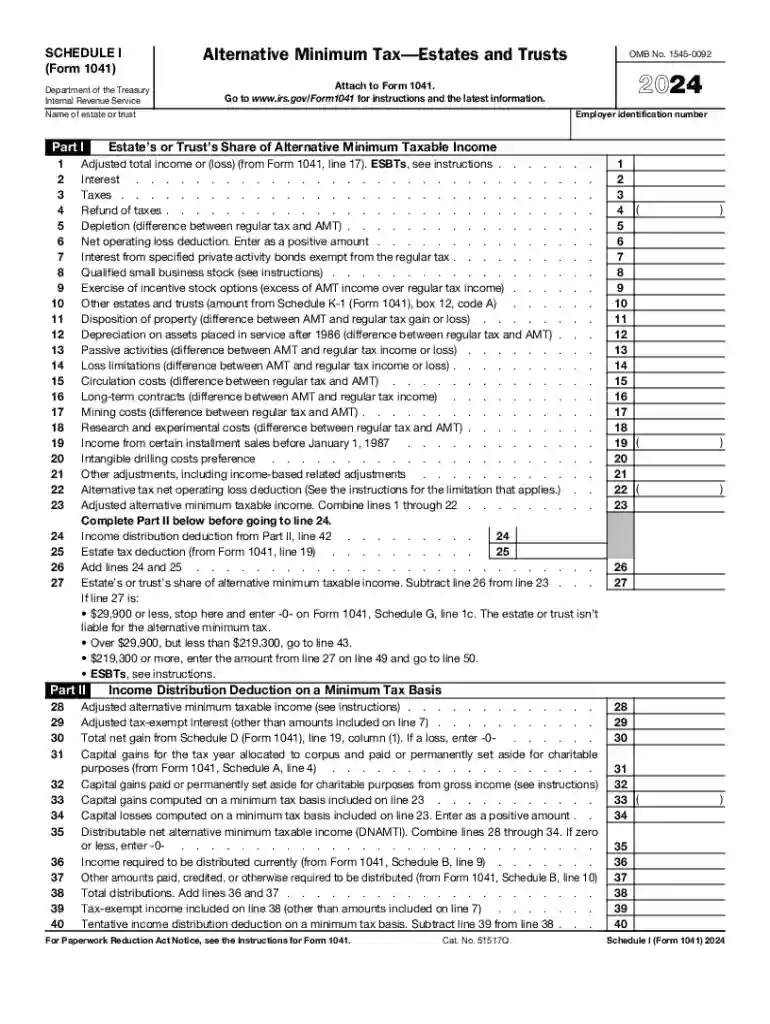
Schedule I (Form 1041) is used to report and calculate the Alternative Minimum Tax (AMT) for estates and trusts. This specialized tax calculation ensures that certain entities pay a minimum amount of tax, limiting the benefits of favorable tax treatment from particular deductions and credits. Estates and trusts use this form to report any adjustments that might push their tax obligations closer to the minimum thresholds defined by the AMT rules in the Internal Revenue Code.
The AMT is calculated separately from the regular tax and may require additional tax payment if the AMT liability exceeds what is calculated under regular tax rules. This separate calculation prevents taxpayers from using loopholes to significantly reduce tax liabilities, ensuring a fair contribution by high-income estates and trusts.
Initial Examination: Begin by gathering relevant financial records, including income statements, deductions, and credits applicable to the estate or trust.
Follow IRS Instructions: Utilize the IRS instructions specific to Schedule I to navigate through the form. This document will guide you through each section required for filing AMT.
Fill Out Adjustments: Complete Part I of the form, making necessary adjustments for items such as depreciation, tax-exempt interest, and passive activities, which must be recalculated for AMT.
Calculate AMT: In Part II, compute the alternative minimum taxable income (AMTI) by incorporating adjustments and preferences. From this amount, use the AMT tax rates to determine potential AMT due.
Finalize and Submit: Review all entries for accuracy. Attach Schedule I to Form 1041 before submission.
A trust may have notable adjustments due to depreciation on real estate. If the straight-line depreciation allows for significant deductions that would reduce taxable income substantially, these amounts may need to be recalculated at more restrictive AMT rates, impacting the trust's overall tax obligation.
The IRS provides comprehensive instructions for completing Schedule I, specifying each line item to be addressed. Users should stay updated on IRS publications as annual amendments may alter forms or instructions, affecting how AMT is to be calculated and reported each year.
The form is accessible through several channels, providing flexibility for obtaining necessary documentation.
The corresponding deadlines for filing Form 1041 and Schedule I align with estate and trust tax responsibilities:
Failure to accurately file Schedule I (Form 1041) or report incorrect AMT may result in penalties and interest on unpaid taxes. The IRS imposes stringent requirements to ensure all tax obligations are met.
Beyond financial penalties, significant errors may be subjected to further investigation, which may lead to legal repercussions reflecting on the fiduciary responsible for the estate or trust.
This form is vital for fiduciaries of estates and trusts that meet certain income thresholds. These entities often include:
Understanding the provisions and implications of Schedule I (Form 1041) ensures accurate reporting and fulfills the fiduciary duties connected to managing estates and trusts.
We've got more versions of the irs schedule i form 1041 form. Select the right irs schedule i form 1041 version from the list and start editing it straight away!
| Versions | Form popularity | Fillable & printable |
|---|---|---|
| 2025 | 4.2 Satisfied (59 Votes) | |
| 2024 | 4.8 Satisfied (46 Votes) | |
| 2023 | 4.5 Satisfied (39 Votes) | |
| 2022 | 4.6 Satisfied (24 Votes) | |
| 2021 | 4.8 Satisfied (63 Votes) | |
| 2020 | 4.4 Satisfied (182 Votes) | |
| 2019 | 4.2 Satisfied (142 Votes) | |
| 2018 | 4.2 Satisfied (74 Votes) | |
| 2017 | 4.4 Satisfied (129 Votes) | |
| 2016 | 4.4 Satisfied (183 Votes) | |
| 2015 | 4.4 Satisfied (114 Votes) | |
| 2014 | 4 Satisfied (28 Votes) |
At DocHub, your data security is our priority. We follow HIPAA, SOC2, GDPR, and other standards, so you can work on your documents with confidence.






I 1041 FVCC ART 249 Digital Imaging II 3 GDSN 249 Digital Imaging
Schedule 1 reports additional income and adjustments to income. Schedule 2 reports additional taxes, and Schedule 3 reports additional credits and payments.
Product Number Instruction 1041 (Schedule I) Title Instructions for Schedule I (Form 1041), Alternative Minimum Tax - Estates and Trusts, Revision Date 2024.


