




01. Edit your form online
Type text, add images, blackout confidential details, add comments, highlights and more.

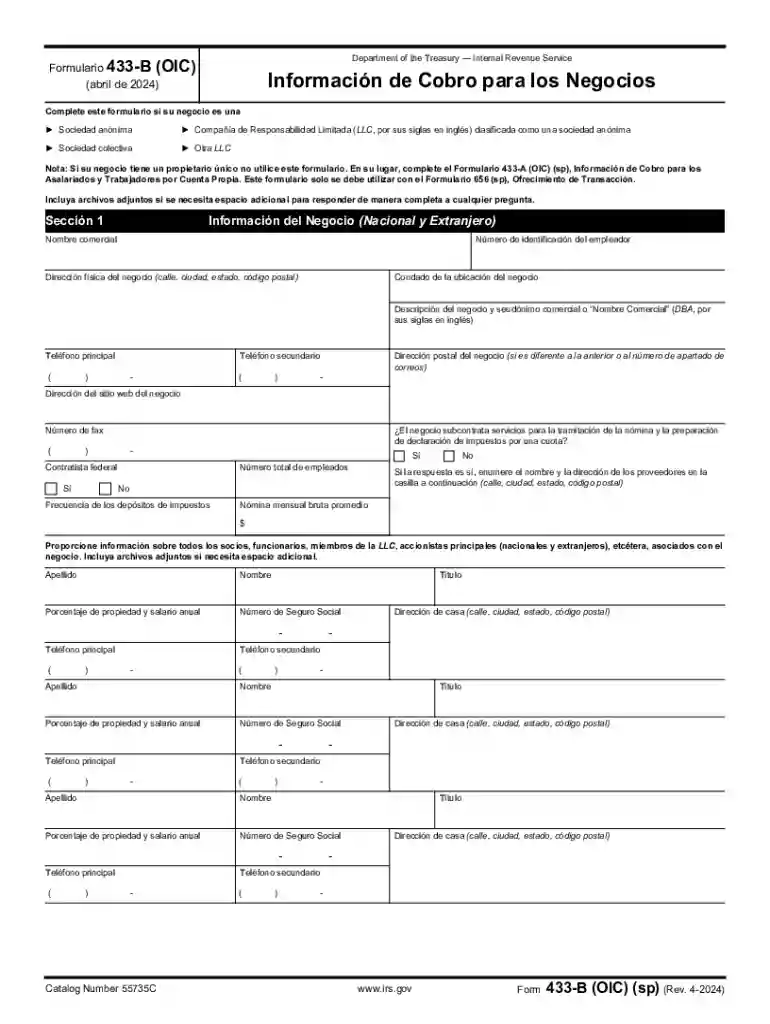
Type text, add images, blackout confidential details, add comments, highlights and more.

Draw your signature, type it, upload its image, or use your mobile device as a signature pad.

Send it via email, link, or fax. You can also download it, export it or print it out.
Form 433-B, titled "Collection Information Statement for Businesses," is a critical document used by the Internal Revenue Service (IRS) to obtain a comprehensive financial overview of a business seeking to resolve tax debts. This form is primarily intended for C corporations, S corporations, partnerships, and limited liability companies (LLCs). The IRS uses the information provided on Form 433-B to assess a business's financial standing and to determine eligibility for various tax resolution options, such as installment agreements or offers in compromise.
Businesses seeking tax relief must accurately complete and submit Form 433-B to the IRS. This process involves:
Proper use of Form 433-B is essential for obtaining an accurate assessment from the IRS and setting the stage for a potential tax resolution agreement.
Completing Form 433-B requires several detailed steps. The following guide outlines the process:
Accurate completion of each section is vital for the IRS's assessment of the business's financial capability to pay its tax liabilities.
The primary users of Form 433-B are businesses structured as:
Sole proprietors typically use Form 433-A, designed for individuals and self-employed taxpayers.
Form 433-B contains several integral elements that businesses need to complete:
Each section plays a crucial role in portraying an accurate financial picture to the IRS.
To complete and submit Form 433-B, businesses must gather and present several supporting documents, including:
These documents substantiate the information provided on the form and assist the IRS in making an informed decision.
The IRS provides explicit guidelines on completing Form 433-B and the ramifications for non-compliance:
Understanding and adhering to these guidelines significantly impacts the form’s approval process.
Form 433-B is tailored for specific business entities facing tax liabilities. Eligibility and applications may vary based on the business structure:
Entities need to meet specific criteria related to their business operations and debt situation to qualify for relief through this form.
A variety of scenarios showcase the applicability and necessity of Form 433-B for different businesses:
These examples emphasize the form's utility as a tool for businesses to engage constructively with the IRS.
We've got more versions of the Form 433-B, Collection Information Statement for Businesses form. Select the right Form 433-B, Collection Information Statement for Businesses version from the list and start editing it straight away!
At DocHub, your data security is our priority. We follow HIPAA, SOC2, GDPR, and other standards, so you can work on your documents with confidence.



Collection Information Statement for Businesses. Complete all blocks, except shaded areas. Information about owner, partners, officers, major shareholder, etc.
Product Number Form 433-B Title Collection Information Statement for Businesses, Revision Date Jun 2026 ; Product Number Form 433-A Title CollectionRead more
Browse press releases, fact sheets, contact info, logos, b-roll and multimedia assets, answers to common questions and additional corporate information.Read more


