
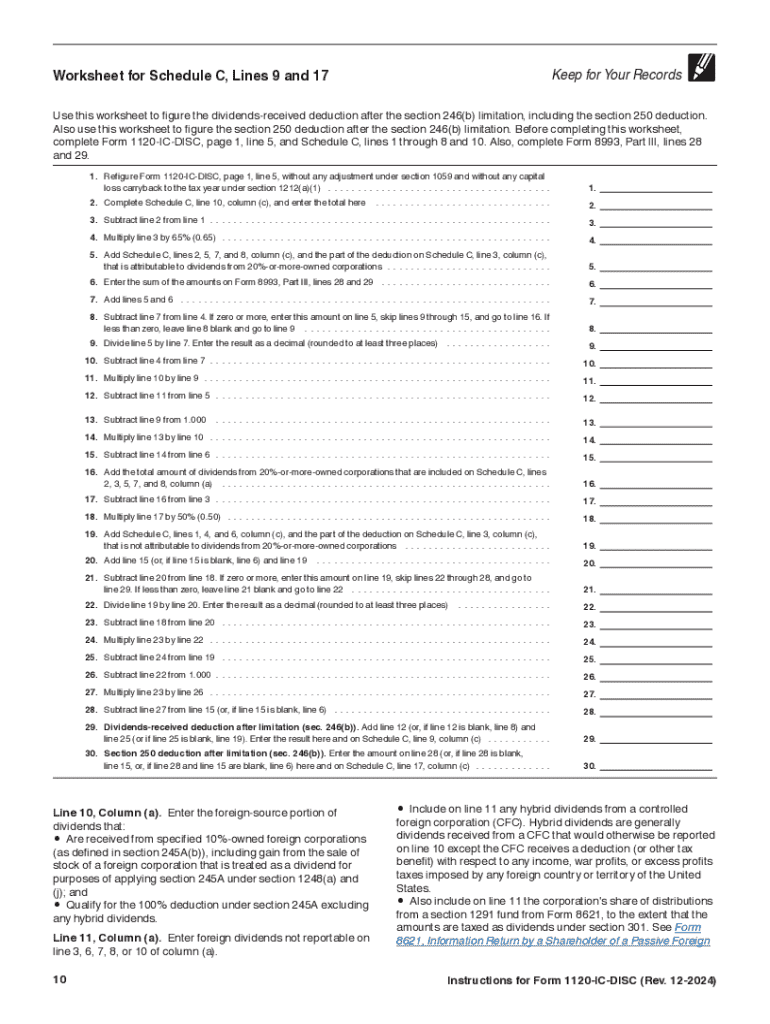







Definition and Purpose of the 1120-IC-DISC Form
The 1120-IC-DISC form is used by Interest Charge Domestic International Sales Corporations (IC-DISCs) to report their income, deductions, and shareholder distributions. This form allows these corporations to benefit from a federal tax incentive, designed to boost U.S. exports by deferring a portion of export income. The form essentially helps these entities utilize tax deferral opportunities while keeping track of revenue generated from international sales.
Steps to Complete the Form
-
Gather Necessary Documents: Before filling out the form, collect all relevant financial statements, prior year tax returns, and records of income from international sales.
-
Fill Out Part I – IC-DISC Qualifications: Determine if your corporation qualifies as an IC-DISC by meeting the various criteria listed, including gross export receipts, shareholder documentation, and conducting majority of transactions in a foreign marketplace.
-
Complete Part II – Income and Deductions: Provide details on total receipts, export gross receipts, and any deductions. This includes all income directly related to the exported goods and associated services.
-
Report Shareholder Distributions in Part III: Specify dividends paid to shareholders, which are pivotal in understanding the net benefit from the deferral. Include documentation of any U.S. citizens or residents who are recipients.
-
Review and Submit: Double-check all entries for accuracy and consistency with supporting documentation. File the form with the IRS by its due deadline, either electronically or via mail.
IRS Guidelines for Filing
-
Eligibility Criteria: To qualify as an IC-DISC, a corporation must be incorporated in the U.S., have only one class of stock, and maintain a minimum of $2,500 in shareholder equity.
-
Documentation: Maintain detailed records and supporting documents, including contracts and invoices, to substantiate all export transactions reported.
-
Timely Filing: Submit the form by the 15th day of the ninth month after the end of the tax year. Extensions may be available, but late submissions without an extension can result in penalties.
Penalties for Non-Compliance
Failure to accurately file the 1120-IC-DISC form or meet eligibility requirements can lead to hefty penalties. The IRS may impose fines on the undistributed export income and potentially disqualify the corporation from future IC-DISC tax benefits. It is critical to ensure compliance and take remedial steps in case of discrepancies.
Legal and Tax Implications
The form not only aids in tax deferral but also plays a role in legal business structuring. By correctly using the 1120-IC-DISC, businesses can lawfully reduce taxable income and enhance reinvestment opportunities in foreign markets. Incorrect filing or misuse can lead to legal exposure and require formal audits by the IRS.
Key Elements of the Form
-
Income Statement: Covers general income received through export activity.
-
Dividend Distribution: Captures how export profits are shared among shareholders.
-
Schedule S: Used to report shareholder's pro-rata share of certain foreign corporation's income, deductions, and credits.
Software Compatibility
To simplify completion and filing, various software solutions such as TurboTax and QuickBooks support the 1120-IC-DISC form, providing structured guidance and error checking capabilities. Opt for software that is up-to-date with IRS regulations to leverage the automated submission process.
Business Types That Benefit the Most
Primarily, manufacturing and agricultural businesses that extensively trade internationally gain significant advantages. By deferring tax liability on qualifying export revenue, these entities can capitalize on accelerated growth and reinvestment in global markets.
Choice and proper execution of the 1120-IC-DISC form is strategic, offering multiple benefits if approached with rigorous attention to IRS guidelines and procedural details.




