




01. Edit your schedule j online
Type text, add images, blackout confidential details, add comments, highlights and more.

Type text, add images, blackout confidential details, add comments, highlights and more.

Draw your signature, type it, upload its image, or use your mobile device as a signature pad.

Send schedule j form via email, link, or fax. You can also download it, export it or print it out.
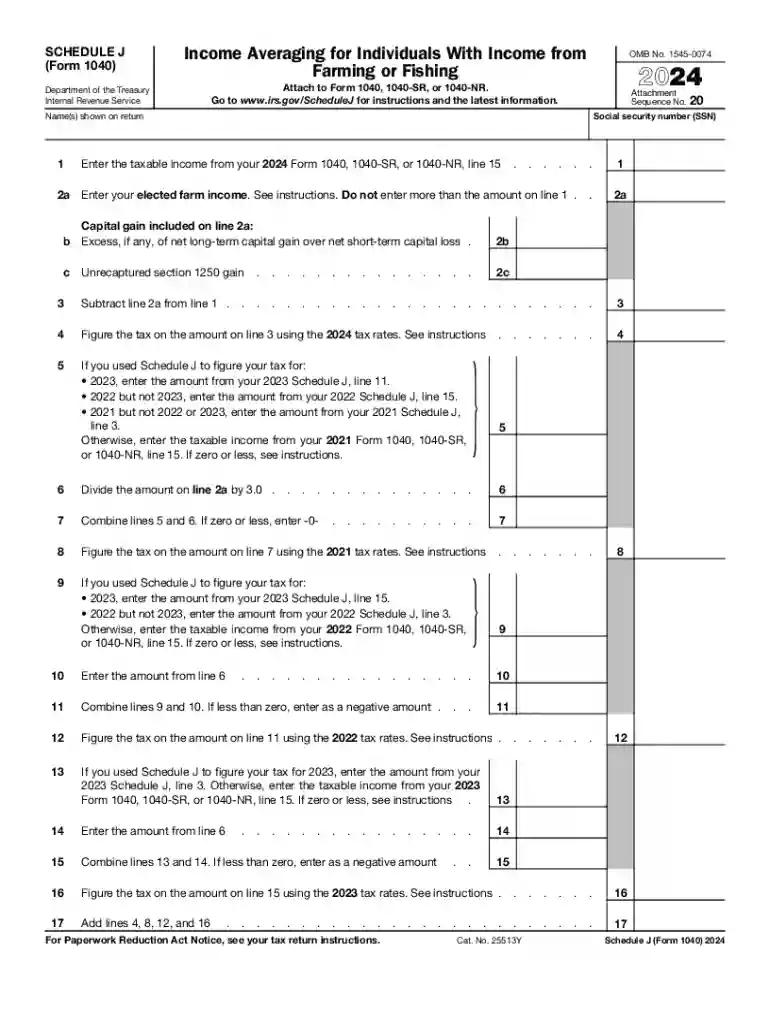
Form 1040 (Schedule J) is primarily used by individuals in the farming and fishing industries to report and average income over a period of years to stabilize tax liabilities. This section provides a comprehensive understanding of its purpose, utility, and general instructions.
Using Form 1040 (Schedule J) involves a series of specific steps to ensure correct income averaging. These steps include calculating the taxable income and the elected farm income for the designated years. Detailed instructions guide taxpayers through the process, outlining how to employ the form effectively within a tax year.
Calculation of Taxable Income: Begin by listing the total taxable income for the year. This serves as the foundation for any subsequent averaging.
Determination of Elected Farm Income: Identify portions of the income that are directly from farming activities. This portion is crucial in calculating the average tax rate.
Utilizing Prior Year Data: Fetch tax records from the previous three years. These records are needed to determine income trends and potential averaging benefits.
Completing the Form: Follow the IRS-provided guidelines to fill out the particulars of Form 1040 (Schedule J), ensuring all required fields are completed without errors.
Verifying Calculations: Double-check all the arithmetic and entry data for accuracy before submission. Mistakes can lead to penalties and delays.
The IRS provides specific guidelines for completing and submitting Form 1040 (Schedule J). These guidelines are crucial to understanding both the timing and method of submission, ensuring compliance with all necessary regulations. Following these guidelines can prevent common mistakes and facilitate a smoother filing process.
The form is primarily used by individuals involved in farming and fishing. These sectors benefit from income averaging, which helps mitigate sharp fluctuations in income, thereby stabilizing tax liabilities year over year. Understanding who should use this form aids in recognizing its importance within these industries.
Consider a farmer whose income varies greatly due to seasonal variations and market prices. By using Form 1040 (Schedule J), this farmer can reduce tax spikes in high-income years by averaging over previous years, leading to potentially significant tax savings.
Adhering to the IRS's prescribed deadlines for Form 1040 (Schedule J) is crucial. Typically, the form should accompany your main tax return for the year and must be filed by April 15, unless an extension is granted. Staying aware of deadlines ensures compliance and avoids penalties.
To accurately complete Form 1040 (Schedule J), gather:
Many taxpayers use software like TurboTax or QuickBooks for filing ease. These software solutions streamline the process by providing guided steps for completing Form 1040 (Schedule J). Ensure compatibility and integration for a seamless digital filing experience, which may also allow for direct electronic submissions to the IRS.
Failing to properly file Form 1040 (Schedule J) when required can lead to penalties. These may include interest on unpaid taxes, additional fines, or other IRS sanctions. Accurate and timely submission mitigates these risks, emphasizing the importance of adhering to filing guidelines and deadlines.
We've got more versions of the schedule j form. Select the right schedule j version from the list and start editing it straight away!
| Versions | Form popularity | Fillable & printable |
|---|---|---|
| 2025 | 4.2 Satisfied (28 Votes) | |
| 2024 | 4.9 Satisfied (27 Votes) | |
| 2023 | 4.2 Satisfied (48 Votes) | |
| 2022 | 4.4 Satisfied (22 Votes) | |
| 2021 | 4.8 Satisfied (22 Votes) | |
| 2020 | 4.3 Satisfied (98 Votes) | |
| 2019 | 4.4 Satisfied (740 Votes) | |
| 2018 | 4.3 Satisfied (196 Votes) | |
| 2017 | 4.4 Satisfied (168 Votes) | |
| 2016 | 4.4 Satisfied (436 Votes) |
At DocHub, your data security is our priority. We follow HIPAA, SOC2, GDPR, and other standards, so you can work on your documents with confidence.






Sep 28, 2023 Use Schedule J (Form 1040) to elect to figure your 2023 income tax by averaging, over the previous 3 years (base years), all or part of yourRead more
Farmers and fishers experience DocHub variations in income from year to year, which causes their taxable income (and taxes owed) to fluctuate.


