




01. Edit your maryland 510d online
Type text, add images, blackout confidential details, add comments, highlights and more.

Type text, add images, blackout confidential details, add comments, highlights and more.

Draw your signature, type it, upload its image, or use your mobile device as a signature pad.

Send 510d tax via email, link, or fax. You can also download it, export it or print it out.
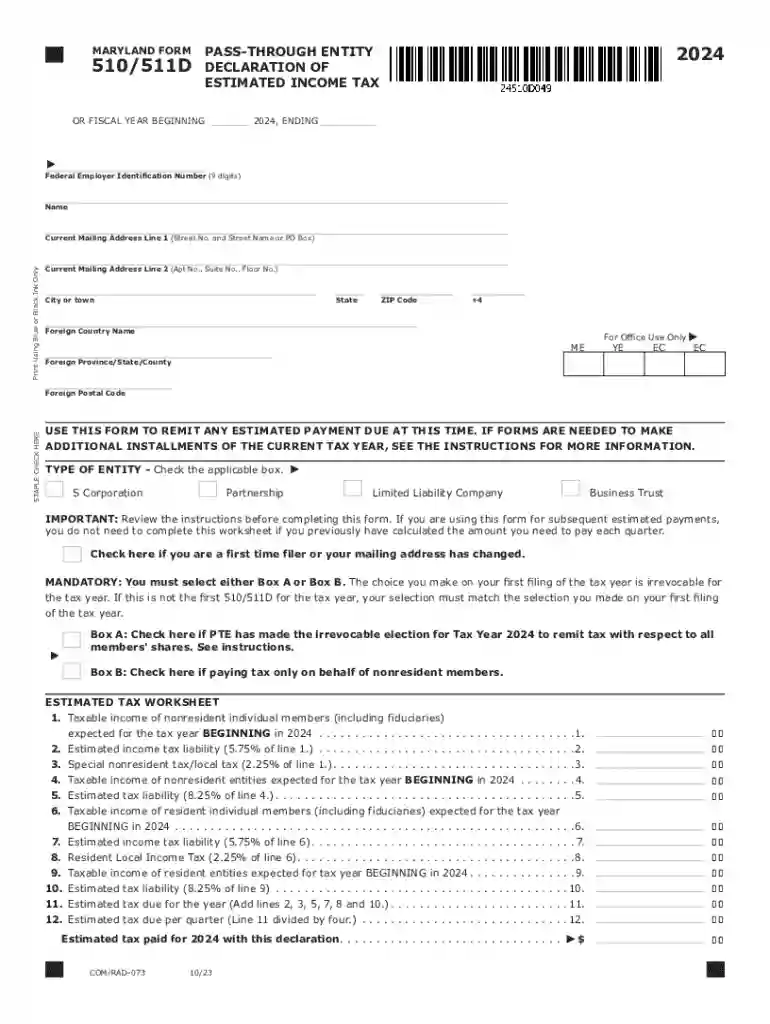
The Maryland Form 510/511D, commonly referred to as Form 510D, is a crucial document for pass-through entities (PTEs) such as partnerships, S-corporations, and limited liability companies in Maryland. This form is a declaration used to report and remit estimated income tax liabilities for the calendar year 2024. It allows PTEs to elect whether to pay taxes on behalf of all members or only on behalf of nonresident members. Understanding this form is essential for the accurate reporting of income and tax obligations, ensuring compliance with state tax regulations.
Completing the Maryland Form 510D involves several steps. Below is a structured approach:
To fill out the Maryland Form 510D efficiently, follow these detailed steps:
Understanding the core components of Form 510D can enhance its accurate completion:
Familiarity with specific terms can aid in successfully navigating Form 510D:
Maryland state tax rules influence how Form 510D is used:
Failing to file or pay estimated taxes using Form 510D can result in penalties:
We've got more versions of the maryland 510d form. Select the right maryland 510d version from the list and start editing it straight away!
At DocHub, your data security is our priority. We follow HIPAA, SOC2, GDPR, and other standards, so you can work on your documents with confidence.






510/511D (PDF) Declaration of Estimated Pass-Through Entity Tax Form used by a pass-through entity to declare and remit estimated tax for tax year 2025.
Complete lines 1 4, following the instructions on page 2 of the form. Line 3: enter the non-filers street address and zip or postal code. Use the addressRead more


