




01. Edit your form online
Type text, add images, blackout confidential details, add comments, highlights and more.

Type text, add images, blackout confidential details, add comments, highlights and more.

Draw your signature, type it, upload its image, or use your mobile device as a signature pad.

Send it via email, link, or fax. You can also download it, export it or print it out.
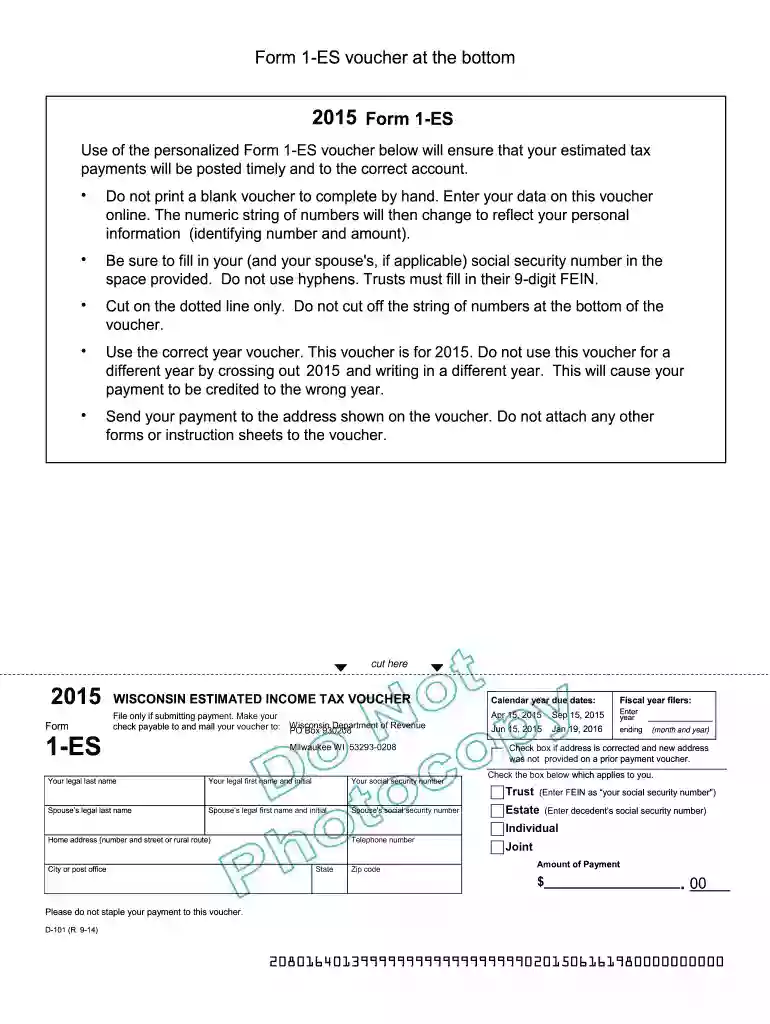
The 2015 Wisconsin Form 1-ES is a tax document used by individuals to report and pay estimated tax payments in Wisconsin for the tax year 2015. Its primary function is to help taxpayers make timely quarterly payments to the Wisconsin Department of Revenue to avoid penalties associated with underpayment of taxes. This form is particularly relevant for individuals who do not have taxes withheld from their income, such as the self-employed, retirees with taxable incomes, or investors with high capital gains.
Using the 2015 Wisconsin Form 1-ES involves calculating your estimated tax liability for the year and dividing it into four payments. Each payment is made on a quarterly basis, requiring the taxpayer to estimate their annual income and expected tax deductions.
Obtaining the 2015 Wisconsin Form 1-ES is simple and can be done in multiple ways. It is available both online and through direct request from the Wisconsin Department of Revenue.
Pay special attention to the payment schedule for estimated tax payments in 2015. The deadlines are crucial for avoiding penalties:
Understanding the components of the 2015 Form 1-ES ensures accurate completion.
Using the form correctly ensures compliance with Wisconsin tax laws. The form is governed by specific statutory requirements that dictate its use and the manner in which taxpayers must report their estimated taxes.
To better grasp its application, consider these scenarios where taxpayers would use the 2015 Wisconsin Form 1-ES:
Failure to comply with estimated payment requirements can lead to significant penalties:
By thoroughly understanding and following these comprehensive guidelines, taxpayers can effectively manage their estimated tax obligations using the 2015 Wisconsin Form 1-ES.
We've got more versions of the 2015 Wisconsin Form 1-ES form. Select the right 2015 Wisconsin Form 1-ES version from the list and start editing it straight away!
At DocHub, your data security is our priority. We follow HIPAA, SOC2, GDPR, and other standards, so you can work on your documents with confidence.





Use Form 1-ES to make an extension payment even if you will be filing your return electronically do not use Form EPV.
Quick BioPIC User Guide Updated October 2021 This Quick Guide is intended for at a POC) rather than the temporal components.
Fill-in forms option: Income Tax Forms. Tax Forms and Instructions. Property Tax Exemptions. Electronic Filing or Electronic Payment


