




01. Edit your equipment consignment agreement online
Type text, add images, blackout confidential details, add comments, highlights and more.

Type text, add images, blackout confidential details, add comments, highlights and more.

Draw your signature, type it, upload its image, or use your mobile device as a signature pad.

Send equipment consignment agreement via email, link, or fax. You can also download it, export it or print it out.
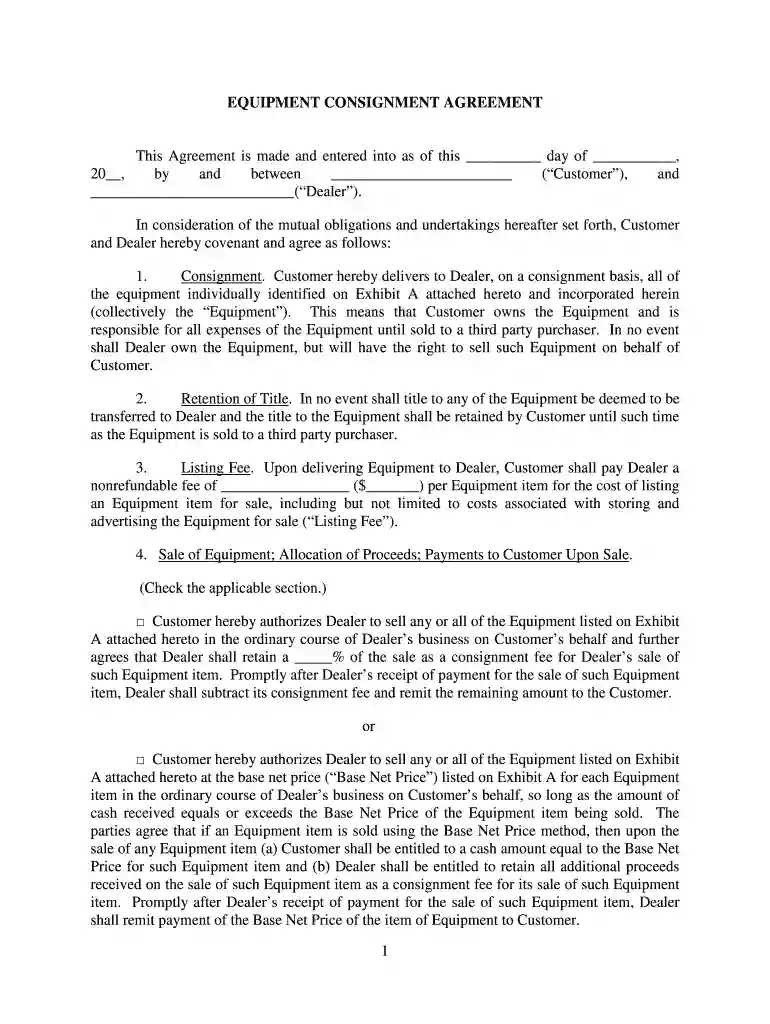
An equipment consignment agreement is a legal contract between a customer and a dealer that outlines the terms under which equipment is consigned for sale. The customer, who owns the equipment, retains ownership until the equipment is sold. The dealer, in turn, is authorized to sell the equipment on behalf of the customer. This contract highlights the responsibilities of both parties, ensuring that expectations are clear and legally bounded. Key components include the allocation of sale proceeds, responsibilities surrounding delivery, risk of loss, and maintenance obligations, reinforcing the necessity of precise documentation in consignment transactions.
Understanding the key elements of an equipment consignment agreement is crucial for ensuring legal and practical clarity. Critical components include:
Ownership and Risk of Loss: The customer retains ownership until the sale, but the contract should specify who bears the risk of loss and whether insurance is required.
Sale Proceeds Allocation: Clarity on how the sale proceeds will be divided between the customer and dealer, including any fees or commissions to be deducted.
Listing Fees: Any costs associated with listing the equipment for sale should be outlined to prevent misunderstanding.
Termination Clauses: Conditions under which either party can terminate the agreement should be clearly detailed.
Governing Law: The agreement should specify which state laws govern the contract, especially important for interstate transactions.
Utilizing an equipment consignment agreement involves several precise steps to ensure it serves its intended purpose. To effectively utilize the agreement:
Review All Terms: Before signing, both parties should meticulously review all terms, ensuring mutual understanding of responsibilities and expectations.
Amendment of Terms: Should any section require modification, negotiations should occur before formal agreement to avoid legal disputes.
Signatures and Execution: Once all terms are agreed upon, both parties should sign the agreement, ideally in the presence of a legal professional to validate authenticity.
Documentation and Filing: Maintain organized records, including the agreement and any related communications, to facilitate audits or disputes.
In the United States, equipment consignment agreements must adhere to specific legal standards to ensure their enforceability. These agreements should comply with the Uniform Commercial Code (UCC), which governs commercial transactions, including consignment sales. This includes ensuring all necessary parties are accurately identified, maintaining clear title to the equipment, and ensuring the agreement is not unconscionable. It’s advisable to consult with a legal professional to ensure the contract meets all state-specific legal requirements and to mitigate risks of potential legal challenges.
Completing the equipment consignment agreement involves several detailed steps:
Identify Parties: Clearly state the names and contact information of the customer and dealer.
Describe Equipment: Provide a detailed description of the equipment, including model numbers, condition, and any identifying marks.
Establish Sale Terms: Outline the price or method for determining the sale price, including any consignor fees.
Define Duties and Responsibilities: Specify delivery obligations, responsibilities for maintenance, and handling during the consignment period.
Sign and Date: Both parties should sign and date the agreement, witnessed if required, to officially complete the contract.
Several terms are vital for anyone working with equipment consignment agreements:
Consignor and Consignee: The consignee is the dealer, authorized to sell the equipment, while the consignor is the equipment owner maintaining ownership until sale.
Commission: The fee or percentage of the sale proceeds paid to the dealer, which should be explicitly stated in the agreement.
Inventory Report: Regular reports the dealer should provide detailing the status of the equipment and sales progress.
Termination Notice: The process and time required to terminate the agreement, which should protect both parties from abrupt cancellations.
Equipment consignment agreements are commonly used by businesses involved in the sale of industrial, agricultural, or large-scale electronic equipment. This includes:
Utilizing such agreements allows these entities to expand their business operations without incurring significant upfront costs associated with purchasing inventory outright.


Real-world scenarios illustrate the application of equipment consignment agreements:
Dealer Networks: A national manufacturer ships construction equipment to regional dealers under a consignment agreement to increase local sales.
Tech Start-Up: A small tech company consigns demo equipment to educational institutions, retaining ownership to recover assets if not sold within a school year.
Artisan Equipment: A craftsman consigns specialized tools to a niche supplier, reaching audiences without managing direct sales logistics.
These examples highlight the flexibility of consignment agreements in varied industries while mitigating risks via clearly defined terms.
Typically, the equipment consignment agreement is drafted by the consignor, often in consultation with legal advisors to ensure compliance with applicable laws. The form establishes the framework within which the dealer operates, providing terms that protect both the consignor's interests and the consignee's obligations. In some cases, templates are available through legal professionals or business advisory services, which can be customized to suit specific needs and circumstances.
We've got more versions of the equipment consignment agreement form. Select the right equipment consignment agreement version from the list and start editing it straight away!
| Versions | Form popularity | Fillable & printable |
|---|---|---|
| 2006 | 4.9 Satisfied (33 Votes) |
At DocHub, your data security is our priority. We follow HIPAA, SOC2, GDPR, and other standards, so you can work on your documents with confidence.


