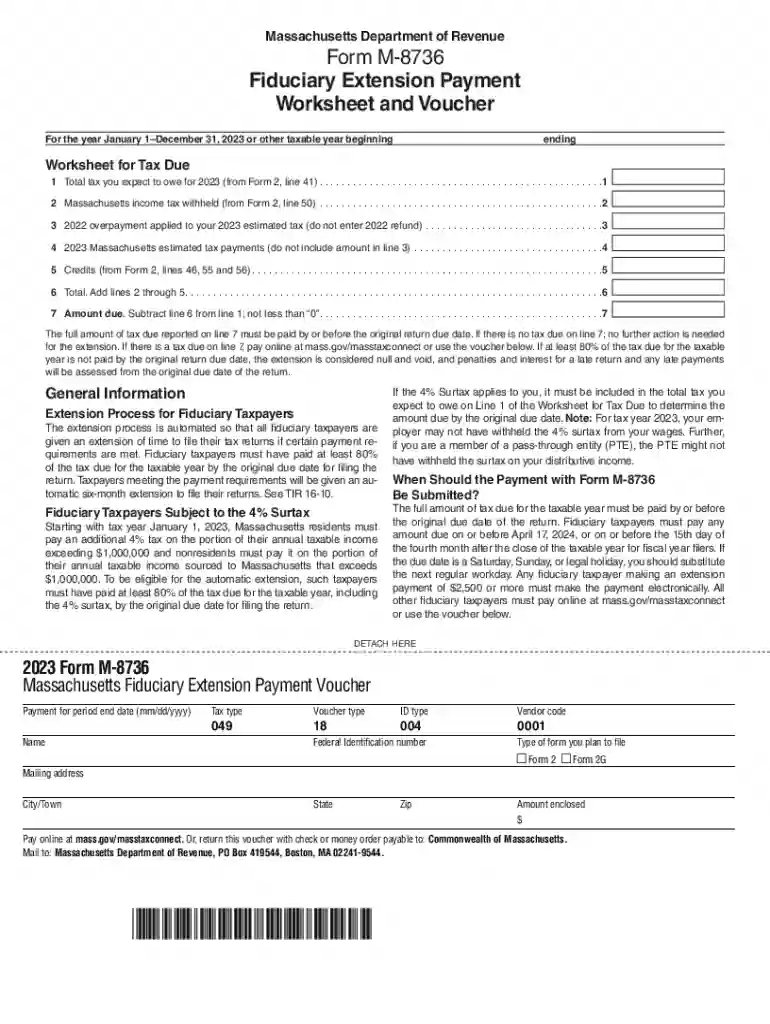
Form M-8736 Fiduciary Extension Payment Worksheet and Voucher-2026

Get Form
Form M-8736 Fiduciary Extension Payment Worksheet and Voucher Preview on Page 1

Here's how it works

01. Edit your form online
Type text, add images, blackout confidential details, add comments, highlights and more.

02. Sign it in a few clicks
Draw your signature, type it, upload its image, or use your mobile device as a signature pad.

03. Share your form with others
Send it via email, link, or fax. You can also download it, export it or print it out.

Definition and Purpose of Form M-8736 Fiduciary Extension Payment Worksheet and Voucher

Form M-8736 is a document issued by the Massachusetts Department of Revenue. It facilitates fiduciary entities, such as trusts and estates, in calculating and submitting an extension payment for their tax obligations. This form enables fiduciaries to automatically secure a six-month extension on their tax returns, contingent on paying at least 80% of the owed tax by the original due date. The document assists in assessing total tax liability, accounting for prior payments made, and identifying potential late payment penalties.

Steps to Complete the Form M-8736 Fiduciary Extension Payment Worksheet and Voucher

  1. Calculate Total Tax Owed: Start by determining the total tax liability for the fiscal year. Include all income, deductions, and credits applicable to the fiduciary entity.
  2. Determine Payments Made: Record any estimated taxes and withholdings already paid during the year. This step is crucial to ensure accurate calculation of the remaining balance.
  3. Estimate Extension Payment: Subtract the payments already made from the total tax owed. Pay a minimum of 80% of this amount to qualify for the extension.
  4. Complete the Payment Voucher: Fill out the payment voucher section with the calculated payment, ensuring that all details are accurate and complete.
  5. Submission: Submit the completed form and payment voucher to the Massachusetts Department of Revenue by the original tax due date.

Key Elements of the Form M-8736

  • Fiduciary Information: Includes the name, address, and tax identification number of the fiduciary entity.
  • Tax Calculation Details: Sections for filling in details of total income, deductions, credits, and other pertinent information for accurate tax calculation.
  • Payment Calculation Worksheet: Detailed section to calculate the necessary payment to accompany the extension request.
  • Voucher for Sending Payment: Includes instructions and space for entering payment details when sending in the check or money order to the tax authorities.

How to Obtain the Form M-8736 Fiduciary Extension Payment Worksheet and Voucher

The Massachusetts Department of Revenue website offers Form M-8736 as a downloadable PDF. Fiduciaries can also access the form through tax preparation software packages, such as TurboTax and QuickBooks, which may provide digital versions of the form for electronic completion and submission.

Important Terms Related to Form M-8736

  • Fiduciary: A legal entity, such as a trust or estate, responsible for managing assets on behalf of beneficiaries.
  • Extension Payment: The advance payment made to secure a tax filing extension.
  • 6-Month Automatic Extension: The privilege to delay submitting a complete tax return by six months while preventing late filing penalties, given the extension payment conditions are met.
  • Surtax: An additional tax rate imposed on high-income earners, applicable to certain fiduciary entities.

Filing Deadlines / Important Dates

The extension form and payment must be submitted by the original tax due date, typically April 15, unless otherwise specified by the Massachusetts Department of Revenue. Missing this deadline could result in penalties and interest charges for late payment or filing.

Penalties for Non-Compliance

Failure to submit Form M-8736 with the required payment by the deadline can lead to penalties, including accrual of interest on unpaid taxes, fines for late filing, and possible legal actions. Ensuring compliance is vital for fiduciary entities to avoid unnecessary financial burdens.

User Scenarios for Form M-8736

  • Trusts: Entities that hold and manage assets on behalf of beneficiaries might use the form to manage their tax affairs during complex planning scenarios.
  • Estates: Executors managing estate settlements may file the form to extend filing deadlines while ensuring due taxes are accounted for and settled.
  • High-Income Earners: Fiduciaries overseeing estates or trusts with substantial incomes need to account for potential surtaxes and make provisional payments accordingly.

Legal Use of Form M-8736

Authorized for use by fiduciary entities within Massachusetts, the form is a legitimate tool for managing tax payment extensions. It ensures compliance with state tax laws and regulations, allowing fiduciaries to extend their filing deadlines responsibly and efficiently.

be ready to get more

Complete this form in 5 minutes or less

Get form

Got questions?

We have answers to the most popular questions from our customers. If you can't find an answer to your question, please contact us.
Contact us
The Massachusetts Form M-4868 is an application for an automatic six-month extension to file your income tax return. It is essential for taxpayers who need additional time to complete their tax obligations. This form helps ensure compliance with Massachusetts income tax regulations.
The personal representative of the estate must file the estate tax return. If there is no personal representative, the person who has the decedents property must file the return. The term personal representative includes: Executor.
Massachusetts Tax Extension Form: If you arent subject to the electronic filing requirement, you can request a Massachusetts extension by submitting Form M-4868 on or before the original due date of your return. Remember to include payment for your Massachusetts tax with Form M-4868, if applicable.
The fiduciary (or one of the joint fiduciaries) must file Form 1041 for a domestic estate that has: Gross income for the tax year of $600 or more, or. A beneficiary who is a nonresident alien.
An ongoing fiduciary duty is not imposed on a broker-dealer or agent beyond the time that a recommendation is made, unless the broker-dealer or agent has: (1) discretion in a customers account (unless the discretion relates solely to the time and/or price for the execution of the order); (2) a contractual fiduciary

Security and compliance

At DocHub, your data security is our priority. We follow HIPAA, SOC2, GDPR, and other standards, so you can work on your documents with confidence.

Learn more
ccpa2
pci-dss
gdpr-compliance
hipaa
soc-compliance
be ready to get more

Complete this form in 5 minutes or less

Get form

People also ask

Every executor, administrator, trustee, guardian, conservator, trustee in a noncorporate bankruptcy or receiver of a trust or estate that received income in excess of $100 that is taxable under MGL ch 62 at the entity level or to a beneficiary(ies) and that is subject to Massachusetts jurisdiction must file a Form 2.
Form 8736, application for automatic extension of time to file U.S. return for a partnership, REMIC, or for certain trusts. Author: United States. Internal Revenue Service.
Everyone whose Massachusetts gross income is $8,000 or more must file a Massachusetts personal income tax return on or by April 15th following the end of every tax year. If the due date falls on a Saturday, Sunday, or legal holiday, the due date is the next business day.

Related links