What are the disadvantages of a shared well?
However, community wells have notable drawbacks. Shared ownership means less control over water usage, maintenance schedules, or system upgrades. Disputes among neighbors over usage limits, payment responsibilities, or maintenance priorities can arise, especially if some households use more water than others.Jul 28, 2025
What are the pros and cons of shared well water?
Shared wells offer cost savings, land efficiency, and access to reliable aquifers, but challenges like inconsistent pressure, maintenance disputes, and water quality risks require careful management.Jun 23, 2025
What salary do you need for a $400,000 mortgage?
To afford a $400k mortgage, you generally need an annual income between $90,000 and $135,000, but this varies DocHubly; lenders look for your total monthly housing costs (PITI) plus other debts to be under 36-43% of your gross monthly income, so higher interest rates, more debt, or smaller down payments increase the required income, while a great credit score helps lower it. Key Factors Influencing Income Needed Debt-to-Income (DTI) Ratio: Lenders use this (monthly debt/gross monthly income), typically aiming for under 36% for housing and 43% total debt. Interest Rates: Higher rates mean higher monthly payments, requiring more income. Down Payment: A larger down payment reduces the loan amount, lowering payments and income requirements. Credit Score: A higher score can secure better interest rates, reducing costs. Property Taxes Insurance: These vary by location and add to your monthly housing cost. Example Scenarios With Average Rates 20% Down: You might need around $100,000 - $102,000 (approx. $8,465/month) if you have some other debt, assuming a 6.5% rate. With Lower Debt: If youre debt-free, you might qualify with lower income, possibly closer to $85,000 - $95,000, by using a lower DTI, say 36% of gross income for housing. Quick Calculation Guide Estimate Monthly Costs: Find Principal, Interest, Taxes, Insurance (PITI). Check Your DTI: Divide your total monthly debt (PITI + other debts) by your gross monthly income. Aim Low: Keep that number below 36% for housing and 43% total, suggests Bankrate. To get a precise figure, use mortgage calculators and consider getting pre-approved, as these numbers are just estimates, notes Better Mortgage. For financial advice, consult a professional. How much income down payment is needed for a $400k home?Jan 16, 2026 To afford a $400,000 home, assuming a 20% down payment and a 6.5% interest rate on a 30-year mortgage, you would need Guaranteed RateWhats the income needed for a $400k mortgage?Aug 8, 2025Better Mortgage
How does a shared well agreement work?
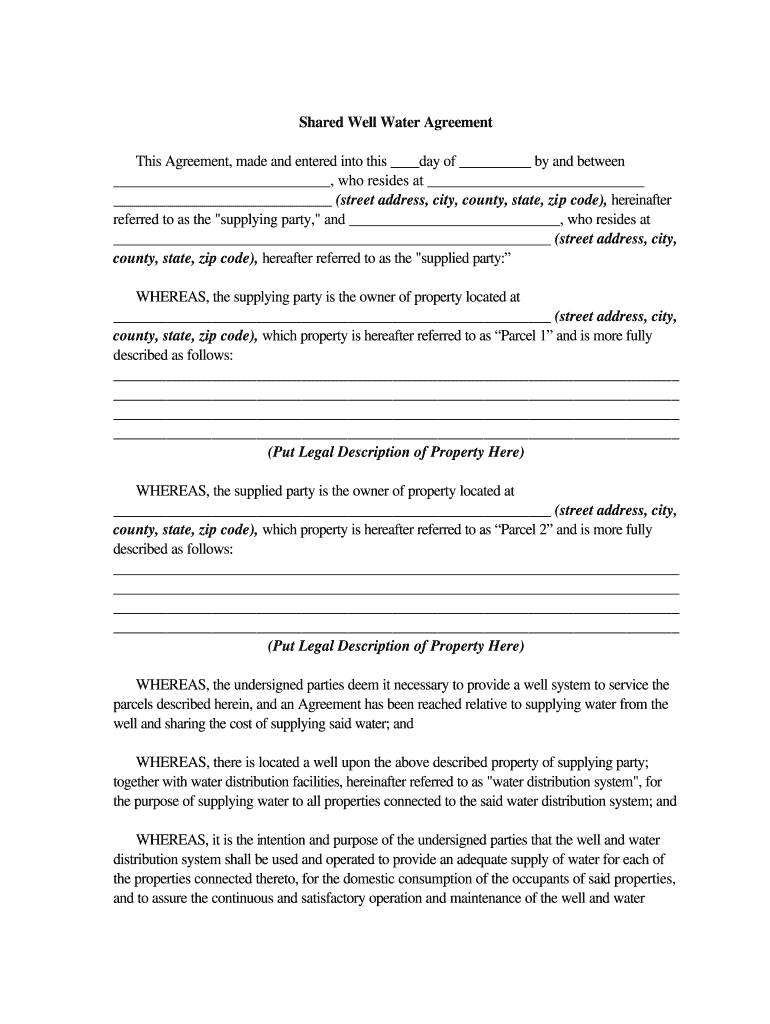
A Shared Well Agreement is a contract regarding the drilling, maintenance, and use of a well. As a contract, the Agreements core provisions must properly identify the parties, properties, well and water distribution system, maintenance liabilities, easements, and registered water rights, if any.
Does FHA allow a shared well?
Under federal mortgage insurance guidelines, shared wells must meet minimum flow and water quality standards. U.S. Department of Housing and Urban Development (HUD) sets minimum standards for shared wells that must be met to qualify for a Federal Housing Administration (FHA) insured mortgage.