
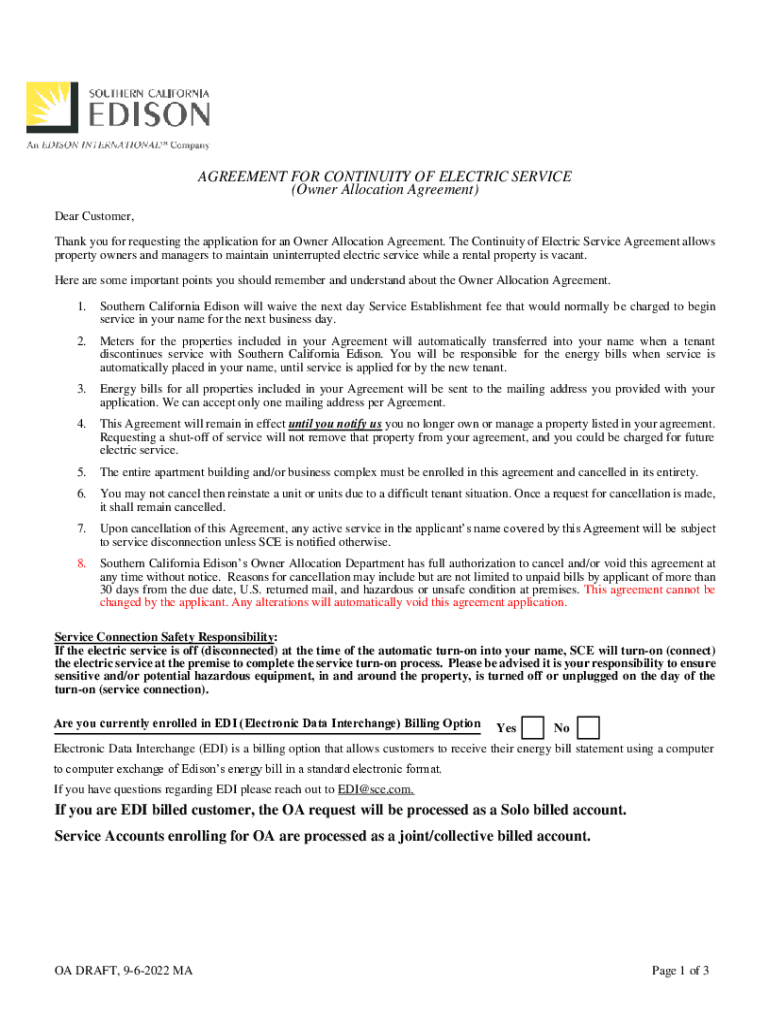







Definition & Meaning
The "Agreement for Continuity of Electric Service" is a formal arrangement typically established between a property owner and an electric service provider such as a utility company. This agreement ensures that electric service at a property continues uninterrupted, even if there is a change in tenant occupancy. The main purpose is to automatically transfer the billing responsibility from a departing tenant to the property owner, preventing any lapse in service during tenant transitions. Such agreements are crucial in maintaining continuous utility service, thus avoiding any disruptions that could affect property maintenance or tenant satisfaction.
How to Use the Agreement for Continuity of Electric Service
To effectively utilize the Agreement for Continuity of Electric Service, property owners must first establish a contractual relationship with their local utility provider. The agreement typically requires details about the property, the owner's identification, and consent to automatic service transfers. Owners should keep a copy of the signed agreement for their records. Whenever there is a tenant changeover, service is seamlessly transferred to the owner's account, minimizing administrative workloads typical of manual service transfers. Engaging with the utility company to understand any particular procedural requirements is also recommended.
How to Obtain the Agreement for Continuity of Electric Service
Acquiring this agreement generally involves contacting the local electric utility provider and requesting the specific form. Owners can often download the form from the utility’s website or receive it via mail or in-person at the provider’s office. The document typically needs to be filled out with essential information about the property and the owner. It may also require submission of additional documents like identification proofs or property management details. Once completed, the form can be returned via mail, fax, or preferably, online through the utility provider’s portal for more efficient processing.
Steps to Complete the Agreement for Continuity of Electric Service
- Obtain the Form: Request the form from your local utility provider, either online, by mail, or in person.
- Gather Necessary Documents: Have your property ownership details, ID proofs, and tenant management information on hand.
- Fill Out the Form: Complete all required sections, ensuring accuracy to avoid delays.
- Review Terms and Conditions: Carefully read any terms, focusing on billing responsibilities and conditions for service transfer.
- Submit the Form: Return the form to the utility provider through their specified method, ensuring it’s sent to the correct department.
- Confirmation: Await confirmation from the utility provider that your agreement has been processed and is active.
Key Elements of the Agreement for Continuity of Electric Service
- Automatic Transfer Clause: This clause facilitates the seamless transition of service to the owner's name upon tenant vacation.
- Billing Responsibilities: Clear delineation of who is responsible for charges during different phases of tenant occupancy.
- Cancellation Conditions: Specifies any conditions under which the agreement can be terminated, requiring clear communication between parties.
- Safety Provisions: Includes obligations related to ensuring safe continuity when service transitions occur, such as ensuring access to utility meters.
Legal Use of the Agreement for Continuity of Electric Service
This agreement is legally binding and is often governed by state-specific utility regulations in the U.S. It compels property owners to uphold their end of the service continuity by accepting billing during tenant transitions. In a legal context, both parties—the utility and the property owner—are obligated to comply with the terms, and any disputes are typically resolved according to local utility laws. Owners should ensure compliance with all state-specific rules that may impact the enforceability of the agreement.
Who Typically Uses the Agreement for Continuity of Electric Service
Property owners who frequently manage rental properties are the primary users of these agreements. This includes landlords of apartment complexes, individual rental properties, and real estate management companies. They leverage this agreement to maintain uninterrupted service, especially in regions with high tenant turnover. Additionally, utility companies use it to streamline their administration of service transitions, reducing their customer service load by minimizing disruptions that could arise from changes in tenants.


State-Specific Rules for the Agreement for Continuity of Electric Service
State utility commissions often regulate these agreements, and rules can vary considerably. For instance, California requires stringent consumer protection measures for tenants, whereas Texas might focus more on service reliability. Property owners must familiarize themselves with specific local rules, which might include procedures for dispute resolution, tenant notification requirements, or specific filing methods. Consulting with legal assistance specialized in real estate or utility regulations may be beneficial to ensure comprehensive compliance.




