







Definition and Meaning
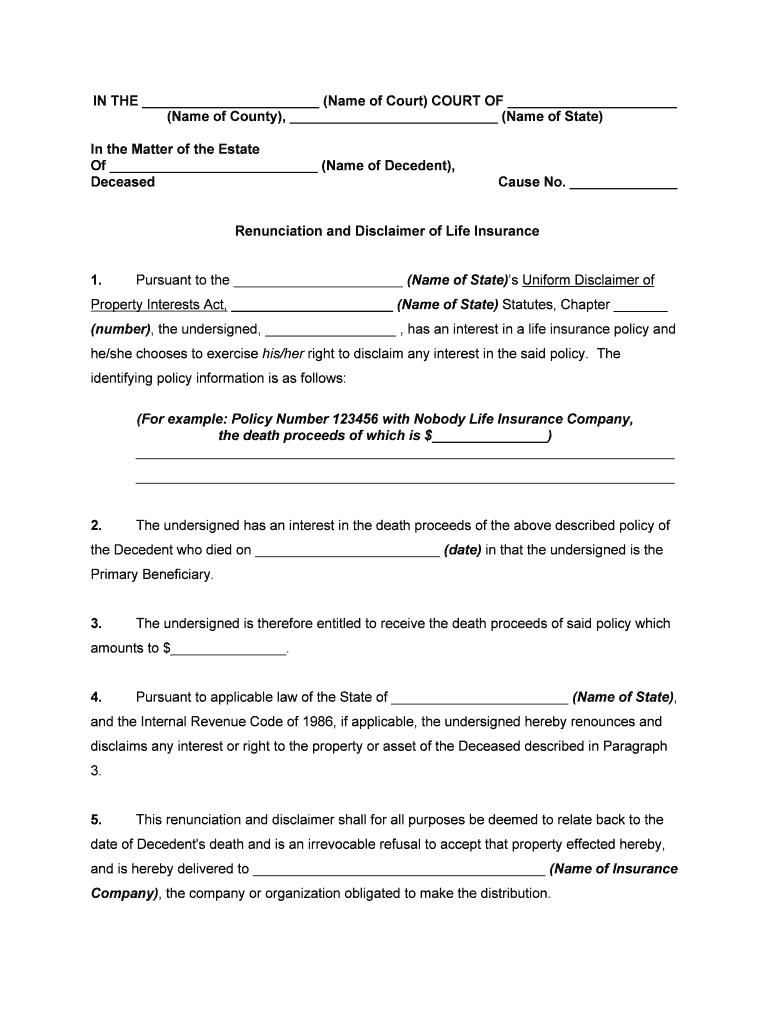
A disclaimer form is a legal document used to renounce or refuse a vested interest or claim on an asset or obligation. Frequently utilized in scenarios involving inheritance or insurance policies, a disclaimer form allows an individual to refuse benefits, thus permitting the asset or obligation to pass to an alternate beneficiary. Typically, the form is used by a primary beneficiary following the death of the policyholder or the original owner. It sets forth the primary beneficiary's intention to disclaim their interest according to applicable laws and regulations, potentially alleviating tax implications or altering the distribution of assets.
Steps to Complete the Disclaimer Form
Completing a disclaimer form involves several steps to ensure that all necessary legal requirements are met.
-
Review the Policy or Asset Documentation: Begin by examining the relevant policy or legal documentation to understand the rights you are disclaiming.
-
Identify the Applicable Laws: Research the state laws applicable to your case as they may influence how you fill out the form.
-
Fill Out the Form: Enter specific information such as your full name, the deceased's name, policy number, and your decision to disclaim the interest.
-
Include Required Signatures: Ensure that the form includes signatures from the beneficiary and, in some cases, a notary public for validation.
-
Submit the Form: Send the completed form to the appropriate party, such as the insurer or estate executor, by mail, in person, or electronically, depending on submission guidelines.
Key Elements of the Disclaimer Form
Several key elements should be included in a disclaimer form to ensure its validity:
- Identification of the Asset or Policy: Clearly specify the asset, policy, or obligation in question.
- Beneficiary Details: Provide all relevant details of the beneficiary disclaiming the interest: full name, contact information, and relationship to the deceased.
- Statement of Disclaimer: Clearly articulate the decision to disclaim the interest, mentioning any relevant dates and state laws.
- Signatures and Notarization: Capture signatures from both the disclaiming party and a notary public if necessary.
Legal Use of the Disclaimer Form
The disclaimer form must be used in compliance with both federal and state laws. Its legal use often pertains to:
- Estate Planning: Allows beneficiaries to manage estate distributions in line with personal and tax strategies.
- Insurance Policies: Used to refuse proceeds from life insurance, potentially shifting benefits to contingent beneficiaries.
- Trust Assets: Ensures a seamless transfer of assets within a trust without tax penalties.
Filing a disclaimer form is often time-sensitive and contingent on meeting specific legal criteria to be deemed valid.
State-Specific Rules for the Disclaimer Form
Each state has its own set of rules governing the use and execution of disclaimer forms, which can significantly influence how they are applied:
- Time Limits: States may impose different deadlines for filing a disclaimer form, often within a few months of the decedent's death.
- Documentation Requirements: Additional documentation, such as proof of relationship to the deceased, may be required based on state law.
- Notarization and Witnessing Requirements: Some states mandate that forms include witnesses or be notarized to validate the disclaimer.
Understanding these variations is critical in ensuring the disclaimer's legality and effectiveness.
Who Typically Uses the Disclaimer Form
The primary users of a disclaimer form generally include:
- Beneficiaries of Estates or Wills: Often, these individuals wish to decline their share of an inheritance for tax or personal reasons.
- Life Insurance Beneficiaries: Primary beneficiaries who decide not to accept policy proceeds.
- Trust Beneficiaries: Individuals opting to refuse trust benefits for strategic estate planning.
These parties typically use disclaimer forms to achieve specific financial, legal, or personal objectives within the confines of the law.


How to Obtain the Disclaimer Form
Obtaining a disclaimer form involves a few straightforward steps:
- Contact the Issuing Entity: Reach out to the insurance company, estate executor, or attorney handling the case.
- Online Resources: Forms can sometimes be downloaded from the issuing entity’s website or legal resource sites.
- Professional Consultation: A legal adviser or estate planner can provide tailored advice and ensure that the correct form is used.
The method of obtaining the form can depend on the asset or obligation being disclaimed.
Required Documents
Several documents are often required to accompany a disclaimer form submission, ensuring that the process meets all legal standards:
- Identification Documents: A government-issued ID to confirm the identity of the person disclaiming the interest.
- Legal or Policy Documents: Copies of the will, trust, life insurance policy, or related legal documents.
- Proof of Relationship: Evidence of the beneficiary's relationship to the deceased, such as a birth or marriage certificate.
- Signed Disclaimer Form: The completed and duly signed form, sometimes needing notarization or witness signatures, depending on jurisdiction.
Ensuring these documents are complete and accurate is essential for a smooth disclaimer submission process.




