




01. Edit your sf273 form online
Type text, add images, blackout confidential details, add comments, highlights and more.

Type text, add images, blackout confidential details, add comments, highlights and more.

Draw your signature, type it, upload its image, or use your mobile device as a signature pad.

Send it via email, link, or fax. You can also download it, export it or print it out.
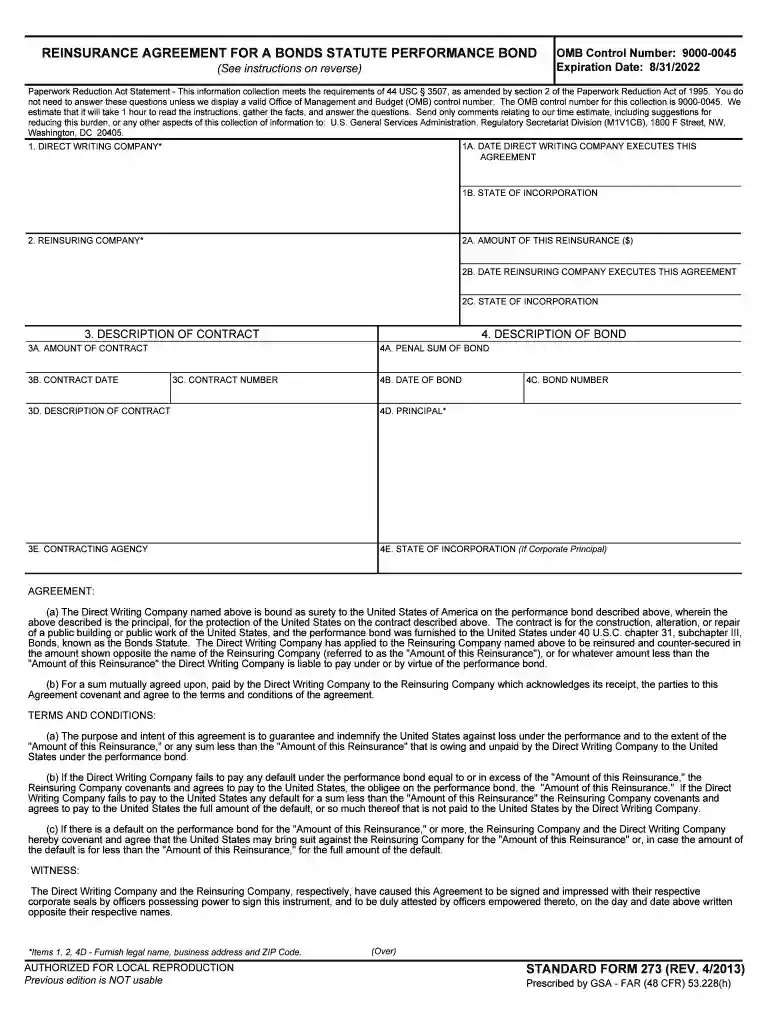
A Reinsurance Agreement for a Bonds Statute Performance Bond is a critical financial instrument used in the construction industry, particularly for public construction projects in the United States. It involves a contract between two parties: a Direct Writing Company, which issues the original performance bond, and a Reinsuring Company, which provides additional coverage. The purpose of this agreement is to mitigate the financial risk associated with defaults by contractors. In the event a contractor fails to fulfill the contract terms, the reinsurance agreement ensures that the financial obligations under the bond are met by the reinsuring party.
Understanding the core components of a Reinsurance Agreement for a Bonds Statute Performance Bond is essential for both direct writing companies and reinsuring companies. Critical elements include:
Each section of the agreement serves a unique role in defining how the agreement functions and what is expected of each party involved.
The agreement details the process for making a claim, including:
By clearly defining these steps, the agreement reduces ambiguity and ensures swift resolutions.
For companies involved in issuing or reinsuring bonds, utilizing a Reinsurance Agreement for a Bonds Statute Performance Bond involves several strategic steps:
Proper usage of this agreement safeguards financial interests and mandates clarity in responsibilities and processes.
Completing a Reinsurance Agreement involves a detailed approach:
Each step ensures the agreement is comprehensive and enforceable, minimizing potential disputes.
The importance of a Reinsurance Agreement lies in its ability to provide financial reassurance:
These agreements are invaluable for companies wanting to protect their financial interests in large or public sector projects.
Understanding specific legal and financial terms is crucial:
Familiarity with these terms ensures clarity and aid in the accurate interpretation of the agreement terms.
In the U.S., reinsurance agreements for bonds are regulated by specific legal frameworks:
Varying rules may apply to reinsurance agreements depending on the state:
Understanding the state-specific nuances ensures compliance and reduces the risk of legal challenges.
To illustrate practical applications:
These cases highlight the agreement's role in facilitating project completion and financial stability.
Primarily used by:
By understanding who uses these agreements, companies can successfully navigate contractual obligations and minimize risks.
We've got more versions of the sf273 form form. Select the right sf273 form version from the list and start editing it straight away!
| Versions | Form popularity | Fillable & printable |
|---|---|---|
| 2013 | 4.8 Satisfied (83 Votes) |
At DocHub, your data security is our priority. We follow HIPAA, SOC2, GDPR, and other standards, so you can work on your documents with confidence.


The following standard forms are prescribed for use for bond and insurance requirements, Reinsurance Agreement for a Bonds statute Performance Bond.
Insurance and reinsurance ➜ Definition meaning ✔️ Implementation strategies ✔️ Drivers barriers ✔️ Examples ✔️ Read article.
Feb 13, 2024 This form is intended for use by government contractors and contracting personnel for compliance with and management of financial security


