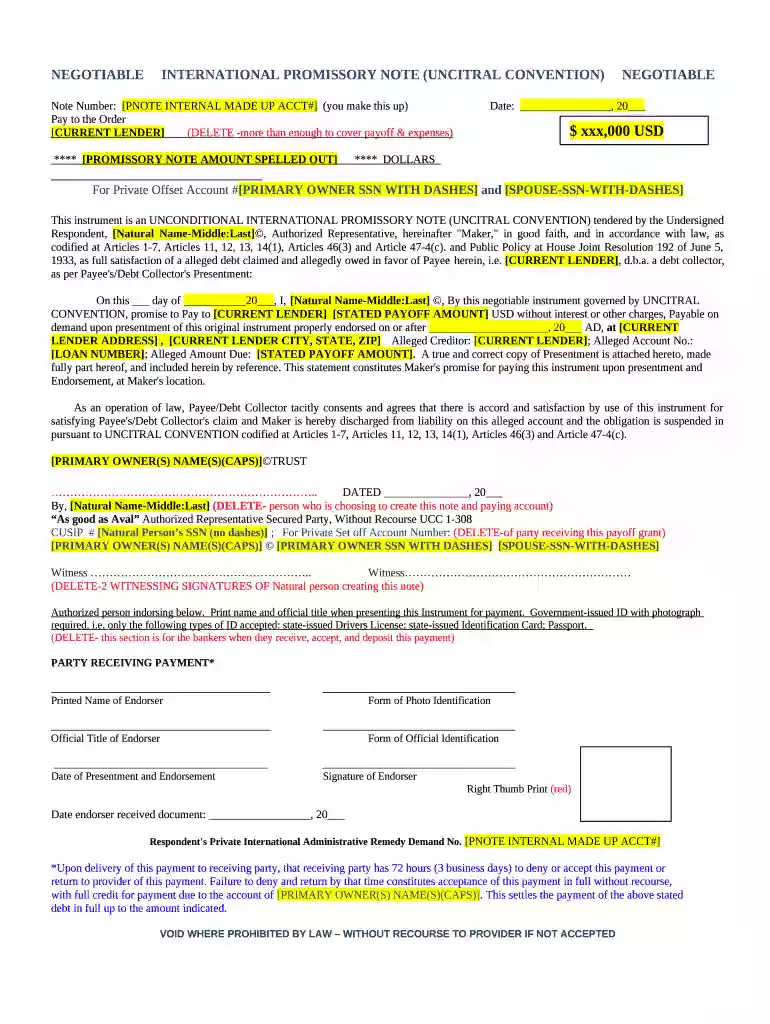
NEGOTIABLEINTERNATIONAL PROMISSORY NOTE (UNCITRAL CONVENTION)NEGOTIABLE 2026

Get Form
NEGOTIABLEINTERNATIONAL PROMISSORY NOTE (UNCITRAL CONVENTION)NEGOTIABLE Preview on Page 1

Here's how it works

01. Edit your form online
Type text, add images, blackout confidential details, add comments, highlights and more.

02. Sign it in a few clicks
Draw your signature, type it, upload its image, or use your mobile device as a signature pad.

03. Share your form with others
Send it via email, link, or fax. You can also download it, export it or print it out.

Definition & Meaning

The Negotiable International Promissory Note governed by the UNCITRAL Convention is a legal instrument that signifies an unconditional promise by the Maker to pay a specific amount to another party, known as the Payee or Lender. This document is designed to be exchanged and enforced under international commercial practices as stipulated by the United Nations Convention on International Bills of Exchange and International Promissory Notes. It includes terms for repayment, discharge from liability upon acceptance, and presentation procedures, ensuring that the debt is settled under pre-agreed conditions. This note is considered "negotiable," meaning it can be transferred to another party, fulfilling the debt owed.

How to Use the International Promissory Note

To use this promissory note effectively, both parties should be aware of the terms set within the document.

  1. Drafting the Note: Include the amount payable, due date, and any interest applicable. Ensure clarity in terms regarding acceptance and discharge.

  2. Signing the Document: The Maker (or debtor) and the Lender (or creditor) should sign the note, which can be done electronically with legally binding e-signatures.

  3. Transfer and Negotiation: The note can be endorsed to a third-party, facilitating its transferability in international trade.

  4. Presentation and Acceptance: The Payee should present the note for payment per the specified terms, requiring acknowledgment of receipt.

Steps to Complete the Promissory Note

Completing the International Promissory Note involves a detailed process to ensure legal compliance and clarity:

  1. Identify Parties: Clearly state the names and addresses of the Maker and the Payee.

  2. Specify Terms: Define payment amount, interest rate, maturity date, and conditions for payment.

  3. Legal Review: Have a legal professional review the note to confirm it aligns with UNCITRAL provisions.

  4. Execution: Both parties should sign, witnessing the execution to validate its authenticity.

  5. Record Keeping: Store a copy of the completed note for both parties’ records to facilitate any future references.

Key Elements of the International Promissory Note

The note consists of several critical components, each essential for its validity and enforceability:

  • Parties Involved: Clearly identify the Maker and Payee.
  • Promise to Pay: Explicit declaration of the obligation to pay a specified sum.
  • Payment Terms: Details about due dates, interest rates, and payment conditions.
  • Negotiability: Terms that allow the note to be transferred to others.
  • Governing Law: Reference to the UNCITRAL Convention as the governing authority.
  • Security or Collateral: Identification of any collateral securing the note's payment.

Legal Use of the International Promissory Note

Under UNCITRAL, this promissory note provides a framework for legal constraints ensuring the rights of parties across different jurisdictions are respected:

  • Governs cross-border commercial transactions.
  • Facilitates easier enforcement of debt collection internationally.
  • Used as a means to secure international trade agreements.

Who Typically Uses the International Promissory Note

This financial instrument is widely used by:

  • Businesses and Corporations: Engaged in international transactions.
  • Financial Institutions: Offering lines of credit or loans secured by promissory notes.
  • Private Lenders and Investors: Extending credit in international markets.
decoration image ratings of Dochub

Important Terms Related to the Promissory Note

Understanding critical terminology ensures parties can navigate the note effectively:

  • Maker: The party obliged to pay the note.
  • Payee: Recipient of the payment as stipulated in the note.
  • Negotiability: Ability to transfer the note to third parties.
  • Holder in Due Course: A third-party who acquires the note under certain conditions and has specific rights.

State-Specific Rules for the Promissory Note

While governed by international conventions, state-specific rules can influence enforcement and recognition:

  • Uniform Commercial Code (UCC): In the U.S., states adopt UCC provisions affecting promissory notes and negotiable instruments.
  • State Statutes: Some states may have additional requirements for validity or enforcement.

By fully exploring these blocks, one gains a comprehensive understanding of the Negotiable International Promissory Note as governed by the UNCITRAL Convention, and its applicability to international financial transactions.

be ready to get more

Complete this form in 5 minutes or less

Get form

Got questions?

We have answers to the most popular questions from our customers. If you can't find an answer to your question, please contact us.
Contact us
It must be an unconditional promise or order to pay. It must be for a fixed amount in money. It must be payable on demand or at a definite time. It must be payable to order or bearer, unless it is a check.
What makes a promissory note negotiable? A promissory note is negotiable if it is written, signed, contains an unconditional promise to pay a fixed sum, is payable on demand or at a definite time, and is payable to order or bearer.
An instrument to be negotiable must conform to the following requirements: (1) It must be in writing and signed by the maker or drawer; (2) Must contain an unconditional promise or order to pay a sum certain in money; (3) Must be payable on demand, or at a fixed or determinable future time; (4) Must be payable to order
Promissory notes are a common type of financial instrument in loan transactions. As the payer of such a note, its important to know that, unless a note expressly stipulates that it is not negotiable, promissory notes are negotiable instruments that can be transferred or assigned by the original payee to a third party.
A Bill of Exchange and a Letter of Credit both facilitate international trade payments, but they are fundamentally different. A Bill of Exchange is a negotiable instrument drawn by the seller, the buyer has to pay on a specified date.

Security and compliance

At DocHub, your data security is our priority. We follow HIPAA, SOC2, GDPR, and other standards, so you can work on your documents with confidence.
Learn more
ccpa2
pci-dss
gdpr-compliance
hipaa
soc-compliance
be ready to get more

Complete this form in 5 minutes or less

Get form

People also ask

Section 4 of the Act defines, A promissory note is an instrument in writing (note being a bank-note or a currency note) containing an unconditional undertaking, signed by the maker, to pay a certain sum of money to or to the order of a certain person, or to the bearer of the instruments. promissory note.
In order for a note to be negotiable it must meet the following requirements 1) signed writing; 2) unconditional promise or order to pay; 3) a fixed amount of money; 4) at a definite time or upon demand; 5) to order or to bear (words of negotiability); 7) the instrument cannot contain any extraneous undertakings; 8)