
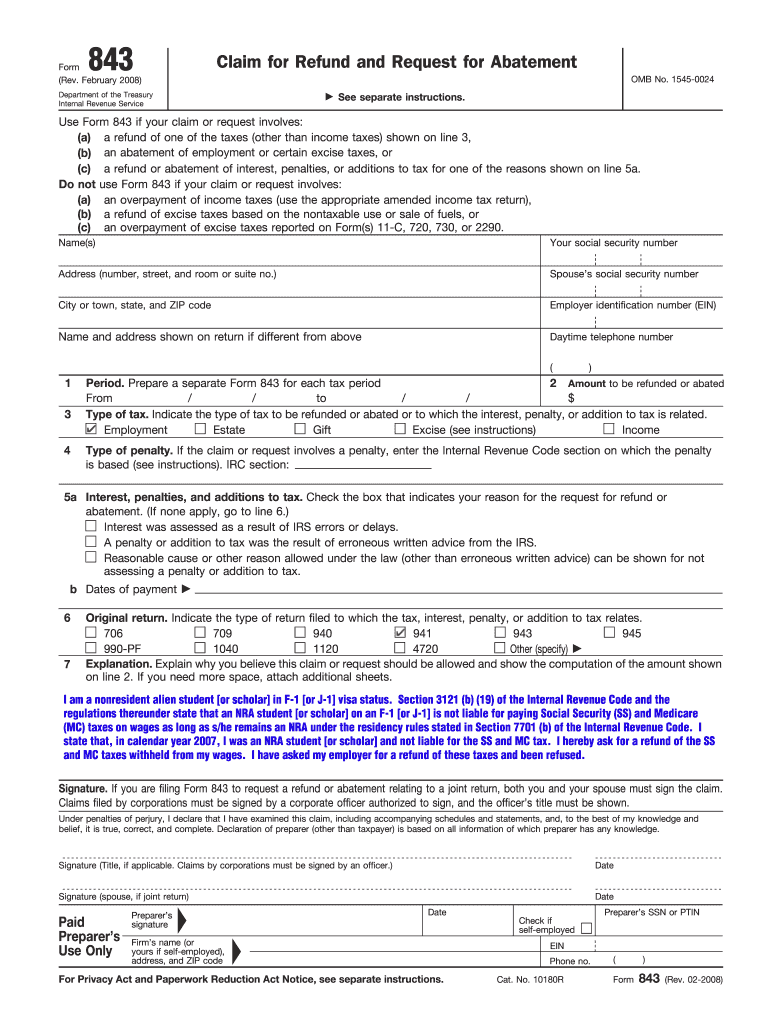







Definition & Meaning
Form 843, officially titled "Claim for Refund and Request for Abatement," is designated for taxpayers seeking refunds or abatements for specific types of taxes, such as penalties, interest, and certain taxes, other than income taxes. This form is instrumental when an individual or entity believes they have overpaid taxes, incurred penalties unjustly, or are eligible for a refund due to an incorrect tax assessment.
Examples of Use
- A taxpayer who discovers they have overpaid an excise tax can file Form 843 to request a refund.
- Situations where penalties were imposed inaccurately, such as a late filing penalty when the filing was on time due to an IRS error, can be addressed using this form.
Steps to Complete the Form 843 (Rev. February 2008)
Filling out Form 843 involves a systematic approach to ensure all necessary information is provided accurately.
- Identify the Tax Type: Specify the tax, penalty, or interest to be refunded or abated by checking the appropriate box.
- Personal Information: Include your name, social security number, and address.
- Tax Period Details: Clearly indicate the period for which you are filing the claim.
- Explanation: Provide a detailed explanation in Part II of the form about why you believe a refund or abatement is warranted.
- Sign the Form: Ensure to sign and date the form before submission.
Key Considerations
- Double-check all entries for accuracy to avoid processing delays.
- Attach any supporting documentation or additional explanatory statements that can substantiate your claim.
Eligibility Criteria
Eligibility to utilize Form 843 is contingent on specific circumstances that justify a claim for a refund or abatement.
- Non-Resident Aliens: For instance, students who may claim a refund on Social Security and Medicare taxes if they meet IRS exemption criteria.
- Business Entities: Corporations that have been assessed a penalty incorrectly can apply for abatement.


Requirements for Eligibility
- The tax in question must be one of the types allowed for refund or abatement under IRS guidelines.
- Documentation that supports the reason for the claim should be available upon request by the IRS.
Key Elements of the Form 843
The form is designed to capture essential information that supports your claim for a refund or abatement.
- Detailed Explanation: This section is critical to articulate the rationale for your claim.
- Supporting Documentation: IRS may require additional documents to substantiate your eligibility.
- Tax Period Specificity: Indicating the correct tax periods ensures the IRS processes the claim accurately.
IRS Guidelines
The IRS provides specific guidelines on how to correctly file and submit Form 843.
- Instructions: The official IRS instructions must be reviewed to identify additional form specifications and submission protocols.
- Timeliness: Claims should be filed promptly to fit within statutory time frames for claims and refunds.
Examples of Relevant IRS Instructions
- IRS guidelines specify the types of refundable taxes and authoritative exemptions that justify filing Form 843.
- The need to differentiate between income taxes and those eligible for refund claims via Form 843.
Filing Deadlines / Important Dates
Timely filing of Form 843 is crucial to ensure your claim is considered by the IRS.
- General Deadline: Typically, a claim for refund must be filed within three years from the date of the original return or within two years from the date the tax was paid, whichever is later.
- Exceptions: Certain exceptions may apply based on specific tax types or taxpayer situations, so consult IRS guidance.
Required Documents
When filing Form 843, providing the right documentation is vital to validate your claim.
- Proof of Payment: Copies of payment receipts or statements supporting any overpayment claims.
- Correspondence with IRS: Additional documentation, such as IRS notices or correspondence, can help substantiate your claim.
- Legal Support: Any legal documents that support the basis of your request for abatement.
Additional Documentation
- Include any forms or records that show eligibility for a specific tax exemption or abatements.
Who Typically Uses the Form 843
Understanding the common use cases for Form 843 helps gauge its relevance to various taxpayer groups.
- Individual Taxpayers: People who have received erroneous penalty assessments or overpaid taxes.
- Businesses: Companies seeking to address incorrect tax assessments or penalties not applicable under IRS laws.

Scenarios of Use
- An individual filing for an abatement of penalties due to a reasonable cause or IRS error.
- Corporations identifying errors in excise tax calculations and seeking corrections.
Penalties for Non-Compliance
Failure to adhere to IRS protocols when filing Form 843 can result in penalties or additional financial liabilities.
- Accuracy Penalties: Incorrect or fraudulent claims may incur penalties for misinformation.
- Filing Delays: Late submissions might result in forfeiting the right to claim a refund or abatement.
Preventive Measures
- Ensure the accuracy and completeness of all forms and supporting documentation.
- Follow all IRS deadlines and submission instructions strictly.




