




01. Edit your form online
Type text, add images, blackout confidential details, add comments, highlights and more.

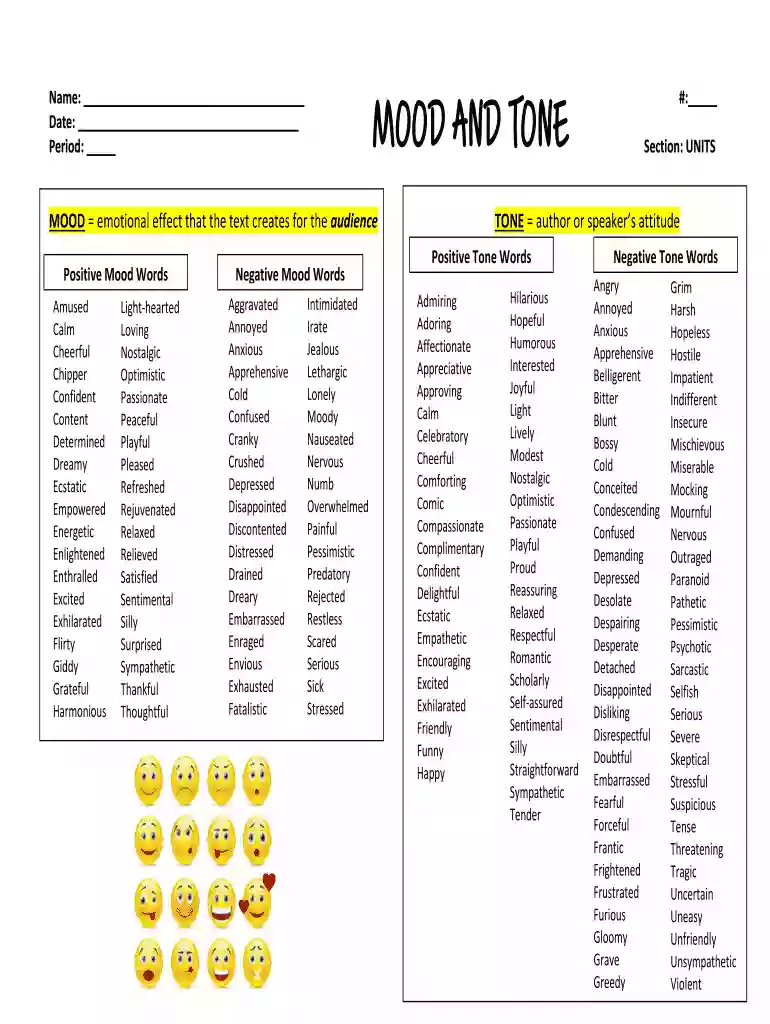
Type text, add images, blackout confidential details, add comments, highlights and more.

Draw your signature, type it, upload its image, or use your mobile device as a signature pad.

Send it via email, link, or fax. You can also download it, export it or print it out.
Mood and tone are fundamental concepts in writing and communication. Understanding these elements helps reveal the emotional underpinning of a piece of text or speech. 'Mood' is the emotional effect created for the audience, often generated through setting, imagery, and word choice. It influences how the audience feels after reading or hearing the content. On the other hand, 'tone' reflects the author's or speaker's attitude toward the subject matter or audience. This can be detected through stylistic choices, such as diction, syntax, and figurative language.
Skillfully manipulating mood and tone can greatly enhance a writer's ability to communicate. Writers utilize different elements to evoke the desired audience response.
Many educators and writers seek guides and lists that categorize mood and tone words to enhance their writing skills. These resources typically provide context and examples to help users understand and implement these elements effectively.
Analyzing the mood and tone of a text involves several systematic steps.
Comprehending mood and tone is essential for effective communication in writing and speaking. It allows individuals to engage readers emotionally, ensuring that the intended message is delivered.
Several elements contribute to establishing mood and tone within a piece of text.
Different genres and formats utilize mood and tone differently. A horror novel might rely heavily on a dark mood, while a motivational speech might focus on a positive tone.
Exploring how mood and tone are applied across different forms can bring clarity to their use.
While mood and tone are primarily literary concepts, they still hold relevance in legal and professional documents where the tone can significantly impact interpretation.
Understanding how mood and tone seamlessly integrate into various contexts can dramatically enhance both the comprehension and creation of content that resonates with its audience.
We've got more versions of the MOOD AND TONE form. Select the right MOOD AND TONE version from the list and start editing it straight away!
| Versions | Form popularity | Fillable & printable |
|---|---|---|
| 2017 | 4.9 Satisfied (44 Votes) |
At DocHub, your data security is our priority. We follow HIPAA, SOC2, GDPR, and other standards, so you can work on your documents with confidence.
by UW Weger 2007 Cited by 64 Similarly, with respect to the auditory modality, conventional wisdom suggests that high tones and ascending melodies are likely to elevate the mood of theRead more
Feb 4, 2015 This is explained by the fact that the vocal folds require a humid environment to produce the right tone. The tone pitch is a key element ofRead more
Nov 14, 2022 Mood shows the particular scenes that direct us toward the subject of a story, but tone tells what each character actually thinks of thatRead more


