




01. Edit your form online
Type text, add images, blackout confidential details, add comments, highlights and more.

Type text, add images, blackout confidential details, add comments, highlights and more.

Draw your signature, type it, upload its image, or use your mobile device as a signature pad.

Send it via email, link, or fax. You can also download it, export it or print it out.
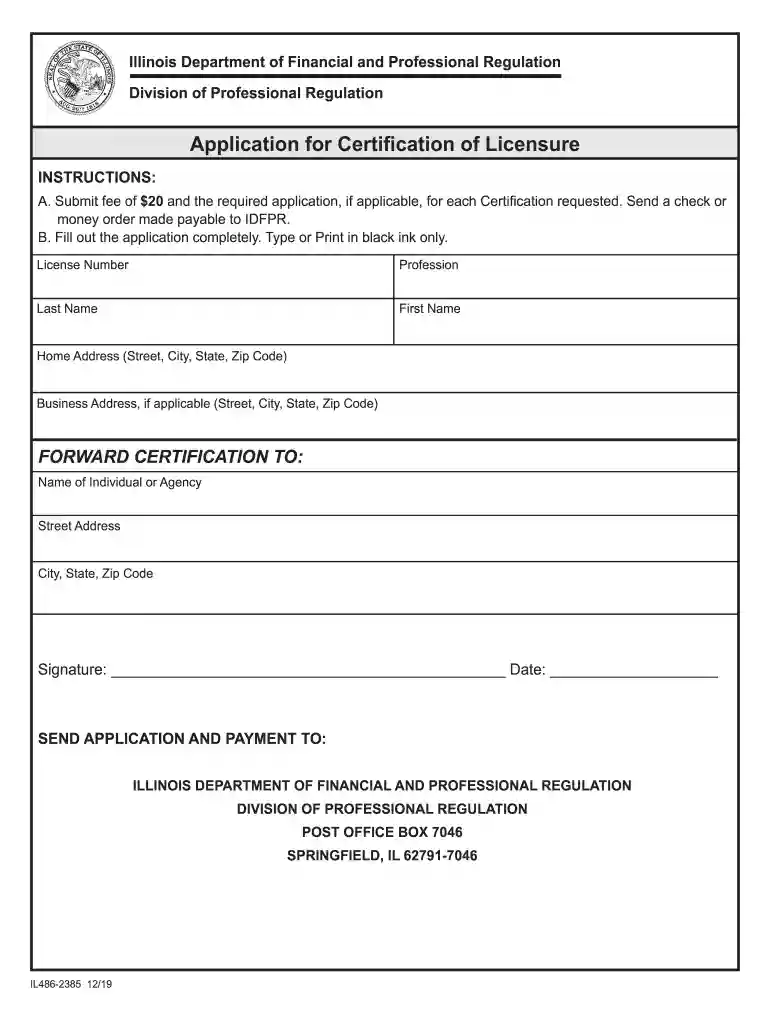
A Certification of Licensure - IDFPR is an official document issued by the Illinois Department of Financial and Professional Regulation (IDFPR). This certification serves as a verification of an individual's professional licensure status within the state of Illinois. It confirms that a professional is qualified, in good standing, and legally permitted to practice in their licensed discipline, such as medicine, architecture, or accountancy. This document can be critical for professionals moving across state lines, applying for jobs, or confirming credentials to clients and other entities.
The application process for the Certification of Licensure - IDFPR starts with filling out the application form on the IDFPR's website, accompanied by the appropriate fee. Approval typically takes a few business days but can vary depending on the workload of the IDFPR. Once processed, the certification is sent to the specified recipient. Keep in mind that delays may occur if the submitted application has incomplete information or incorrect payment, so it's crucial to review everything carefully.
Professionals in licensed fields often require the Certification of Licensure for various reasons. It is particularly useful for individuals who are:


To successfully request a Certification of Licensure, have the following documents ready:
The Certification of Licensure is a legally recognized document in the United States, primarily used to validate the status of a professional license within Illinois. It may be required during legal proceedings that involve professional conduct, applied in disciplinary hearings, or used in interstate licensure transfers. Legal use ensures compliance with state and federal regulations regarding professional practice.
While the primary guidelines for requesting a Certification of Licensure are consistent, there are state-specific nuances to consider:
The IDFPR provides both digital and paper versions of the Certification of Licensure. The digital format is often quicker to dispatch and receive, beneficial in time-sensitive scenarios. Paper versions are traditionally used where digital copies aren't accepted, or a physical document is explicitly requested. Both formats offer the same legal standing and information; however, verify which version is required by the requesting party to avoid delays.
We've got more versions of the How to Request a Certification of Licensure - IDFPR form. Select the right How to Request a Certification of Licensure - IDFPR version from the list and start editing it straight away!
At DocHub, your data security is our priority. We follow HIPAA, SOC2, GDPR, and other standards, so you can work on your documents with confidence.
An Online Certification of Licensure (for most professions) can be requested by accessing your account on the IDFPR Online Services Portal.
Application instructions including forms, checklists, and FAQs Submit initial application online through the IDFPR Online Services Portal. Office at GME


