




01. Edit your form online
Type text, add images, blackout confidential details, add comments, highlights and more.

Type text, add images, blackout confidential details, add comments, highlights and more.

Draw your signature, type it, upload its image, or use your mobile device as a signature pad.

Send it via email, link, or fax. You can also download it, export it or print it out.
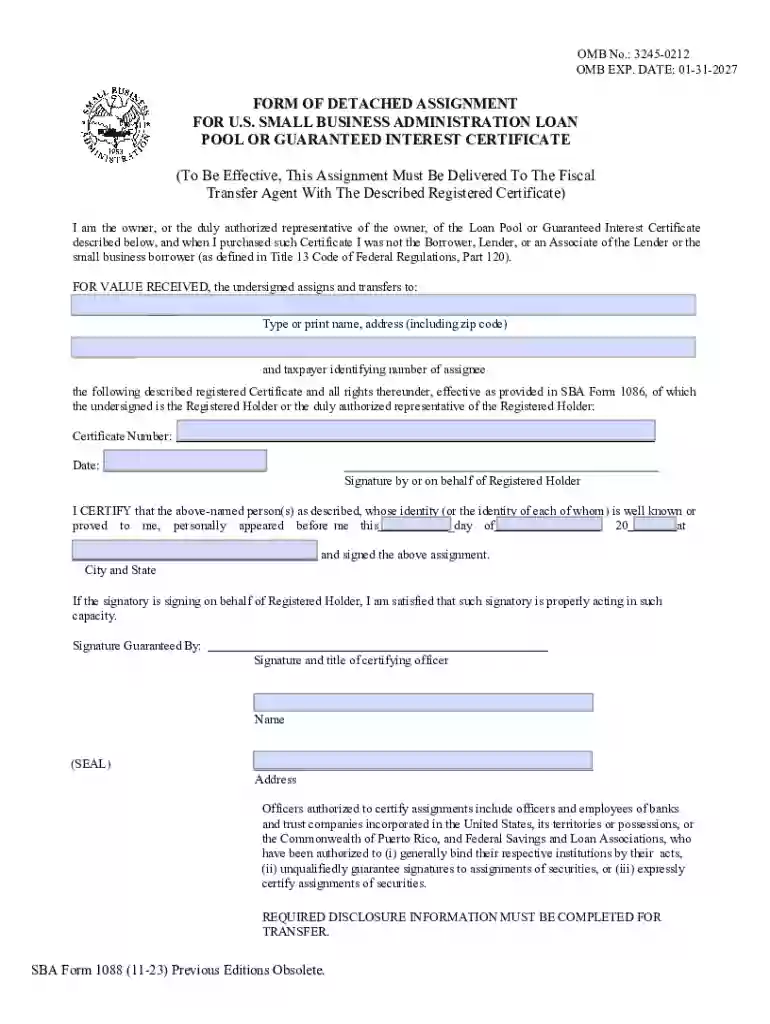
The Form of Detached Assignment for U.S. Small Business Administration Loan Pool or Guaranteed Interest Certificates is a document used for transferring ownership of SBA loan pool certificates or guaranteed interest certificates. This form is crucial in delineating the responsibilities and rights transferred during a sale or reassignment of these financial instruments. It acts as a legal proof of transfer, ensuring that the new owner gains all applicable rights, such as interest payments and principal repayment schedules, under a specified loan pool or guaranteed interest agreement established by the SBA.
The form is used to officially document the transfer of SBA loan pool certificates. Here's a step-by-step guide to using it:
Identify Parties Involved: Clearly state the names and addresses of both the current and new owners.
Describe the Certificates: Include detailed descriptions such as the certificate number, loan pool details, and any other identifiers.
Declare Agreement Terms: Specify the terms and conditions under which the transfer is taking place.
Authorize Signatures: Acquire signatures from both parties involved to authenticate the document.
Submission: Submit the completed form to the designated Fiscal Transfer Agent for official processing.
Obtain the Form: Request or download the form from the SBA or the designated Fiscal Transfer Agent's website.
Fill in Identification Details: Enter the relevant information for both the assignor (the current owner) and the assignee (the new owner).
Certificate Details: Provide exhaustive details about the specific certificates being transferred.
Declaration: Both parties should declare their consent to the terms and sign the form.
Review Compliance: Ensure all details align with SBA regulations.
Submission: Submit the form either electronically or via mail as instructed by the Fiscal Transfer Agent.
The primary users of this form are:


The form is a legal document used to fulfill regulatory requirements for the transfer of loan pool interests under the U.S. SBA guidelines. It establishes a clear, legally binding transition of ownership, which is critical for maintaining compliance with federal regulations governing SBA loan instruments.
Forms can be submitted either through online channels or mailed to the address provided by the Fiscal Transfer Agent. It's important to confirm the preferred submission method before sending the form. Timely submission as per the guidelines is crucial to avoid any discrepancies in the transfer process.
To be eligible for a detached assignment, both parties need to be approved by the SBA and meet specific financial stability criteria. The assignor must have clear ownership of the certificate, while the assignee is typically required to prove financial capability to hold and benefit from the certificate’s proceeds.
This configuration presents key aspects of the form, its applications, legal implications, and detailed instructions for successful completion. This ensures that individuals and institutions engaging in these transactions are equipped with the right information for a smooth process.

We've got more versions of the Form of Detached Assignment for U S Small Business Administration Loan Pool or Guaranteed Interest C form. Select the right Form of Detached Assignment for U S Small Business Administration Loan Pool or Guaranteed Interest C version from the list and start editing it straight away!
At DocHub, your data security is our priority. We follow HIPAA, SOC2, GDPR, and other standards, so you can work on your documents with confidence.


