
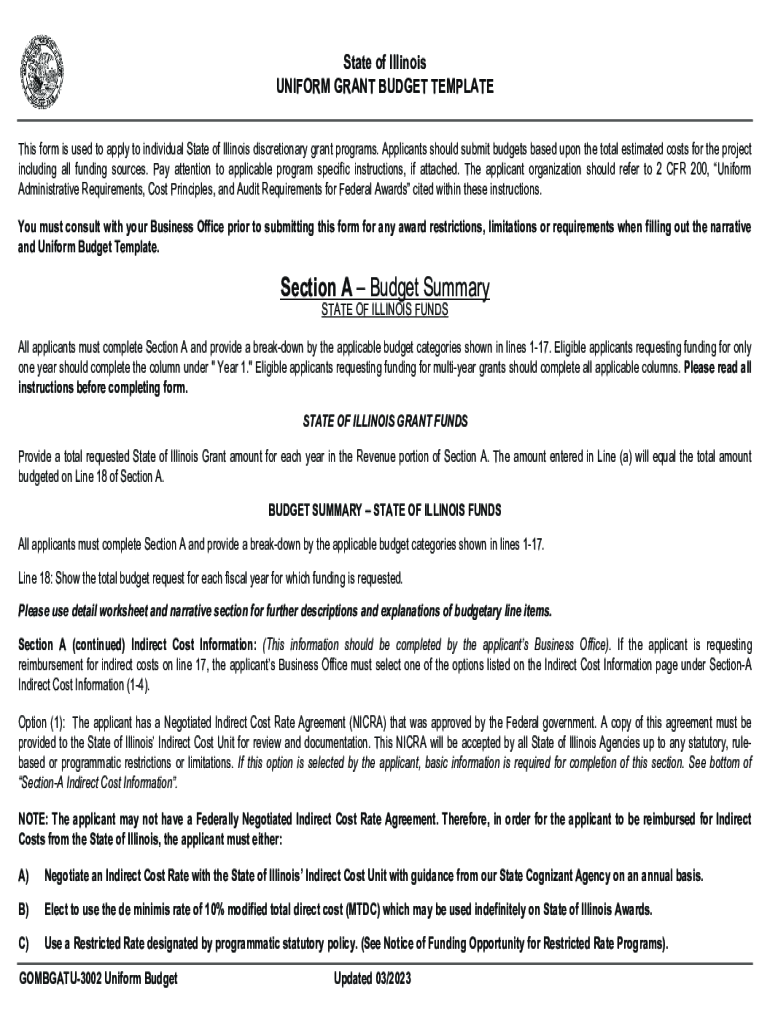







Definition & Meaning
The "Section A Budget Summary" is a crucial component of the Uniform Grant Budget Template, primarily utilized by applicants submitting proposals for discretionary grant programs in the State of Illinois. This section is tailored to provide a comprehensive overview of anticipated project costs, funding sources, and essential budget categories. By meticulously detailing both direct and indirect costs, applicants ensure thorough understanding and transparency of the financial requirements associated with their proposed projects. This helps align expectations between applicants and granting agencies, facilitating smoother approval processes.
Key Elements of the Section A Budget Summary
The Section A Budget Summary is segmented into various categories, each requiring specific financial data and justifications. Key elements include:
-
Total Estimated Project Costs: A consolidated figure representing the sum of all projected expenses associated with implementing the project. This figure must encapsulate direct costs like materials and salaries as well as indirect costs such as overheads.
-
Funding Sources: Detailed descriptions of where funds will be sourced from, including state contributions, federal funding, and any private or internal funding streams. Identifying multiple funding sources can strengthen the application by showcasing financial resilience.
-
Budget Categories: The summary is further broken down into categories such as personnel, equipment, travel, and supplies. Each category requires an itemized breakdown of expenses to provide clarity on where funds will be allocated and how they contribute to the overall project objectives.
How to Use the Section A Budget Summary
Utilizing the Section A Budget Summary involves several steps that ensure accuracy and compliance with regulatory requirements. Here’s a step-by-step approach:
-
Gather Financial Data: Compile all relevant financial information, including existing budgets, forecasts, and historical data relevant to the proposed project.
-
Allocate Costs: Distribute the total estimated project costs across the various budget categories, ensuring alignment with project objectives and grant requirements.
-
Identify Funding Sources: Clearly list all anticipated funding sources, ensuring that the information is consistent with any supporting documentation.
-
Review and Justify: Provide narratives to justify each listed expense and funding source. This helps reviewers understand the necessity of each cost item and its correlation to project success.
-
Consult Stakeholders: Involve financial officers or relevant stakeholders to verify figures and ensure compliance with institutional and grantor guidelines.
Steps to Complete the Section A Budget Summary
Completing the Section A Budget Summary effectively requires diligence and attention to detail. Here’s a guide:
-
Download the Form: Access the Uniform Grant Budget Template, ensuring it's the correct version for the State of Illinois.
-
Input Basic Information: Fill out administrative details such as project title, grant number, and applicant information in their designated fields.
-
Elaborate on Expenses: Break down estimated project costs into prescribed categories, providing specific amounts and detailed justifications for each entry.
-
Document Funding Sources: Clearly specify expected funding sources, linking them to particular expenses where applicable.
-
Verify Indirect Costs: Ensure all indirect costs are calculated consistently with prevailing regulations, attaching any necessary supporting documentation.
-
Submit for Review: Once completed, the document should be reviewed by key stakeholders or a financial officer and then submitted to the appropriate grant agency for evaluation.
Who Typically Uses the Section A Budget Summary
The Section A Budget Summary is predominantly used by entities applying for grants, including:
-
Nonprofits: Organizations seeking funding for community projects or services would find this summary indispensable in illustrating financial needs and planning.
-
Educational Institutions: Schools and universities applying for grants to fund research or educational programs utilize this template to demonstrate comprehensive budget plans.
-
Government Agencies: State and municipal agencies often use this summary to apply for federal funding to support local projects and initiatives.
-
Business Organizations: Companies seeking state-funded support for innovation or development projects must submit detailed budget plans using this summary format.


Legal Use of the Section A Budget Summary
The Section A Budget Summary must be completed and used in compliance with applicable legal and regulatory frameworks. This ensures:
-
Accuracy and Honesty: All provided financial information must be accurate and truthful. Misrepresentation can lead to legal repercussions and disqualification from receiving funds.
-
Compliance with Federal Regulations: The budget summary must align with federal grant guidelines, particularly regarding allowable costs and indirect cost calculations.
-
Confidentiality: Any sensitive information contained within the budget summary should be handled following applicable data protection laws to ensure confidentiality and security.
Examples of Using the Section A Budget Summary
Real-world applications of the Section A Budget Summary include:
-
Community Development Projects: A nonprofit aiming to build affordable housing may utilize this section to outline construction costs, funding partnerships, and operational budgets.
-
Research Grants: University departments applying for research funding might use this summary to project costs for materials, personnel, and facility use, thereby offering a transparent financial narrative to potential funders.
-
Public Health Initiatives: With state agencies applying for health program funding, this summary allows them to break down expected expenses related to personnel, community outreach, and medical supplies.
Software Compatibility
For organizations seeking to streamline the completion of the Section A Budget Summary, several software tools are compatible with this task:
-
Excel: Common for its flexibility and ability to create customized formulas, making it ideal for detailed budget calculations.
-
QuickBooks: Suitable for integrating existing financial data into the summary, especially for nonprofit organizations and small businesses.
-
TurboTax: Though primarily a tax software, its budgeting feature can be adapted to plan expenses if used creatively.
Overall, ensuring software compatibility can improve accuracy and ease of completing the Section A Budget Summary.




