Additional work authorization form 2026

Get Form
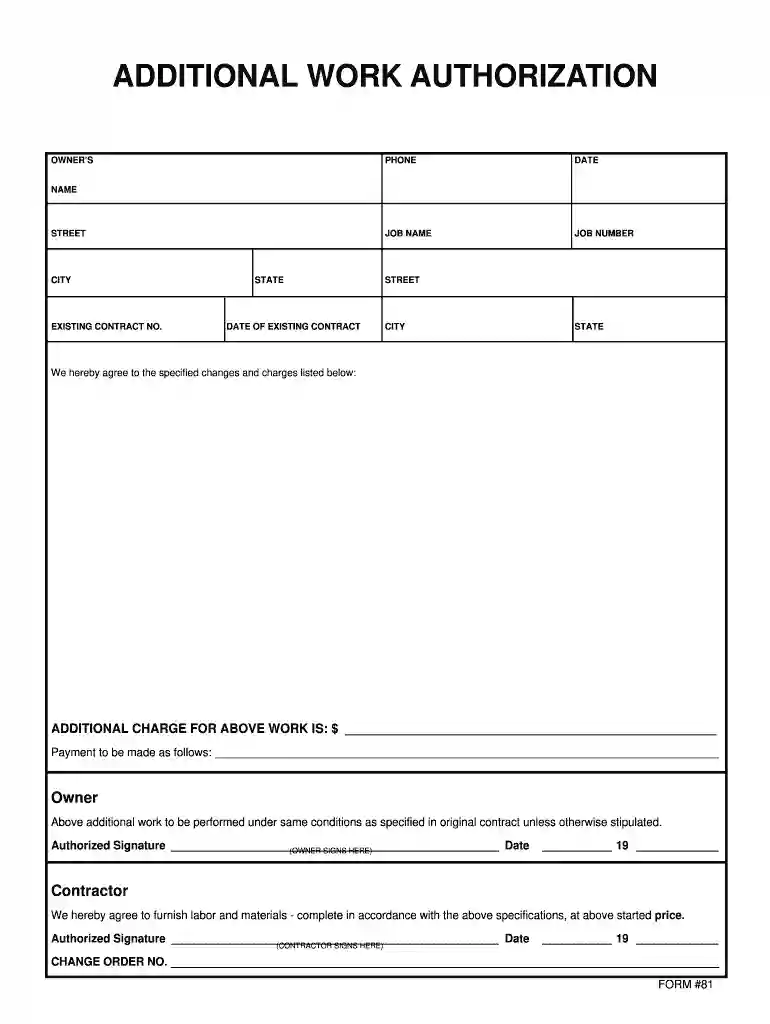
free contractor work authorization form template Preview on Page 1

Here's how it works

01. Edit your free contractor work authorization form template online
Type text, add images, blackout confidential details, add comments, highlights and more.

02. Sign it in a few clicks
Draw your signature, type it, upload its image, or use your mobile device as a signature pad.

03. Share your form with others
Send additional work authorization via email, link, or fax. You can also download it, export it or print it out.

Comprehensive Overview of the Additional Work Authorization Form

The additional work authorization form serves as a critical document in construction management, facilitating the official modification of work agreed upon in a construction contract. It outlines specific changes, additional charges, and payment terms that both the contractor and the project owner must agree on to ensure seamless workflow and compliance.

Definition and Purpose of the Additional Work Authorization Form

The additional work authorization form is essentially a contract modification tool. It is used primarily in situations where the scope of work needs to be altered, resulting in extra costs or timeline adjustments. This document ensures clear communication and agreement between both parties regarding:

  • Project Changes: Detailing what additional work is required and why it is necessary.
  • Payment Details: Stipulating how much extra will be charged and when payments are expected.
  • Signatures: Collecting signatures from both the contractor and the owner validates the changes and agrees to adhere to the terms outlined.

Including legal protections, this form formalizes any agreed-upon amendments to the original contract, safeguarding the rights of both the contractor and client.

Key Components of the Form

Understanding the essential elements of the additional work authorization form is vital for effective use. Here are the key components typically included in the form:

  • Contractor and Owner Information: Names, addresses, and contact details of both the contractor and project owner.
  • Description of Additional Work: A clear, concise description of the additional tasks that need to be completed.
  • Cost Estimates: Detailed breakdown of any additional charges arising from the additional work.
  • Payment Terms: Terms of payment such as deposit requirements, due dates, or progress payments.
  • Signatures: Spaces for both parties to sign, indicating agreement to the terms.

Each section serves to document the agreement clearly, ensuring accountability and transparency throughout the project.

Steps to Complete an Additional Work Authorization Form

Completing the additional work authorization form requires careful attention to detail to ensure that all pertinent information is adequately captured. Here is a structured approach to filling out the form:

  1. Header Information:

    • Enter the names and contact information for the contractor and the project owner at the top of the form.
  2. Describe the Changes:

    • Write a detailed description of the necessary additional work. Be specific about the scope, reasoning, and any pertinent deadlines.
  3. Estimate Additional Costs:

    • Calculate and write out the projected costs associated with the additional work, including labor, materials, and overhead.
  4. Detail Payment Terms:

    • Specify the payment schedule, including due dates, payment methods, and any penalties for late payment.
  5. Signature Section:

    • Include lines for signatures from both parties along with the date. Ensuring that both parties sign is critical, as it confirms mutual agreement.

Legal Considerations and Compliance

Legal compliance is pivotal when using the additional work authorization form. Understanding the implications of this document can prevent disputes and ensure clear expectations. Important points include:

  • Contractual Obligations: The form serves as an amendment to the original contract. Both parties are obliged to adhere to the new terms once it is signed.
  • Record Keeping: It is crucial to retain copies of the additional work authorization form alongside the primary contract for reference in case of future disagreements.
  • Local Regulations: Compliance with local laws and regulations regarding construction work and amendments is essential. The form should be crafted according to any specific legislative guidelines to be legally binding.

Common Scenarios and Use Cases for the Form

The additional work authorization form may be used in various construction-related scenarios where changes are required. Below are a few common cases:

  • Change in Design: If a project owner decides to change the layout or design after construction has begun, this form documents the authorization for additional work required to implement these changes.
  • Unforeseen Conditions: Construction may reveal issues, such as structural damage or environmental challenges. The form outlines the additional work needed to address these unexpected conditions.
  • Client Requests: A client may request additional features or upgrades during the project. This form formalizes those requests, ensuring both parties understand the implications on cost and timeline.

Types and Variants of Additional Work Authorization Forms

There are several variations of the additional work authorization form, primarily based on the specific needs of a project or industry. Some common types include:

  • Free Contractor Work Authorization Form Template: Often available online, this template allows contractors to quickly fill out necessary information without starting from scratch.
  • Extra Work Authorization Form Construction: Specified for situations where unforeseen additional work is necessary, ensuring all parties acknowledge the changes.
  • Form 81 Additional Work: A specific model used in certain sectors or regions that outlines additional work definition and approval processes.

By understanding the purpose, components, and correct usage of the additional work authorization form, both contractors and clients can navigate project changes with confidence and clarity.

be ready to get more

Complete this form in 5 minutes or less

Get form

Got questions?

We have answers to the most popular questions from our customers. If you can't find an answer to your question, please contact us.
Contact us
Your Green Card (Form I-551, Permanent Resident Card) is evidence of your employment authorization. You also do not need to apply for an EAD if you have a nonimmigrant status that authorizes you to work for a specific employer incident to your status (for example, you are an H-1B, L-1B, O, or P nonimmigrant).
What are the types of Work Permits? There are seven main types of work permits: Hot Work Permits, Cold Work Permits, Confined Spaces Work Permits, Chemical Work Permits, Height Work Permit, and Excavation Permit.
If you have not already started the EAD application process, you can begin here by creating a USCIS account online and filing Form-I-765. We will mail your work permit to the address you provided in your application if your application is approved.
Additional work authorization forms are required to protect contractors and their clients for additional costs associated to a project. Details of work to be done are not always fully apparent at the start of every project.
Documents that Establish Both Identity and Employment Authorization U.S. Passport or U.S. Passport Card. Permanent Resident Card or Alien Registration Receipt Card (Form I-551) Foreign passport that contains a temporary I-551 stamp or temporary I-551 printed notation on a machine-readable immigrant visa.

Security and compliance

At DocHub, your data security is our priority. We follow HIPAA, SOC2, GDPR, and other standards, so you can work on your documents with confidence.
Learn more
ccpa2
pci-dss
gdpr-compliance
hipaa
soc-compliance

People also ask

USCIS issues the following types of EADs: Initial EAD: This document proves you are allowed to work in the United States. Renewal EAD: This document renews your initial EAD. Generally, you should not file for a renewal EAD more than 180 days before your original EAD expires.
A work permit is a type of work authorization. Work permits are legal documents and can be temporary or permanent solutions for non-citizens to gain employment in the United States. A work permit can be verified by an employer through Employment Authorization Documents (EADs).
Work authorization is a broader term encompassing all forms of legal permission to work in a country, while a work visa is a specific type of work authorization document that allows a foreign national to enter and work in a country for a defined period.

additional work authorization form