




01. Edit your pdu1 online
Type text, add images, blackout confidential details, add comments, highlights and more.

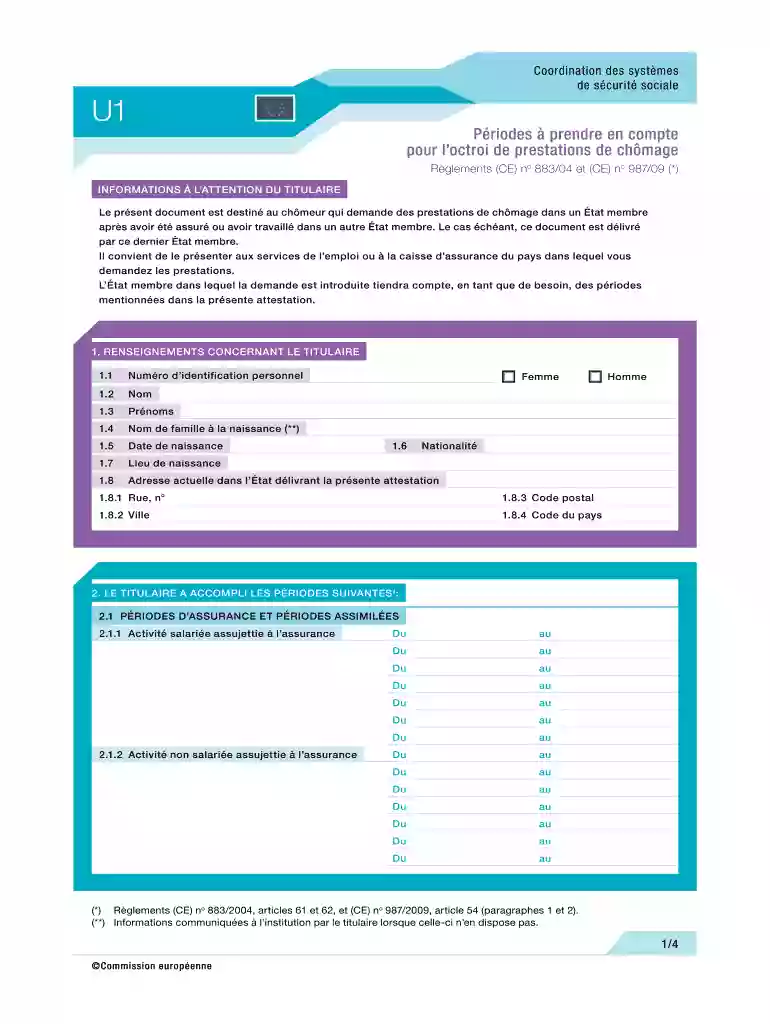
Type text, add images, blackout confidential details, add comments, highlights and more.

Draw your signature, type it, upload its image, or use your mobile device as a signature pad.

Send pdu1 formular via email, link, or fax. You can also download it, export it or print it out.
The PDU1 form is a crucial document for individuals who are looking to claim unemployment benefits after having worked in another European Union member state. It verifies the periods of insurance and employment histories, detailing the contributions made while employed. This form, particularly useful for expatriates or those who have moved between member states, ensures seamless access to benefits in their new residence.
The PDU1 form serves as a certificate that outlines your work history and periods of contribution to social security systems across EU member states. This certification is essential for determining eligibility and the amount of unemployment benefits one can receive in a different member state. Understanding its significance helps applicants navigate the complexities of cross-border unemployment insurance.
Filling out the PDU1 form correctly is essential for a successful application for unemployment benefits. Here are the steps to ensure accurate completion:
Gather Necessary Information:
Fill out the Sections:
Review for Accuracy:
Understanding key terminology associated with the PDU1 form can help in navigating the process more effectively.
While the PDU1 form offers valuable benefits, applicants may encounter several challenges, including:
Real-world examples can illustrate how the PDU1 form is applied in different scenarios:
The PDU1 form comprises several key elements that are crucial for successful claims:
To qualify for unemployment benefits using the PDU1 form, applicants must meet specific criteria:


Based on eSignature regulations, forms approved electronically have the same validity as those approved with pen and paper. You can electronically sign almost any business and private paperwork. Four types of paperwork still require handwritten signatures only - wills and testamentary trusts, court orders and other court forms, state statutes regulating divorce, adoption, or other family law, and notice of cancellation of utility services. If you follow the guidelines and utilize a safe and compliant software solution, like DocHub, you can eSign your pd u1 form without printing it.
If you are searching for a state-specific pdu1 forma sample, you can find it in our DocHub Forms & Templates catalog. Use the search field, key in your form’s name, and search through the results for your state. You may also filter out irrelevant results while searching our catalog by categories.
At DocHub, your data security is our priority. We follow HIPAA, SOC2, GDPR, and other standards, so you can work on your documents with confidence.
Par exemple, les soins tertiaires peuvent comprendre : Centres de traumatologie de niveau 1, soins mdicaux trs spcialiss, comme les centres de
1 Requirements for PDU Encapsulation . For example, Protocol Data Units (PDU) represent L3 packets of any kind, especially IPv4 2 The delay used inRead more
Connecting 1 power supply to one power supply grid and the remaining 1 power supply to a secondary power supply grid will create N+N redundancy. This is HighRead more


