




01. Edit your form online
Type text, add images, blackout confidential details, add comments, highlights and more.

Type text, add images, blackout confidential details, add comments, highlights and more.

Draw your signature, type it, upload its image, or use your mobile device as a signature pad.

Send it via email, link, or fax. You can also download it, export it or print it out.
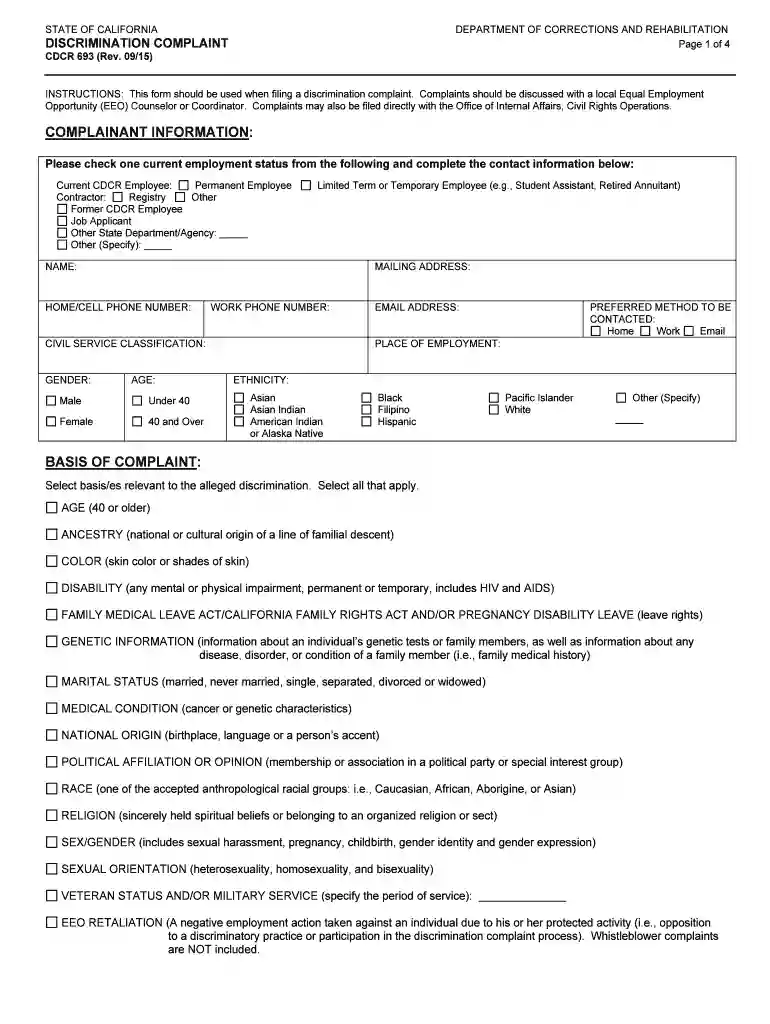
The Discrimination Complaint Form (CDCR 693) is a formal document provided by the California Department of Corrections and Rehabilitation (CDCR) used to report incidents of discrimination within the department. This form facilitates the filing of complaints by employees or applicants who believe they have experienced discrimination in the workplace. The primary aim of the form is to ensure a work environment free of discrimination and to outline a structured process for addressing and resolving such complaints.
Discrimination can include, but is not limited to, unfair treatment based on race, color, religion, sex, national origin, age, disability, or genetic information. The form provides a standardized way to document such grievances, ensuring that they are recorded, reviewed, and addressed systematically by the appropriate CDCR authorities.
To effectively use the CDCR 693 form, follow these steps:
Identify the Basis of Complaint: Clearly state the grounds under which the discrimination has occurred. This could involve specifying categories such as race, gender, or other protected characteristics.
Complete Complainant Information: Provide personal details such as your name, position, and contact information. This section ensures that the CDCR can follow up with the necessary communications regarding the complaint.
Detail the Incident: Include a narrative of the incident(s). Be sure to provide dates, locations, and specific actions or comments that you believe constitute discrimination.
List Involved Parties and Witnesses: Name any individuals involved in the incident, including witnesses who can corroborate your account.
Attach Supporting Documents: If relevant, include any additional documents or evidence that support your claim of discrimination.
Filing a discrimination complaint through the CDCR 693 form involves several key steps:
Access the Form: Obtain the form from the CDCR's official website or your workplace's HR department.
Fill Out Each Section: Ensure all relevant sections of the form are completed accurately. Take care to avoid leaving any mandatory fields blank, as this could delay processing.
Review for Accuracy: Double-check all information provided. An accurate and complete form aids in a thorough and timely review of the complaint.
Submit the Form: Depending on the available options, submit your completed form via mail, in-person, or through any designated online submission platform.
Keep a Copy: Retain a copy for your records. This serves as a reference in case any follow-up is required or if you need to provide additional information.
Several critical components form the backbone of the CDCR 693:
Understanding these elements ensures the complaint is filed comprehensively, facilitating effective resolution.
The CDCR 693 form is designed to align with state and federal laws protecting employees from workplace discrimination. Filing a complaint through this form is legally recognized as the initial step in formally addressing discriminatory practices within the CDCR environment.
The form's use is grounded in compliance with laws like the Civil Rights Act, the Americans with Disabilities Act, and other relevant statutes. Utilizing the CDCR 693 safeguards the complainant's legal rights and ensures the department adheres to mandated procedures for handling discrimination claims.
Failing to address or properly file a discrimination complaint using the CDCR 693 can have serious implications. Individuals or departments neglecting to respond to filed complaints may face internal disciplinary actions, as well as external legal ramifications.
For employees, ignoring the mandated process can lead to a lack of resolution and ongoing workplace discrimination. For the organization, non-compliance with the intended use of this document could result in legal penalties, including fines or lawsuits, signaling the importance of adhering to this procedural requirement.
Eligibility to file a CDCR 693 form typically includes any current or prospective CDCR employee who believes they have experienced discrimination related to employment. Individuals must possess credible evidence and a clear basis for their claim to ensure the form is utilized appropriately and results in a substantive investigation.
It’s crucial for complainants to understand that evidence need not be overt; subtle patterns of behavior or consistent microaggressions that contribute to a hostile work environment are valid grounds for filing. However, they must ensure that their claims align with legally protected discrimination categories under relevant laws.


While the CDCR 693 form is a standardized document across the state of California, it is essential to note any region-specific nuances in handling the form. Regional offices may have additional guidelines or resources available to assist in processing the complaint efficiently.
California's robust anti-discrimination laws help ensure that complaints are taken seriously and processed with the necessary diligence due to their potential legal implications. Understanding both state-wide and local procedures enhances the probability of a successful resolution when utilizing the form.
We've got more versions of the Discrimination Complaint Form (CDCR 693) form. Select the right Discrimination Complaint Form (CDCR 693) version from the list and start editing it straight away!
At DocHub, your data security is our priority. We follow HIPAA, SOC2, GDPR, and other standards, so you can work on your documents with confidence.


