




01. Edit your form online
Type text, add images, blackout confidential details, add comments, highlights and more.

Type text, add images, blackout confidential details, add comments, highlights and more.

Draw your signature, type it, upload its image, or use your mobile device as a signature pad.

Send it via email, link, or fax. You can also download it, export it or print it out.
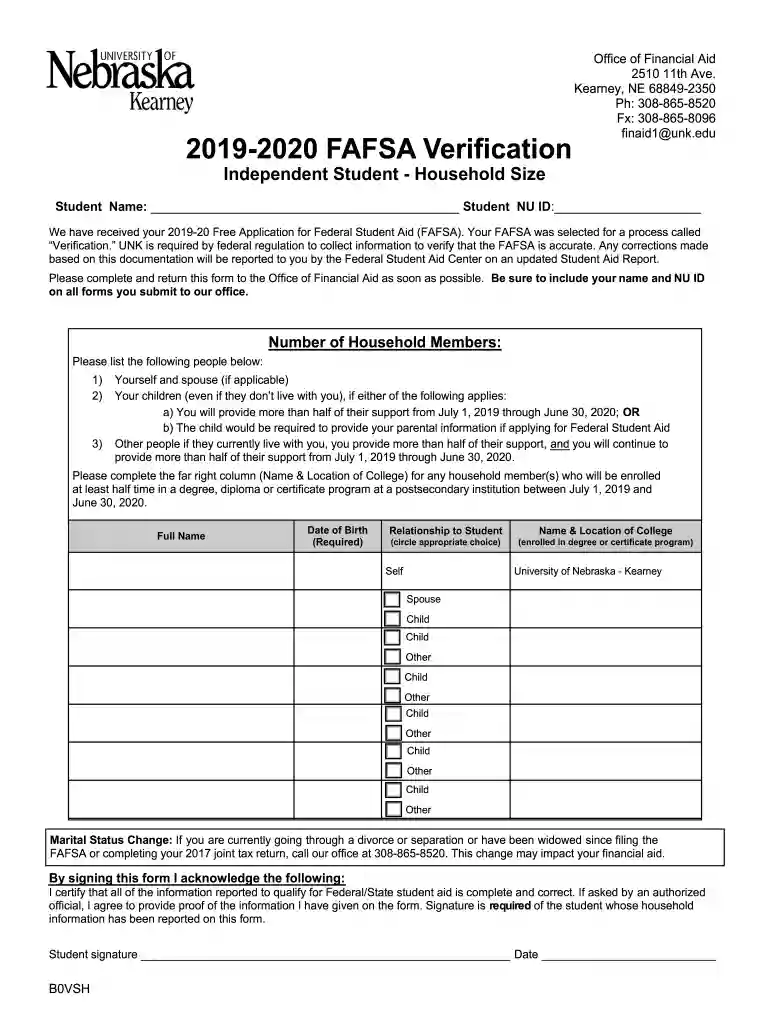
An Independent Student - Household Size form is a verification document commonly associated with the Free Application for Federal Student Aid (FAFSA). This form plays a critical role in determining a student's eligibility for financial aid by verifying their household size, which includes family members supported by the student or household contributions. A student's financial aid package is influenced by the number of people in their household, as it directly affects the analysis of financial burden and need. The form is specific to independent students, who are those that meet criteria set by the FAFSA for financial independence from parental support.
To effectively use the Independent Student - Household Size form, follow these steps:
Gather Information: Collect details about every individual who qualifies as part of your household, including their relationship to you and their enrollment status in college, if applicable.
Complete the Form: Fill out the form with accurate data. You must provide specifics on household members, including spouses, children, or others who live with you and receive more than half of their support from you.
Verify Accuracy: Double-check the information for completeness and correctness to avoid delays in the financial aid process.
Submit the Form: Submit the form by the deadline outlined by your institution's financial aid office. Make sure to follow any specific submission guidelines they provide.
Through this structured approach, you ensure that your financial aid eligibility is assessed based on a comprehensive and correct household size representation.
Identify Household Members: Determine who constitutes your household. Include yourself, your spouse (if married), and any dependents who rely on you for more than half of their support.
Record Relationships: Document the relationship of each household member to you as accurately as possible. This can include children, dependents, or other family members supported financially by you.
Assess College Enrollment: Mark which household members are enrolled at least half-time in college during the relevant academic year. This information influences financial aid awards.
Confirm Details: Review all entries to make sure everything is accurate and consistent with supporting documentation, such as tax returns or enrollment records.
Sign and Date: Ensure the form is signed by the student to validate the information and to authorize the use of the data by the financial aid office.
Careful completion of these steps contributes to an efficient evaluation of your financial aid eligibility.
For independent students to accurately fill out the Household Size form, they must meet certain eligibility requirements defined by the Department of Education. The criteria include:
Age and Marital Status: At least 24 years old or legally married as of the FAFSA submission date.
Parental Dependency: Not claimed as a dependent by parents for financial aid purposes, often verified through tax return information.
Military Service or Orphan/Ward Status: Veterans or individuals with orphan status or who have been a ward of the court at any time since age 13.
Graduate Studies: Enrolled as a graduate or professional student, indicating a higher level of study beyond undergraduate education.
Meeting these conditions classifies the student as independent, allowing them to complete the form without parental information influencing their financial aid package.


To effectively fill and submit the Independent Student - Household Size form, necessary documentation must be prepared:
Tax Returns: Recent federal tax returns for yourself and your spouse (if applicable) to substantiate income and dependency status.
Proof of Enrollment: College registration documents for household members enrolled at least half-time.
Identification: Government-issued IDs for verification of identity and age.
Marriage or Legal Status Documents: If applicable, include marriage certificates or court documents demonstrating legal status changes relevant to household composition.
By having these documents ready, you can ensure accurate and complete form submission.
Important aspects of the Independent Student - Household Size form include:
Household Composition: Details on family members supported financially, directly impacting financial aid determination.
Financial Responsibility: Verification of support provided to household members, aligning with federal regulations and contributing to an accurate financial aid assessment.
Signatory Requirement: Student's signature for validation, affirming that provided details are true and correct.
By focusing on these key elements, students can effectively complete the form and facilitate the financial aid process.
The form must comply with legal standards set forth by the Department of Education. Legal use entails:
Verification Purpose: Used solely for verifying financial need related to federal student aid.
Privacy Compliance: Adherence to confidentiality protocols to protect submitted personal information.
Signature Functionality: Signatures, whether digital or physical, must be valid and uphold integrity requirements specified by financial aid administrators.
These legal requirements ensure that the form is utilized correctly, contributing to fair financial aid distribution.
Submitting the form requires adherence to defined submission methods, including:
Online Submission: Preferred by many institutions for its efficiency. Forms can be uploaded through the school's financial aid portal, ensuring prompt processing.
Mail: Some institutions allow forms to be mailed, but this method may take longer and requires anticipation of mailing times to meet deadlines.
In-Person Submission: Directly submit the form at the financial aid office to receive immediate confirmation of receipt.
Choosing the appropriate submission method can influence processing speed and confirmation, making it crucial to follow institutional guidelines.
Failure to comply with submission and accuracy guidelines can result in several penalties, including:
Delayed Approval: Incorrect or incomplete forms may lead to significant delays in financial aid determination.
Aid Denial: Persistent inaccuracies or non-submissions can result in the denial of financial aid eligibility.
Legal Repercussions: Intentionally falsifying information may lead to severe legal consequences, including fines or criminal charges.
Understanding these penalties emphasizes the importance of preciseness and punctuality in the form submission process.
Consider scenarios where the form is essential:
Graduate Students: Sandy, a graduate student returning to school after working, uses the form to establish her independent status, reflecting her financial and household composition.
Married Couples: Tom and his spouse fill the form jointly to account for shared expenses and educational costs that impact their aid decisions.
Veterans: Chris, a veteran enrolled in college, submits the form to detail his household after service, ensuring veteran benefits align with his education aid.
These examples illustrate the varied contexts in which the form is applicable, highlighting its role in diverse student demographics.
While the form generally follows federal guidelines, state-specific rules may apply, including variations in:
Documentation Requirements: Certain states may request additional verification documents to substantiate household claims.
Submission Deadlines: Deadlines can vary based on state funding cycles and may require earlier submission outside federal timelines.
State-Specific Aid Programs: States might have unique aid programs that demand supplemental forms or information beyond the standard federal requirements.
Navigating these state variations is crucial to ensure compliance and eligibility for state-specific aid packages.
We've got more versions of the Independent Student - Household Size form. Select the right Independent Student - Household Size version from the list and start editing it straight away!
At DocHub, your data security is our priority. We follow HIPAA, SOC2, GDPR, and other standards, so you can work on your documents with confidence.
When you are completing the FAFSA or verification, the household size you will need to use is that of your parent(s)s household, even if you do not live with
Frequently asked questions and answers about virtual currency transactions.
The following persons may be included in the household size of an independent student: - the student; - the students spouse, excluding a spouse not living


