




01. Edit your form online
Type text, add images, blackout confidential details, add comments, highlights and more.

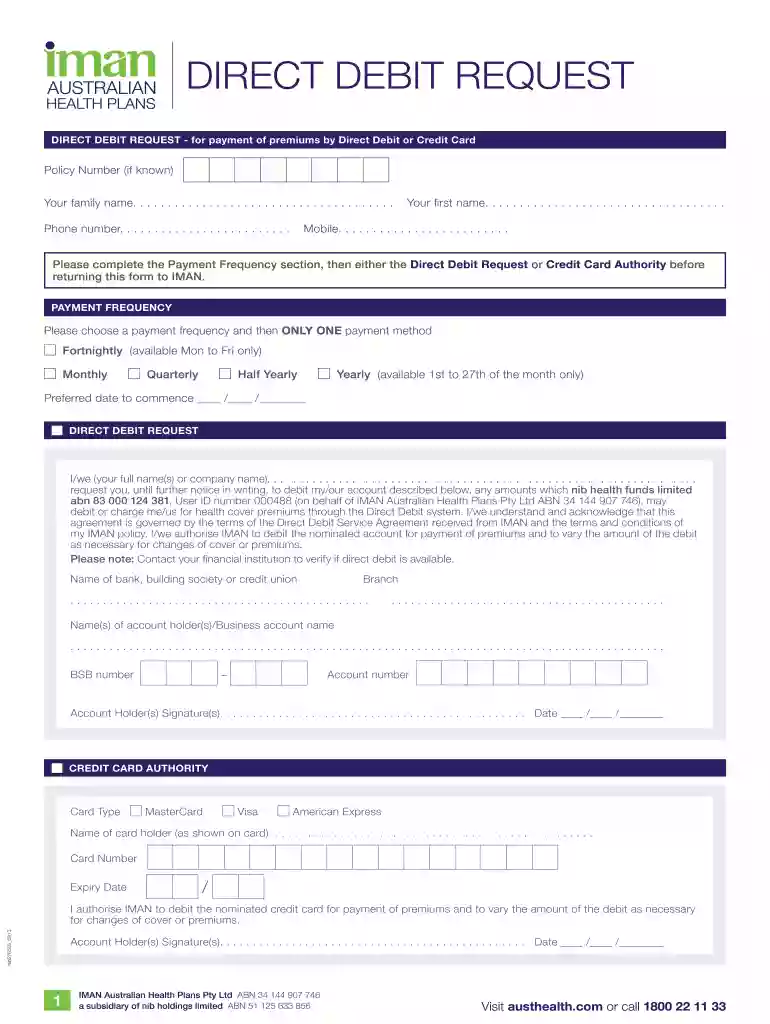
Type text, add images, blackout confidential details, add comments, highlights and more.

Draw your signature, type it, upload its image, or use your mobile device as a signature pad.

Send it via email, link, or fax. You can also download it, export it or print it out.
A Direct Debit Request is a formal document used for authorizing automatic payments of premiums through direct debit or credit card. It is typically used in contexts such as health insurance plans, where consistent and regular payments are required. By completing a Direct Debit Request, users permit the service provider, like IMAN Australian Health Plans, to withdraw funds directly from their account or charge their credit card based on a predefined schedule. This ensures timely payment without the need for manual transactions each cycle. The main goal is to streamline payment processes through automation, thus reducing the potential for missed payments and ensuring continuity of coverage or service.
Once obtained, using the Direct Debit Request involves several key steps to ensure proper setup and execution of payments:
Personal Information: Complete the section with accurate personal details to identify the payee and link the account effectively.
Payment Details: Define payment frequency and amount to ensure alignment with your financial planning and service terms.
Authorization: Carefully review the authorization section to understand your rights and obligations, including terms on fund withdrawal and service termination.
Security Measures: Consider adding a password or personal identification number for security, especially if your financial institution suggests it.
Submission: Submit the completed form to the service provider through the prescribed method—whether online, mail, or in-person—to initiate the debit program.
Completing these steps ensures the form is properly utilized and the payment process commences without delays or complications.
To successfully complete the Direct Debit Request form, follow these detailed steps:
Review and Gather Information: Assemble all necessary information, including your billing and account details, before starting the form to ensure accuracy.
Fill in Personal Details: Provide complete and correct personal information such as name, address, and contact details.
Choose Payment Method: Decide between direct debit or credit card payment, noting any fees or interest rates associated with each option.
Enter Financial Account Details: For direct debit, add bank account information, including account and routing numbers. For credit card, include card number and expiration date.
Specify Payment Frequency: Choose how frequently payments will occur—weekly, biweekly, monthly, or otherwise—based on your insurance company's offerings.
Read Authorization Clause: Thoroughly read and understand your consent for automatic withdrawals, which includes rights to modify or cancel the arrangement.
Sign the Form: Provide your signature to finalize the authorization, acknowledging your agreement to the terms outlined in the document.
Submit: Turn in the completed form using the method required by the service provider, ensuring your bank details are secured appropriately.
Using a Direct Debit Request provides several benefits:
Given these advantages, utilizing a direct debit mechanism can significantly simplify financial management and enhance security.
Understanding the following key terms is essential for navigating and completing a Direct Debit Request:
Payer and Payee: The payer is the individual authorizing payment, while the payee is the service provider receiving payment.
Authorization: The formal consent given by the payer to the payee to deduct amounts from their financial account.
Deposit Institution: The bank or financial entity holding the payer’s account from which funds will be debited.
Payment Frequency: The periodic schedule agreed upon for the withdrawal of funds (monthly, quarterly, etc.).
Cancellation Rights: The conditions under which a payer can revoke authorization or change the payment method with advance notice.
These definitions form the backbone of comprehending direct debit transactions within the scope of insurance premium payments.
When dealing with a Direct Debit Request, several fundamental components must be completed to validate the form:
Section for Account Details: Includes fields for bank or credit card data, critical for linking the financial source with the payments.
Authorization Signature: A mandatory section where the payer agrees to the terms of debit, legally solidifying the agreement.
Personal Identification Section: Space designated for input of personal details ensuring identification accuracy.
Terms and Conditions: A detailed outline of payer and payee responsibilities, including coverage of error resolution protocols.
Understanding and completing these sections is crucial for a smooth execution of the debit process, ensuring compliance with the service agreement.
The Direct Debit Request holds legal weight under specific U.S. regulations:
ESIGN Act Compliance: This federal law ensures electronic signatures are valid and enforceable, applicable if digital submission is involved.
Rights to Cancel: Legal provisions grant the right to terminate or change debit authorizations with advance written notification.
Dispute Resolution: Terms under which payers can dispute unauthorized transactions or errors in charged amounts.
Notification Requirements: Parties must comply with designated notification periods for changes in the amount or frequency of transactions.
These legal parameters support the enforceability and compliance of direct debit agreements, providing protections to involved parties.
Both digital and paper versions of the Direct Debit Request are available, each with its benefits:
Digital Version:
Paper Version:
Regardless of the chosen method, both versions require the same thoroughness in completion to ensure a valid authorization process.
Consider these practical scenarios for using a Direct Debit Request form:
Health Insurance Premiums: Automatically remitting monthly insurance premiums without the need for manual payment action is a common use.
Regular Subscription Services: Employing a direct debit for periodic subscription fees, e.g., gym memberships or streaming services.
Loan Repayment: Ensuring timely deductions to service loan interest and principal, negating late fees.
These examples illustrate the utility of direct debit requests in creating structured financial obligations for diverse services.
We've got more versions of the DIRECT DEBIT REQUEST - for payment of premiums by Direct Debit or Credit Card form. Select the right DIRECT DEBIT REQUEST - for payment of premiums by Direct Debit or Credit Card version from the list and start editing it straight away!
At DocHub, your data security is our priority. We follow HIPAA, SOC2, GDPR, and other standards, so you can work on your documents with confidence.
N.J. Admin. Code 11:1-24.3 - Use of credit cards, charge cards, debit cards, and direct account deduction (alternative payment method) for payment of premiums.
To activate your Direct Debit service, please complete and return the enclosed Direct Debit Request with confirmation of your savings or cheque account
Jul 29, 2025 Its convenient file early and make a payment by debit/credit card later. The payment date will be the date the charge is authorized. Need


