




01. Edit your form online
Type text, add images, blackout confidential details, add comments, highlights and more.

Type text, add images, blackout confidential details, add comments, highlights and more.

Draw your signature, type it, upload its image, or use your mobile device as a signature pad.

Send it via email, link, or fax. You can also download it, export it or print it out.
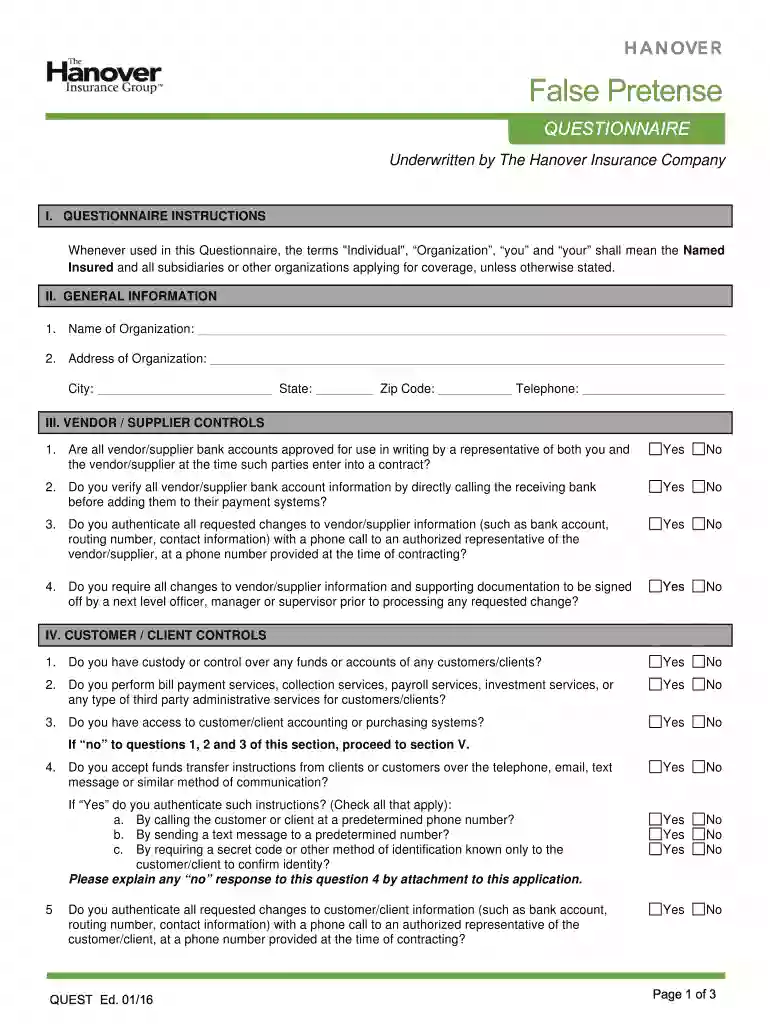
The " False Pretense Questionnaire docx" is a specialized document created by The Hanover Insurance Company. This questionnaire evaluates the controls and risk management practices an organization employs when dealing with vendors, suppliers, customers, and clients. It focuses on assessing the potential risk of false pretenses, particularly in scenarios involving fraud or deceit. The document includes sections for gathering general information, evaluating vendor and supplier controls, understanding internal wire transfer requests, and assessing previous loss experiences related to fraudulent activities. Legal notices are included to ensure compliance with anti-fraud measures, making this document critical for organizations seeking to maintain robust risk management protocols.
The False Pretense Questionnaire contains several important sections that help in evaluating an organization's risk exposure:
This questionnaire serves as a tool to ascertain compliance with legal standards for anti-fraud measures. The information provided by a company in the document can be used to evaluate their eligibility and readiness for specific insurance products offered by The Hanover Insurance Company. Misrepresentation or omission of critical data can lead to legal consequences, including the denial of coverage or claims. Thus, accuracy and honesty in completing the form are paramount.
Organizations applying for insurance coverage from The Hanover Insurance Company typically use this questionnaire. It is essential for risk managers, compliance officers, and senior management who oversee vendor and supplier relationships, internal operations, and client interactions. These stakeholders rely on the document to ensure the company adheres to necessary due diligence and risk management practices, providing evidence of robust internal control systems.


Completing the form requires presenting various documents that substantiate the answers provided within the questionnaire:
While the general format of the Questionnaire remains consistent, certain states may have additional requirements or modifications in their assessment of false pretenses. Organizations should therefore verify any state-specific mandates, such as particular reporting standards or additional control measures, to ensure full compliance. Consulting with local legal experts can provide clarity on any additional obligations specific to the jurisdiction where the organization operates.
We've got more versions of the 119-9320 False Pretense Questionnaire docx form. Select the right 119-9320 False Pretense Questionnaire docx version from the list and start editing it straight away!
At DocHub, your data security is our priority. We follow HIPAA, SOC2, GDPR, and other standards, so you can work on your documents with confidence.


