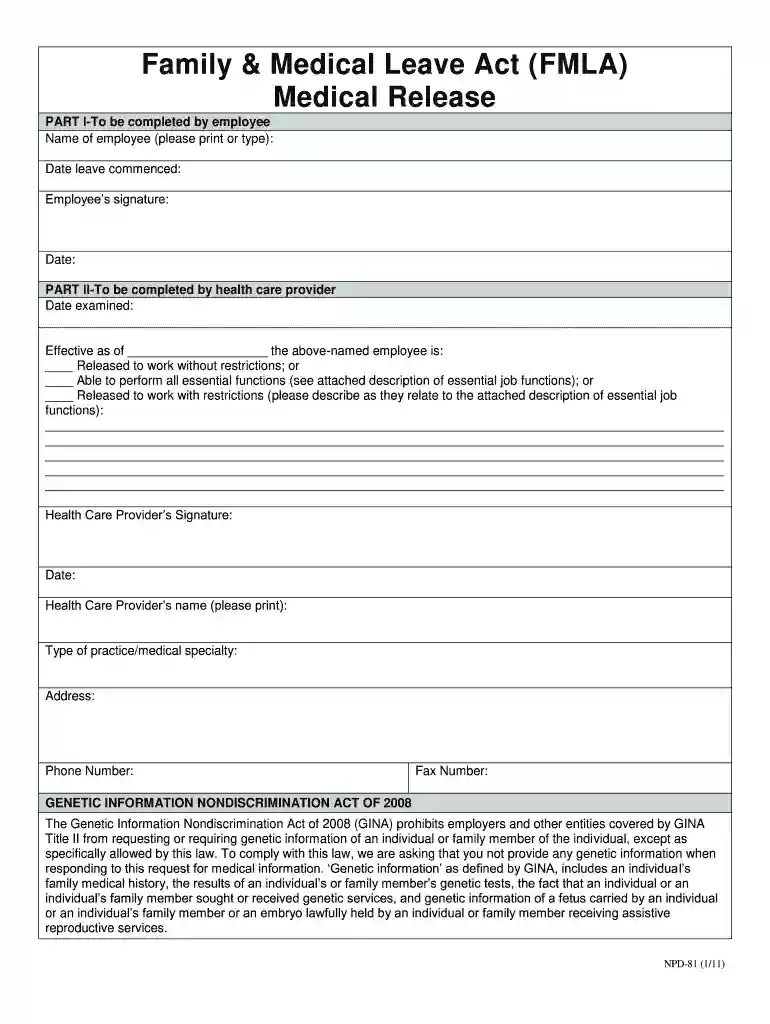
Family and Medical Leave Act (FMLA) Medical Release 2026

Get Form
Family and Medical Leave Act (FMLA) Medical Release Preview on Page 1

Here's how it works

01. Edit your form online
Type text, add images, blackout confidential details, add comments, highlights and more.

02. Sign it in a few clicks
Draw your signature, type it, upload its image, or use your mobile device as a signature pad.

03. Share your form with others
Send it via email, link, or fax. You can also download it, export it or print it out.

Definition and Meaning of the FMLA Medical Release

The Family and Medical Leave Act (FMLA) medical release form is a crucial document employers use to determine an employee's eligibility for leave under the FMLA. This form typically includes sections for the employee to provide personal information and for the healthcare provider to assess the employee's medical condition. The purpose is to certify that the employee, or a covered family member, has a serious health condition requiring FMLA leave.

Key Components

  • Employee Information: Essential personal details such as name, position, and employment status.
  • Healthcare Provider Assessment: Medical evaluations that ascertain the employee's ability to work or need for leave.
  • Confidentiality and Compliance: Adherence to the Genetic Information Nondiscrimination Act (GINA), prohibiting genetic information collection during the process.

Importance

The FMLA medical release form ensures that employees receive leave benefits while protecting employers by verifying the medical necessity of the absence.

How to Use the FMLA Medical Release

Using the FMLA medical release requires a careful approach to ensure compliance and effectiveness. Here is how to properly handle the process:

  1. Gather Necessary Details: Employees must complete their section with accurate personal and employment information.
  2. Consult Healthcare Provider: Provide the form to your healthcare provider to verify the medical need for leave.
  3. Submit to Employer: After completion, submit the form to the employer's HR department or designated FMLA administrator.

Practical Examples

  • Employee Case: An employee experiencing a chronic condition, such as diabetes, submits an FMLA medical release to accommodate frequent medical appointments.
  • Family Care: An employee uses FMLA leave to care for a parent recovering from surgery, with a completed medical release justifying the leave duration.

Steps to Complete the FMLA Medical Release

Completing the FMLA medical release involves several distinct steps, ensuring the document is filled out accurately and comprehensively.

  1. Complete Employee Information: Provide personal and employment-related details.
  2. Healthcare Provider Section: Allow your doctor or specialist to fill out medical assessments, treatment plans, and expected leave duration.
  3. Confirmation and Submission: Review the form for completeness, sign where required, and submit to the pertinent department.

Detailed Instructions

  • Employee Signature: Sign the form to authorize the release of medical information.
  • Provider's Section: Confirm that all medical details, including expected recovery periods and limitations, are included.

Key Elements of the FMLA Medical Release

Understanding the essential elements of the FMLA medical release form can help ensure it meets all legal and procedural requirements.

Essential Fields

  • Medical Diagnosis: A detailed diagnosis from a recognized healthcare provider relating to the FMLA leave request.
  • Treatment Plan: Information on ongoing or anticipated treatments necessitating leave.
  • Leave Duration: Expected length and terms of leave required, according to medical advice.

Examples

  • An employee with a post-operative recovery period requires documentation specifying expected duration and type of care needed for this time.

Legal Use of the FMLA Medical Release

The legal framework surrounding the FMLA medical release emphasizes compliance with federal laws, ensuring all parties respect employee rights and maintain confidentiality.

Compliance Requirements

  1. Employee Consent: Must be obtained to legally handle medical information.
  2. Non-Discrimination: Employers cannot use the information to discriminate against the employee.

GINA Considerations

  • Avoid incorporating genetic information collection, compliant with GINA, which safeguards against genetic discrimination in employment contexts.

Who Typically Uses the FMLA Medical Release

The FMLA medical release form is a tool most common among specific groups within the workforce.

decoration image ratings of Dochub

Primary Users

  • Employees Needing Medical Leave: Primarily those with significant medical conditions.
  • Employers and HR Departments: To verify the legitimacy of leave requests and maintain compliance.

Use Cases

  • An HR specialist regularly processes FMLA requests, ensuring forms are accurately completed and employees are informed of their rights.

Important Terms Related to the FMLA Medical Release

Familiarity with terminology related to the FMLA medical release can enhance understanding and facilitate proper use.

Terms and Definitions

  • Serious Health Condition: A condition involving hospitalization or continued treatment by a healthcare provider.
  • Intermittent Leave: FMLA leave taken in separate blocks of time due to a single qualifying reason.

Usage Context

Understanding these terms can help both employees and employers navigate the complexities of FMLA leave more effectively.

State-Specific Rules for the FMLA Medical Release

While the FMLA is a federal law, variations can occur in its application across different states, impacting the medical release process.

State Variations

  • State Mandates: Some states provide additional leave entitlements beyond FMLA provisions.
  • Compliance with State Laws: Employers must understand both federal and state-specific regulations.

Example

  • California's Pregnancy Disability Leave may offer additional benefits related to FMLA leave, requiring nuanced application processes.

See more Family and Medical Leave Act (FMLA) Medical Release versions

We've got more versions of the Family and Medical Leave Act (FMLA) Medical Release form. Select the right Family and Medical Leave Act (FMLA) Medical Release version from the list and start editing it straight away!
Versions Form popularity Fillable & printable
2015 4.8 Satisfied (91 Votes)
2011 4.3 Satisfied (193 Votes)
be ready to get more

Complete this form in 5 minutes or less

Get form

Got questions?

We have answers to the most popular questions from our customers. If you can't find an answer to your question, please contact us.
Contact us
Employees cannot waive, nor may employers induce employees to waive, their prospective rights under the FMLA. This does not prevent the settlement of FMLA claims by employees based on past employer conduct without the approval of the DOL or a court.
What is the average settlement for the FMLA lawsuit? According to Guardian Life and ESIS, the average FMLA lawsuit settlement in California and the rest of the US is roughly $80,000.
You have a right under the FMLA to take unpaid, job-protected FMLA leave in a 12-month period for certain family and medical reasons, including up to 12 weeks of unpaid leave in a 12-month period for the birth of a child or placement of a child for adoption or foster care, for leave related to your own or a family
Yes, you can be fired once your FMLA leave has been exhausted. The FMLA also doesnt offer you any job additional protections as long as the firing isnt discriminatory.
No particular order or form of records is required. However, employers must keep the records specified by FMLA regulations for no less than three years and make them available for inspection, copying and transcription by DOL representatives upon request.

Security and compliance

At DocHub, your data security is our priority. We follow HIPAA, SOC2, GDPR, and other standards, so you can work on your documents with confidence.

Learn more
ccpa2
pci-dss
gdpr-compliance
hipaa
soc-compliance

People also ask

If you do not take all of the 28 weeks of leave within the 52-week period, you will lose the remaining weeks. You can take separate, non-consecutive shorter periods of leaves (not to exceed the 28-week maximum) within the 52-week period if your family member has several episodes of a serious medical condition.
While employees are on FMLA leave, employers must continue health insurance coverage as if the employees were not on leave. Upon return from FMLA leave, most employees must be restored to the same job or one nearly identical to it with equivalent pay, benefits, and other employment terms and conditions.
Medical Leave: Both can cater to medical needs, such as recuperation from a serious illness or undergoing medical treatment. Parental Leave: FMLA specifically offers leave for the birth or adoption of a child, while leaves of absence may also be provided for parental leave based on the employers policies.

Related links