




01. Edit your form online
Type text, add images, blackout confidential details, add comments, highlights and more.

Type text, add images, blackout confidential details, add comments, highlights and more.

Draw your signature, type it, upload its image, or use your mobile device as a signature pad.

Send it via email, link, or fax. You can also download it, export it or print it out.
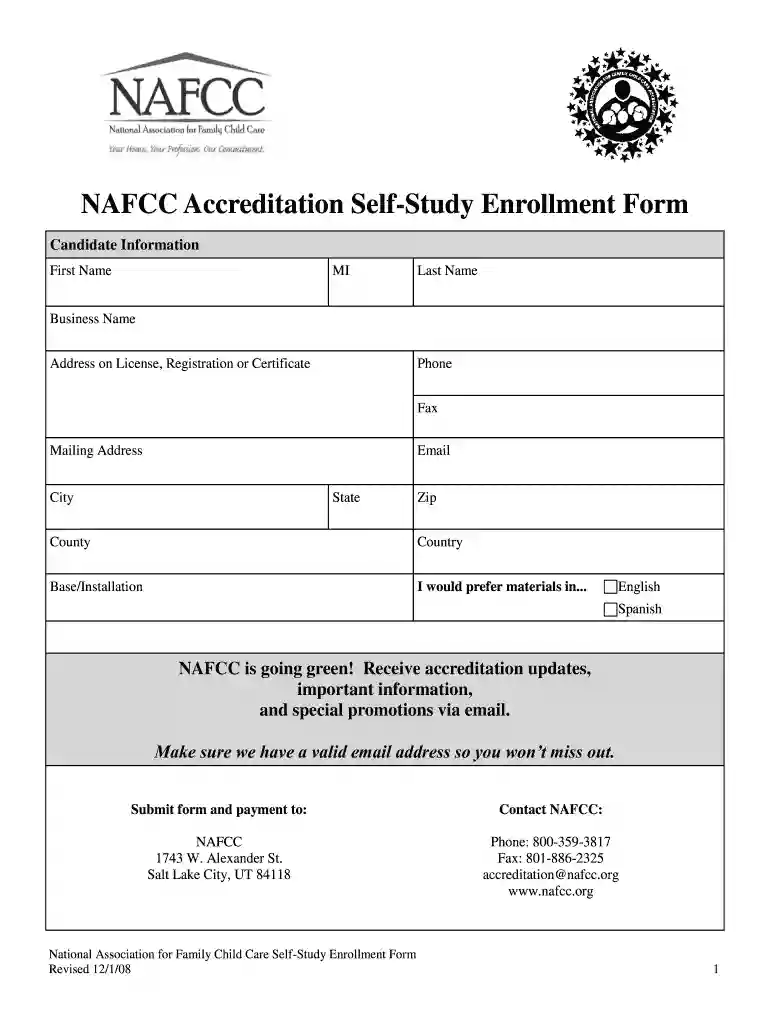
NAFCC forms play a pivotal role in the accreditation process for the National Association for Family Child Care (NAFCC). These forms are essential in documenting self-study enrollment, candidate information, and membership applications for childcare providers seeking accreditation. Primarily, the form ensures that candidates provide comprehensive details needed for membership evaluation and payment processing. Understanding the purpose and structure of NAFCC forms helps candidates accurately complete them and leverage the benefits of accreditation.
Utilizing NAFCC forms effectively requires familiarization with their components. These forms generally consist of sections for candidate information, payment details, and optional fields for membership applications. To use the form, candidates should:
Review Requirements: Begin by understanding the specific information needed for each section.
Provide Accurate Information: Accurately fill out personal and professional data, including name, address, and childcare experience.
Indicate Membership Status: Specify whether they are applying as a new member or renewing existing membership.
Select Payment Method: Choose from the available payment methods and ensure all related details are correctly entered.
Submit the Form: Follow the instructions for submission, either through mail or online, if applicable.
Practicing these steps can streamline the accreditation process and ensure timely processing of the documents.
NAFCC forms are readily available to childcare providers aspiring for accreditation. Providers can obtain these forms through several methods:
Official Website: The most reliable source is the NAFCC's official website, where downloadable PDF versions are available.
Email Requests: Some candidates prefer requesting forms via email, especially if they have specific queries or require guidance.
Certification Workshops: Workshops and training sessions often provide physical copies of the forms.
Professional Associations: Affiliating with local or regional professional childcare associations might also offer access to necessary forms, coupled with expert advice on completing them.
These methods ensure that candidates have easy access to the required forms, facilitating their preparation for accreditation.
Completing NAFCC forms is a structured process, requiring attention to detail and accuracy. The steps involved are:
Gather Required Documents: Start by collecting supporting documents such as identification, proof of childcare experience, and any prior certifications.
Personal Information: Enter accurate personal details like full name, contact information, and residential address.
Professional Experience: Describe relevant professional experience, highlighting any previous childcare roles and qualifications.
Membership Options: If the form includes membership application elements, indicate the preference for membership types.
Review and Verify: Carefully review all entered data to ensure accuracy and completeness. Cross-check with supporting documents.
Selection of Payment Method: Choose an appropriate payment option, fill in necessary details, and record any payment confirmation numbers for future reference.
Finalize and Submit: Once finalized, follow submission instructions—whether via mail or online—to complete the process.
These steps aim to minimize errors and ensure that the forms are processed efficiently.
Understanding the vital components of NAFCC forms enhances the clarity and accuracy of the application process. The key elements typically include:
Personal Information Section: Essential for identifying and contacting candidates.
Professional Background: Includes fields for educational qualifications, work experience, and previous accreditations.
Membership Application (if applicable): Opportunity to apply for or renew membership with the NAFCC, facilitating professional networking and resources.
Payment Details: Includes options for fee payment, essential for processing the application.
Submission Instructions: Guidelines for submitting completed forms, ensuring applications reach the right department for processing.
These elements ensure comprehensive data collection while guiding candidates through the accreditation requirements.
Familiarity with the terminology used in NAFCC forms can simplify the completion process. Important terms include:
Accreditation: The process through which childcare providers demonstrate compliance with NAFCC's standards.
Self-Study Enrollment: A preparatory phase where providers assess their practices relative to standard criteria.
Membership Options: Refers to different levels of engagement with NAFCC, each offering various benefits.
Payment Processing: Involves the submission of fees required for form processing and membership dues.
Understanding these terms aids in navigating the forms effectively and meeting the necessary accreditation criteria.
Given that childcare regulations can vary significantly across states, it is crucial to understand state-specific requirements when filling out NAFCC forms. Candidates should:
Research State Regulations: Begin by comprehensively understanding local childcare laws and how they impact accreditation.
State Certification Requirements: Determine if state-specific certifications are necessary and ensure compliance before submitting forms.
Varying Fee Structures: Be aware that some states might have different fee structures or additional regulatory costs tied to accreditation.
Consult Local Authorities: When in doubt, reach out to state licensure bodies or childcare associations for clarification on regulations affecting the NAFCC forms.
By aligning submission practices with state-specific rules, applicants can guarantee compliance and prevent processing delays.
Several practical scenarios illustrate the use of NAFCC forms:
Case of a New Provider: A new childcare provider looking to establish credibility in the industry uses the form to apply for NAFCC accreditation, guiding them through self-assessment and qualification documentation.
Member Renewal: An existing member renews their accreditation through the form, updating personal information and professional advancements to maintain compliance and benefits.
Multiple Location Certifications: Providers managing several facilities utilize the form to ensure that each location meets NAFCC standards, thus broadening their operational credibility and market reach.
These examples highlight the versatility of the forms in facilitating both new certifications and ongoing compliance in the childcare sector.
We've got more versions of the nafcc forms form. Select the right nafcc forms version from the list and start editing it straight away!
At DocHub, your data security is our priority. We follow HIPAA, SOC2, GDPR, and other standards, so you can work on your documents with confidence.
Sep 4, 2012 Review the annual update form for specific QI PD Report requirements. Refer to Chapter 13 in the Provider Guide for more Annual Update
NAFCC requires providers to submit documentation for assistants which includes, a copy of the health assessment form dated within the last 2 years, a copy of a


