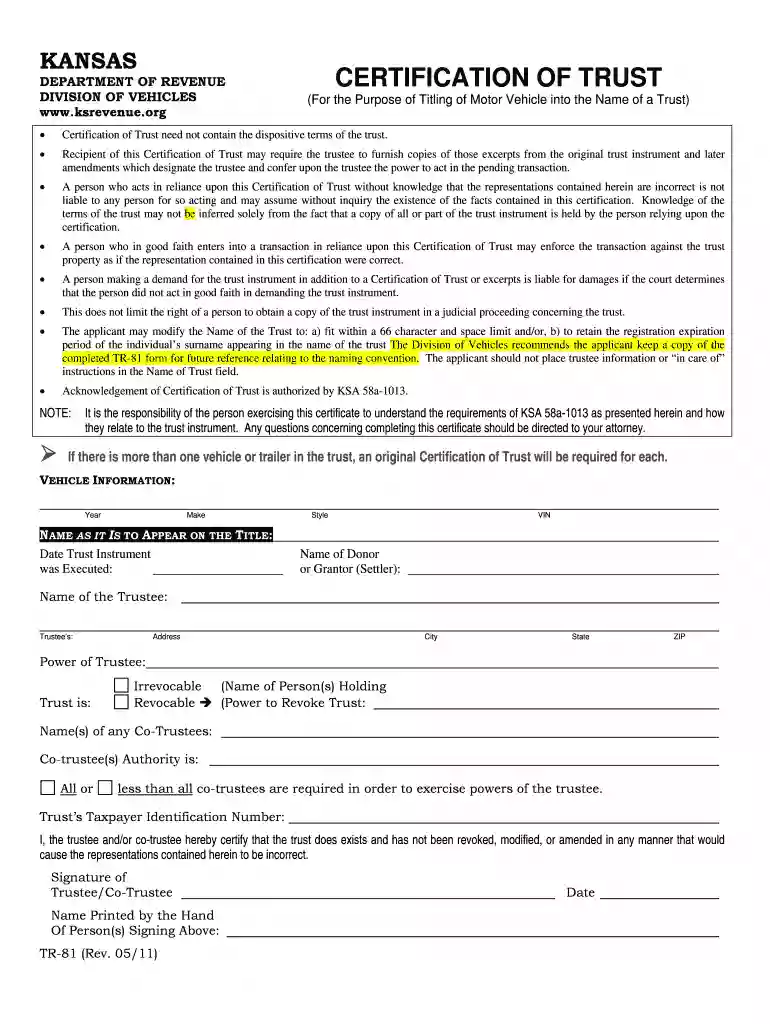
Definition & Meaning
The Certification of Trust (TR-81) from the Kansas Department of Revenue serves as a legal instrument indicating the existence of a trust and providing essential information about it without disclosing the trust's entire terms. This certification helps facilitate the titling of motor vehicles in Kansas, eliminating the need for third parties to scrutinize the complete trust document. By confirming its validity and key elements—such as the trustees' identities and powers—it assists in streamlining various legal and administrative processes.
Key Elements Defined
- Trust Name & Date: Legal title and establishment date confirm the identity of the trust.
- Trustee Information: Lists current trustees authorized to act on the trust's behalf.
- Powers of Trustees: Outlines the transactions and actions trustees are empowered to perform.
- Existence Confirmation: Legal assurance that the trust is currently active and valid.
How to Use the Certification of Trust (TR-81) - Kansas Department of Revenue - ksrevenue
The Certification of Trust (TR-81) is utilized primarily for titling motor vehicles under a trust in Kansas. It delineates the relevant trustees and their powers without divulging confidential trust details. When purchasing, selling, or transferring a vehicle, providing this certification ensures the trust's legal standing and the trustee's authority to engage in the transaction. Financial institutions or regulatory bodies reviewing the trust's role in transactions use it to verify the legitimacy and scope of trustee actions.
Practical Use Scenario
- Vehicle Registration: Presenting the Certification during registration confirms trustee authorization to title the vehicle under the trust.
- Sales Transactions: Ensures buyers and sellers that trustees have the power to sell or purchase vehicles.
- Loan Agreements: Secures the lender's confidence in the trust's participation in securing debts.
Steps to Complete the Certification of Trust (TR-81) - Kansas Department of Revenue - ksrevenue
Filling out the TR-81 form accurately is crucial for trust-related transactions. Below are the necessary steps:
- Identify the Trust: Clearly fill in the trust's official name and the date it was established.
- List Trustees: Provide comprehensive information about each trustee, including full name and contact details.
- Specify Trustee Powers: State the general powers granted to trustees relevant to the transaction.
- Sign and Date: The trustee—acting in their capacity—must sign and date the form, indicating consent and accuracy.
- Verify Document: Ensure the form contains all necessary signature acknowledgments or notarizations as required.
Tips for Accurate Completion
- Double-Check Names: Minor errors in spelling can lead to significant legal complications.
- Consult Legal Advice: If unclear about any section, seek guidance to prevent misunderstandings.
- Maintain Copies: Keep several copies for personal records, additional parties, and future verification purposes.
Important Terms Related to Certification of Trust (TR-81) - Kansas Department of Revenue - ksrevenue
Understanding specific legal terms in the context of the TR-81 guarantees better comprehension and reduces errors:
- Dispositive Terms: Details about how the trust's assets are to be distributed.
- Grantor/Settlor: The individual(s) who created the trust.
- Beneficiary: Persons or entities who benefit from the trust assets.
- Fiduciary Duty: The legal obligation trustees have to act in the trust's best interests.
Legal Use of the Certification of Trust (TR-81) - Kansas Department of Revenue - ksrevenue
The TR-81 form carries significant weight in various legal contexts by verifying the trust's legitimacy and trustee authority:
- Asset Management: Confirms trustee powers to direct trust assets, ensuring compliance with Kansas law.
- Legal Filings: Acts as evidence in legal proceedings, proving the trust's existence and the legal capacity of trustees.
- Third-Party Assurance: Provides assurance to third parties facilitating transactions with trusts, mitigating risk.
Legal Safeguards
- Notary Requirement: Certifying signatures may need a notary to validate, adding a layer of authenticity.
- State Compliance: Ensure compliance with the latest Kansas statutes concerning trust operations and documentation.
State-Specific Rules for the Certification of Trust (TR-81) - Kansas Department of Revenue - ksrevenue
Kansas-specific regulations govern the completion and use of the TR-81 form:
- Separate Certification: One certification per vehicle titled under a trust.
- Record Maintenance: Ensure copies are retained for state audits or inquiries.
- State Validation: Only Kansas Department validations are recognized for in-state legal processes.
Variations Across States
- Compliance: While Kansas has specific requirements, ensure compatibility if conducting business or registering vehicles in other states.
- Acknowledgments: Some states might not recognize out-of-state certifications without additional verification.
Examples of Using the Certification of Trust (TR-81) - Kansas Department of Revenue - ksrevenue
Real-world applications highlight the form's versatility:
- Trust-Owned Business Fleets: Businesses titled under trusts leverage the TR-81 for fleet management, ensuring titles reflect the correct ownership structure.
- Family Trusts: Families use the form to manage inheritances involving vehicle assets, ensuring smooth intergenerational transfers.
- Charitable Organizations: Trusts engaged in philanthropic activities utilize it to acquire vehicles necessary for operational logistics.
Customized Applications
- Commercial Transactions: Trusts entering leasing agreements require certification to demonstrate eligibility and commitment.
- Estate Planning: Plays a strategic role in managing estates where vehicles are significant assets.
Eligibility Criteria
Understanding who can utilize the Certification of Trust (TR-81) is vital:

- Active Trusts: Only valid and recognized trusts can apply for the certification.
- Authorized Trustees: Trustees must clearly demonstrate their authorization to act on the trust’s behalf.
- Intended Use: The trust must have a clear, intended purpose for involving motor vehicle transactions.
Verification Checklist
- Trust Documents: Confirm updated and accurate trust documentation is available.
- Identification: Trustees must provide valid identification matching the trust records.
- Purpose Justification: Clearly define the need for the certification relative to the trust’s activities.
Who Typically Uses the Certification of Trust (TR-81) - Kansas Department of Revenue - ksrevenue
The form serves a diverse group of users:

- Trustees: Individuals or entities responsible for managing trust assets.
- Legal Advisors: Lawyers facilitating trust transactions may prepare or review the certification.
- Financial Institutions: Banks requiring proof of a trustee's authority might request it during financial dealings.
Special Use Cases
- Investment Partnerships: Use for securing vehicle investments under shared trusts.
- Government Agencies: Agencies may need the form when involving trusts in regulatory compliance or benefits frameworks.