- tax alaska 2026

Get Form
- tax alaska Preview on Page 1

Here's how it works

01. Edit your form online
Type text, add images, blackout confidential details, add comments, highlights and more.

02. Sign it in a few clicks
Draw your signature, type it, upload its image, or use your mobile device as a signature pad.

03. Share your form with others
Send it via email, link, or fax. You can also download it, export it or print it out.

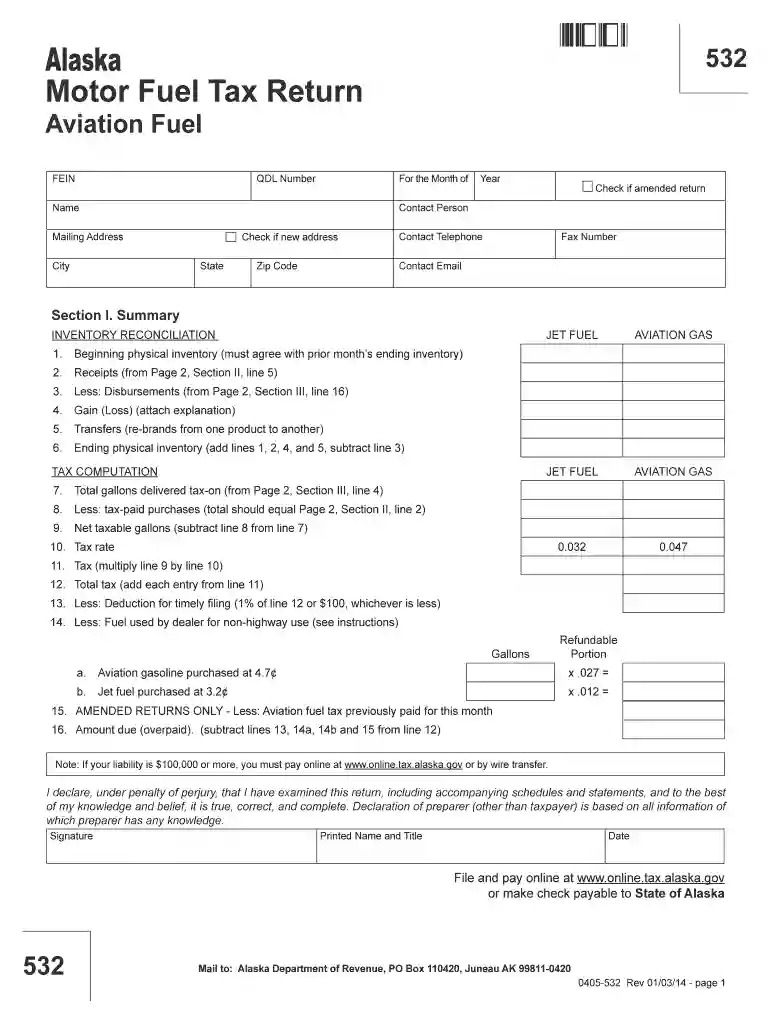
Definition & Meaning of the Alaska Motor Fuel Tax Return

The Alaska Motor Fuel Tax Return form is specifically designed for reporting aviation fuel transactions within the state. This form serves as a key document for individuals and businesses involved in the aviation sector, requiring them to accurately disclose their fuel usage, delivery, and exportation data. The form's primary purpose is to facilitate tax calculations based on the volume of aviation gasoline and jet fuel transactions.

Core Components of the Form

  • Inventory Reconciliation: This section captures the starting inventory, additions, and subtractions throughout the reporting period.
  • Tax Computation: Here, you compute the total tax owed based on fuel usage and applicable tax rates.
  • Receipts and Disbursements: Detailed schedules require documentation of gallons received, delivered, and exported.

Terminology Included

  • Jet Fuel: Refers to fuel specifically intended for turbine-engine aircraft.
  • Aviation Gasoline: Typically used in piston-engine aircraft.

Applicability and Scope

The form applies broadly to aviation fuel distributors in Alaska, ensuring compliance with state taxation laws.

How to Use the Alaska Motor Fuel Tax Return

The Alaska Motor Fuel Tax Return entails a systematic approach to reporting and paying aviation fuel taxes. Here's a breakdown of how to effectively utilize this form.

Initial Setup and Document Preparation

  1. Gather Supporting Documents: Includes invoices, receipts, and any prior tax return submissions.
  2. Review Past Transactions: Ensure accurate period coverage and precise reporting.

Detailed Form Completion Steps

  • Complete Inventory Section: Begin with inventory totals and reconcile changes.
  • Accurately Report Receipts: Enter detailed records of incoming aviation fuel.
  • Calculate Applicable Taxes: Use specified tax rates on total transactions.
  • Finalize with Signature: Ensure the form is signed for validity.

Necessary Adjustments

Corrections or amendments are required if inaccuracies surface post-submission, involving additional documentation or revised entries.

Steps to Complete the Alaska Motor Fuel Tax Return

Filing the Alaska Motor Fuel Tax Return requires precision and an understanding of each section’s requirements.

Gather All Required Information

  • Invoices and Receipts: For verifying transaction quantities.
  • Previous Tax Returns: Serve as reference points for consistency.

Formulating the Return

  • Fill Out Inventory Reconciliation: Establish beginning and ending figures.
  • Detailed Transaction Records: List receipts and disbursements meticulously.
  • Tax Computation and Totaling: Ensure comprehensive computations, including all relevant tax rates and credits.

Submission and Verification Process

  • Review the Entire Form: Double-check all entries for accuracy.
  • Attach Required Documentation: Include any supporting materials as specified.
  • Submission Options: Choose online, mail, or in-person as per your convenience.

Handling Discrepancies

In instances of discrepancies or errors, revisiting documentation and adjusting entries accordingly is crucial.

Why You Should File the Alaska Motor Fuel Tax Return

Participating in state tax processes is crucial for continuity and legal compliance, especially for aviation fuel distributors.

Legal Implications and Compliance

Filing this form ensures adherence to state laws governing fuel usage and tax responsibilities, thereby avoiding legal repercussions and penalties.

Financial Accountability

Accurate tax return submissions foster transparency and financial accuracy, supporting business credibility and fiscal planning.

Business Reputation and Trust

Consistent and timely filing enhances business reputation, especially in regulated industries such as aviation.

Key Elements of the Alaska Motor Fuel Tax Return

Understanding key sections and components of the Alaska Motor Fuel Tax Return is crucial for accurate filing.

Inventory and Reconciliation

  • Importance: Key for tracking fuel changes over the reporting period.
  • Approach: Requires careful tallying of initial, received, and used amounts.

Tax Computation

  • Purpose: Determines tax liability based on fuel volume.
  • Structure: Relies on accurate scaling against posted rates.

Detailed Reporting Sections

  • Component Breakdown: Separate listings for receipts and disbursements help in thorough documentation.
  • Verification Needs: Ensures detailed backing data supports reported figures.

Supplementary Instructions

Adhering to guidelines is essential for correct form completion, focusing on step-by-step clarity and accuracy.

Required Documents and Preparation

Comprehensive preparation involves assembling vital documentations that substantiate entries on the Alaska Motor Fuel Tax Return.

Document Gathering

  • Transaction Records: Official receipts and invoices for all fuel transactions.
  • Prior Filings: Use previous returns as benchmarks for consistency.

Preparing Documentation

  • Compilation Methods: Streamline records to simplify form completion.
  • Cross-Verification: Double-check data against form entries for alignment.

Importance of Accuracy

Accurate documentation minimizes errors, discrepancies, and potential audit flags, promoting a smooth filing process.

Important Terms Related to the Alaska Motor Fuel Tax Return

Grasping the terminology associated with the Alaska Motor Fuel Tax Return aids in its understanding and completion.

Commonly Used Terms

  • Gallons Received: Total volume of fuel acquired.
  • Tax Rate: Specific percentage or dollar amount applied to gallons for tax liability computation.

Usage Contexts

  • Glossary Availability: Consult provided glossaries or external resources for unfamiliar terms.
  • Industry-Specific Language: Stay informed on industry changes to ensure compliance with current standards.

Reference Material

Additional reference materials, such as state-specific guidelines or tax boards, can provide further explanation and insight into technical terms.

State-Specific Rules for the Alaska Motor Fuel Tax Return

Recognizing state-specific regulations is essential for successful compliance with Alaska’s motor fuel tax return requirements.

Regulation Compliance

  • State Mandates: Obligatory adherence to state-defined processes and deadlines.
  • Applicable Standards: Strict adoption of measured guidelines ensures uniform compliance.

Variations from Other States

  • Major Differences: Alaska’s regulatory environment may differ significantly from other states, necessitating specific attention.
  • Adaptation and Alignment: Ensure procedures align with state-specific legislation and economic circumstances.

Sources for State Rules

State government websites and ordinance documents provide primary insights into relevant legislative obligations.

With these focused sections, readers gain comprehensive insight into the intricate processes related to the Alaska Motor Fuel Tax Return, ensuring precise, effective, and compliant filing.

See more - tax alaska versions

We've got more versions of the - tax alaska form. Select the right - tax alaska version from the list and start editing it straight away!
Versions Form popularity Fillable & printable
2015 4.8 Satisfied (142 Votes)
2014 4.3 Satisfied (79 Votes)
be ready to get more

Complete this form in 5 minutes or less

Get form

Got questions?

We have answers to the most popular questions from our customers. If you can't find an answer to your question, please contact us.
Contact us
Five states have no statewide sales tax: New Hampshire, Oregon, Montana, Alaska, and Delaware.
With the pipeline, the petroleum industry boomed, increasing economic activity in the state. In subsequent years, Alaska was able to compensate for individual income tax revenue losses through growth in its severance tax and royalties from petroleum. These taxes amounted to 47 percent of state revenue in 2022.
If you make $100,000 a year living in the region of Alaska, United States of America, you will be taxed $22,671. That means that your net pay will be $77,329 per year, or $6,444 per month.
Alaska does not have a state sales tax but has an average combined state and local sales tax rate of 1.82 percent. Alaska has a 1.07 percent effective property tax rate on owner-occupied housing value.
There is no state sales tax in Alaska; however, local governments which include boroughs, the Alaska equivalent of counties, and municipalities may levy up a sales tax. Municipal sales taxes are collected in addition to borough sales taxes, if any. Regulations and exemptions vary widely across the state.

Security and compliance

At DocHub, your data security is our priority. We follow HIPAA, SOC2, GDPR, and other standards, so you can work on your documents with confidence.

Learn more
ccpa2
pci-dss
gdpr-compliance
hipaa
soc-compliance

People also ask

The typical sales tax rates within Alaska range from 2%-5%. Other types of local taxes levied are raw fish taxes, hotel/motel bed taxes, severance taxes, liquor and tobacco taxes, gaming (pull tabs) taxes and fuel transfer taxes.
There are some exemptions spelled out in state law; however, other than these, exemptions are a local issue. A sales tax is not authorized unless an election is held on the issue and it is approved by a majority of the voters.

Related links