







Definition & Meaning
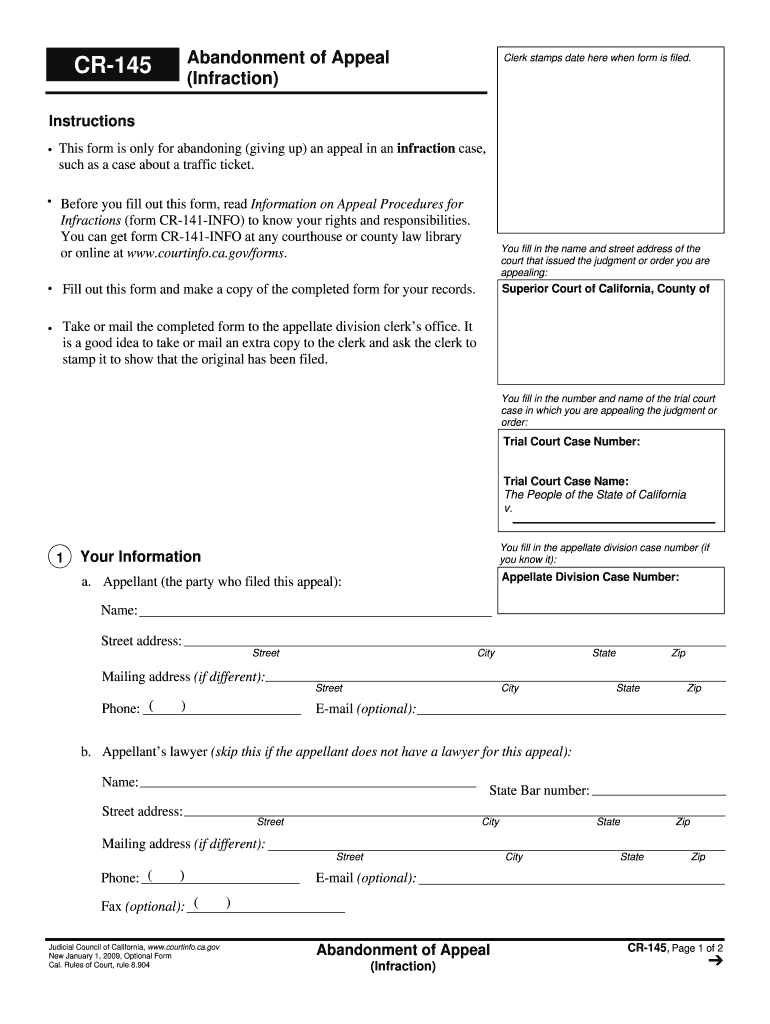
The "Judicial Council Forms Abandonment of Appeal 2009," designated as CR-145, is a formal legal document used in the context of infractions, such as traffic violations, where an appeal process has been initiated but is subsequently being abandoned by the appellant. Filing this form officially notifies the court of the appellant's decision to discontinue the appeal, effectively reverting any actions or proceedings to their status prior to the appeal. Its use aligns with specific procedural rules set by the judiciary to maintain order and clarity within the legal system.
Importance of Understanding the Form's Purpose
- Provides formal notification of appeal abandonment.
- Prevents unnecessary court hearings or proceedings.
- Ensures that the record accurately reflects the current status of the case.
Historical Context and Development
The form was developed as part of the standardization by the Judicial Council to streamline court processes and enhance communication across court systems.
Steps to Complete the Judicial Council Forms Abandonment of Appeal 2009
-
Identify the Court and Case Information
- Enter the court name, location, and your case number.
- This ensures the form is associated with the correct legal proceeding.
-
Fill in Appellant Details
- Include your full name and contact information.
- Verify that your details match those on the case record.
-
State the Reason for Abandonment
- Clearly articulate why you wish to withdraw the appeal.
- Brief statements are sufficient, as no extensive detail is required.
-
Sign the Form
- Provide your signature where indicated.
- This confirms your intent to abandon the appeal officially.
-
File the Form with the Court
- Submit the form in person or via mail, as specified by the court.
- Confirm receipt to ensure the form has been accepted and processed.
Common Mistakes to Avoid
- Incorrect case number: Double-check for accuracy.
- Missing signature: An unsigned form is not valid.
Legal Use of the Judicial Council Forms Abandonment of Appeal 2009
Compliance and Legal Standing
- Filing this form signifies compliance with court procedures.
- Upholds the appellant's rights by providing a formal mechanism to retract an appeal without penalty.
Situations Warrenting Use
- Reaching a settlement outside court.
- Reevaluating the likelihood of success after appealing.
Who Typically Uses the Judicial Council Forms Abandonment of Appeal 2009


Appellant Profile
- Individuals appealing an infraction ruling.
- Legal representatives acting on behalf of an appellant.
Impact on Legal Proceedings
- Halts the appeal process.
- Reverts the case to the previous court's decision.
Benefits for Appellants
- Saves time and resources by ceasing unnecessary court actions.
- Allows focus on alternative resolutions.
Important Terms Related to Judicial Council Forms Abandonment of Appeal 2009
- Appellant: The individual who files an appeal.
- Infraction: A minor violation, often related to traffic laws.
- Appeal: A request for a higher court to review a lower court's decision.
- Abandonment: Formal withdrawal from the appeal process.
Terminology Importance
- Accurate understanding of these terms ensures correct form usage.
- Misinterpretation can lead to procedural errors or unintended legal consequences.
State-Specific Rules for the Judicial Council Forms Abandonment of Appeal 2009
Variations in Processing
- Specific rules may differ by state, as some have unique filing procedures.
- Always verify state-specific guidelines to ensure compliance.
Examples of State Differences
- Filing deadlines might vary.
- Some states may require additional documentation.
Filing Deadlines / Important Dates
- Submit the form promptly upon deciding to abandon the appeal.
- Deadlines depend on individual court regulations; check local rules for stipulations.
Importance of Timely Submission
- Avoids accidental continuance of appeal proceedings.
- Ensures the court system is updated with the correct case status.
Form Submission Methods (Online / Mail / In-Person)
Options for Submission
- Online: Available in jurisdictions with digital capabilities.
- Mail: Traditional method; requires tracking for confirmation.
- In-Person: Direct submission allows immediate acknowledgment and feedback.
Advantages of Online Submission
- Faster processing and confirmation.
- Reduction in filing errors with digital checks and balances.
Penalties for Non-Compliance
Consequences of Failing to Abandon Correctly
- The appeal could be processed without appellant's participation.
- Possible legal ramifications if proceedings resume inadvertently.
Mitigation Strategies
- Contact the court if any doubts or issues arise during the filing process.
- Seek legal advice to ensure all procedures are correctly followed.


