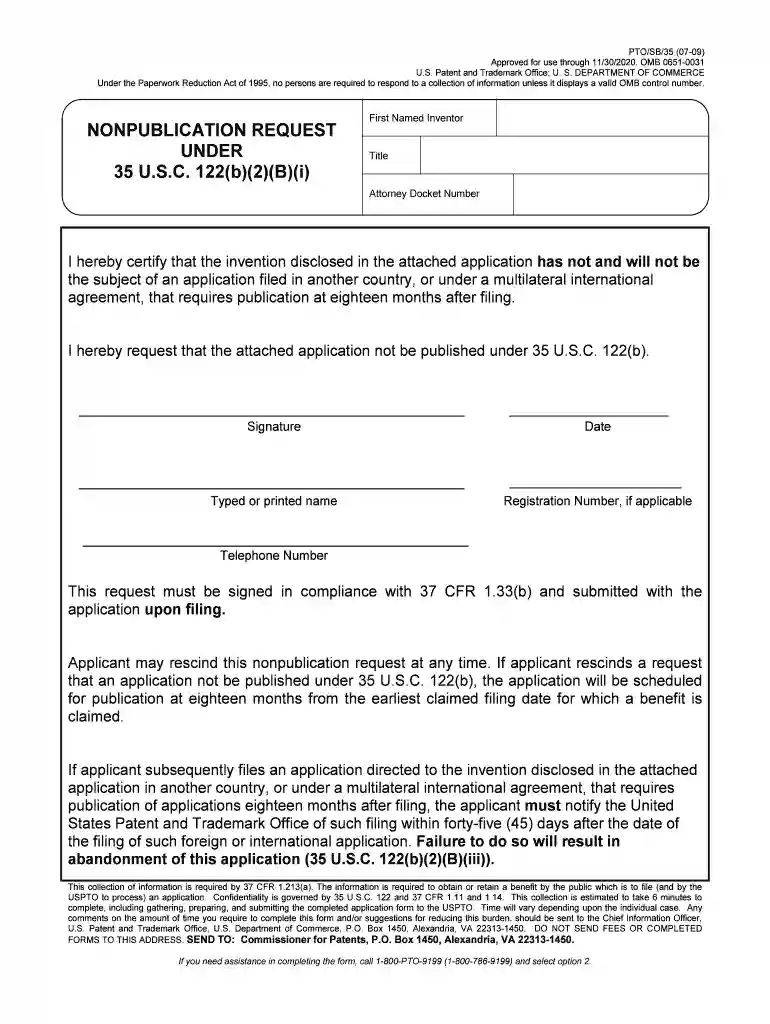
Patents patent 2026

Get Form
patents patent Preview on Page 1

Here's how it works

01. Edit your patents patent online
Type text, add images, blackout confidential details, add comments, highlights and more.

02. Sign it in a few clicks
Draw your signature, type it, upload its image, or use your mobile device as a signature pad.

03. Share your form with others
Send immigration form print via email, link, or fax. You can also download it, export it or print it out.

Definition & Meaning

A patent is a legal instrument granted by the United States Patent and Trademark Office (USPTO), providing an inventor exclusive rights to their invention for a set period, typically 20 years from the filing date. This exclusivity allows inventors control over their invention's use, production, and sale. The "patents patent" is a redundant term, often used colloquially, emphasizing the importance of having an official patent to protect intellectual property.

Types of Patents

  • Utility Patents: Protect new and useful processes, machines, and compositions of matter.
  • Design Patents: Cover new, original, and ornamental designs for an article of manufacture.
  • Plant Patents: Granted to inventors who discover or invent a new and distinct variety of plant.

Importance of Patents

  • Protection: Safeguards inventions from unauthorized use.
  • Market Control: Offers competitive advantages by limiting market entry for competitors.
  • Revenue Generation: Provides potential licensing opportunities and revenue streams.

How to Use the Patents Patent

Patents serve as a crucial tool for inventors and businesses to protect their innovative products or processes.

Practical Applications

  • Commercialization: Use patents to introduce and establish new products in the market.
  • Licensing Agreements: Offer licenses to other businesses to use the patented technology, generating income.
  • Strategic Partnerships: Collaborate with companies to enhance market presence using unique patented technologies.

Strategic Benefits

  • Barrier to Entry: Create market barriers, complicating competitors' ability to copy or replicate the invention.
  • Research and Development: Protect investments in R&D by preventing competitors from exploiting new discoveries without permission.

How to Obtain the Patents Patent

Securing a patent is a structured process that requires thorough preparation and legal compliance.

Initial Steps

  1. Research: Conduct a patent search to ensure the invention is novel and not previously patented.
  2. Documenting the Invention: Maintain detailed records of the invention process, including diagrams, design notes, and prototypes.

Filing Process

  1. Prepare Application: Draft the patent application with specifications, claims, and drawings.
  2. Submit to USPTO: File the application, choosing between provisional and non-provisional applications.

Examination and Approval

  • USPTO Examination: Undergoes rigorous examination for novelty, inventiveness, and industrial applicability.
  • Response to Office Actions: Opportunity to amend the application based on USPTO feedback.

Steps to Complete the Patents Patent

Completing a patent application involves multiple precise steps to ensure compliance and increase approval chances.

  1. Invention Disclosure: Clearly define the invention, highlighting innovative aspects.
  2. Claims Drafting: Draft claims that define the scope of patent protection.
  3. Specification Detailing: Include comprehensive details and drawings that support and clarify the claims.

Common Challenges

  • Claims Rejection: Address examiner objections with detailed responses or amendments.
  • Prior Art Citation: Demonstrate how the invention differs from prior art and existing patents.

Why You Should Patents Patent

Investing in a patent is essential for protecting intellectual property and leveraging business opportunities.

Economic Advantages

  • Revenue Streams: Create additional income through licensing and sales.
  • Investment Attraction: Attract investors by showcasing protected and valuable intellectual property.

Innovation Encouragement

  • R&D Motivation: Protects research investments, motivating continuous innovation.
  • Market Leadership: Secures first-mover advantages and establishes the business as a leader in the field.

Who Typically Uses the Patents Patent

Patents play a crucial role for a diverse audience, benefiting multiple sectors and professionals.


decoration image ratings of Dochub

Primary Users

  • Inventors: Protect personal inventions and innovations.
  • Businesses: Secure competitive edge through proprietary technologies.
  • Research Institutions: Safeguard discoveries and collaborate through licensing.

Industry Applications

  • Technology Companies: Protect software and hardware developments.
  • Pharmaceutical Industries: Secure formulas and medical inventions.
  • Automotive Manufacturers: Patent new engineering advancements.

Important Terms Related to Patents Patent

Understanding specific terminology is key when dealing with patents, ensuring effective communication and compliance.

Key Terminology

  • Prior Art: Existing knowledge and inventions relevant to the current invention.
  • Filing Date: The date when the patent application is officially submitted to the USPTO.
  • Patent Claims: Legal statements defining the invention's scope of protection.

Legal Use of the Patents Patent

Patents are governed by strict legal provisions to ensure fair use and protection.

Legal Protections

  • Enforcement Rights: Patent holders can sue for infringement if unauthorized use is detected.
  • Geographical Coverage: U.S. patents protect inventions under American jurisdiction; international protection requires additional filings under agreements like the PCT (Patent Cooperation Treaty).

Legal Responsibilities

  • Maintenance Fees: Require periodic payments to retain patent validity.
  • Disclosure Requirements: Inventors must fully reveal the invention details as claimed in the patent.

See more patents patent versions

We've got more versions of the patents patent form. Select the right patents patent version from the list and start editing it straight away!
Versions Form popularity Fillable & printable
2009 4.8 Satisfied (212 Votes)
2007 4.9 Satisfied (40 Votes)
be ready to get more

Complete this form in 5 minutes or less

Get form

Got questions?

We have answers to the most popular questions from our customers. If you can't find an answer to your question, please contact us.
Contact us
The four main types of patents are: Utility Patent: Covers new and useful inventions or improvements. Provisional Patent: Establishes an early filing date and allows patent pending status for one year. Design Patent: Protects the unique visual design of an item.
0:25 1:24 These word two pronunciations. Are used in English and are correct in British English in the UK.MoreThese word two pronunciations. Are used in English and are correct in British English in the UK. Its pronounced as patent two syllable stress on the first syllable patent.
There are many types of patents, but most inventors need to know about three: utility, design, and plant patents. Each protects a different kind of invention. Savvy inventors can utilize these three main patent applications to secure the rights they need to protect their inventions.
To be patentable, an invention must satisfy five principal requirements: patentable subject matter, utility, novelty, nonobviousness, and enablement. Patentable Subject Matter. Under 35 U.S.C. 101, patents may cover any process, machine, manufacture, or composition of matter, or improvements thereof. patent | Wex | US Law | LII / Legal Information Institute cornell.edu wex patent cornell.edu wex patent
0:00 0:53 P. Then we have a flap T. It actually sounds like an R a trilled R in some languages like Spanish orMoreP. Then we have a flap T. It actually sounds like an R a trilled R in some languages like Spanish or Russian. R thats the T p.

Security and compliance

At DocHub, your data security is our priority. We follow HIPAA, SOC2, GDPR, and other standards, so you can work on your documents with confidence.

Learn more
ccpa2
pci-dss
gdpr-compliance
hipaa
soc-compliance
be ready to get more

Complete this form in 5 minutes or less

Get form

People also ask

3:58 5:33 Its pretty tough if you say patent with the t the with the t. Sounds youll be well understood itsMoreIts pretty tough if you say patent with the t the with the t. Sounds youll be well understood its an acceptable way to pronounce the word as well.
0:05 1:01 And an emphasis on the first syllable. In American English. However it is usually pronounced asMoreAnd an emphasis on the first syllable. In American English. However it is usually pronounced as patent patent in American English versus patent in British English.
0:14 2:32 I am a European patent attorney. And I work at Aonry. Our company helps get protection legalMoreI am a European patent attorney. And I work at Aonry. Our company helps get protection legal protection for new inventions for companies.

form request 35